Last time we talked about David Wiesner’s more recent wordless book, *I Got It!*Today, let’s talk about one of his very special graphic novels, “The Mermaid Girl”.
This book is special because of its unique appearance. It’s not a picture book like the ones we discussed earlier; the main text is 190 pages long, essentially a novel. Then you open it, and wow, it’s a comic book! Each double-page spread features various ways of dividing the pages: some are full-length illustrations, others are double-page spreads, but most pages are divided into small panels, similar to some pages in *Tuesday* and *The Secret of the Sea*. For example, the scene in *The Secret of the Sea* where the boy goes to the photo studio to develop photos is divided into more than a dozen small panels, perfect for depicting a series of actions or events. However, *The Mermaid Girl* is a text book. The text is mainly dialogue, placed in speech bubbles or square frames within the illustrations, representing narration or the characters’ unspoken thoughts. This format is the traditional way of presenting comic stories.
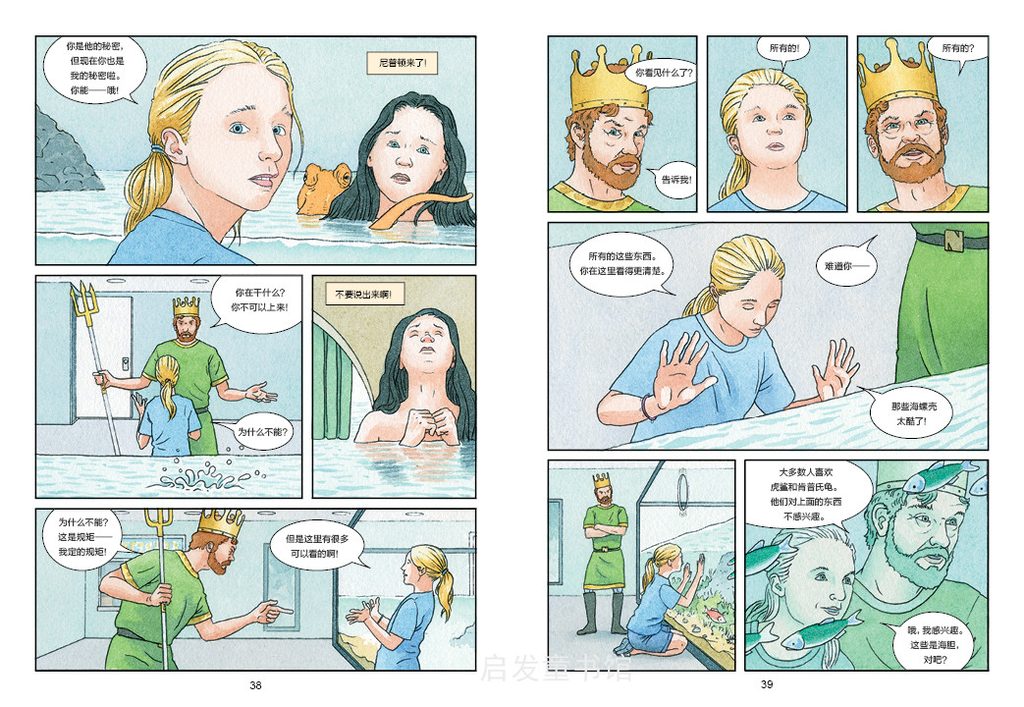
““Uh—” I know some adults feel aversion to the word “comics” because they often equate it with trashy reading material. Its two main characteristics are: first, children are often completely engrossed in it; second, it seems to be entirely devoid of educational value. Therefore, some parents oppose their children reading such materials, and some schools prohibit children from bringing them to school, confiscating them if they are found… I think this stems partly from prejudice, and partly from these adults’ own lack of understanding and expertise in this genre. In reality, every genre has its “trash” books—“trash novels,” “trash biographies,” “trash science books”—aren’t they plentiful? And every genre has its excellent works, and comics are no exception. The “comic” in excellent comics is the “comic” of romance.
Let’s start by looking at David Wiesner’s *The Mermaid Girl*, published in 2017. It’s his first attempt at creating a graphic novel, which you could also call a comic book or picture novel if you prefer. While it resembles a comic book in form, it’s structured like a novel at its core. The text is written by Donna Jo Napoli, a renowned American linguist and children’s book author. She has extensive knowledge of folklore and mythology, as can be seen from the story itself.
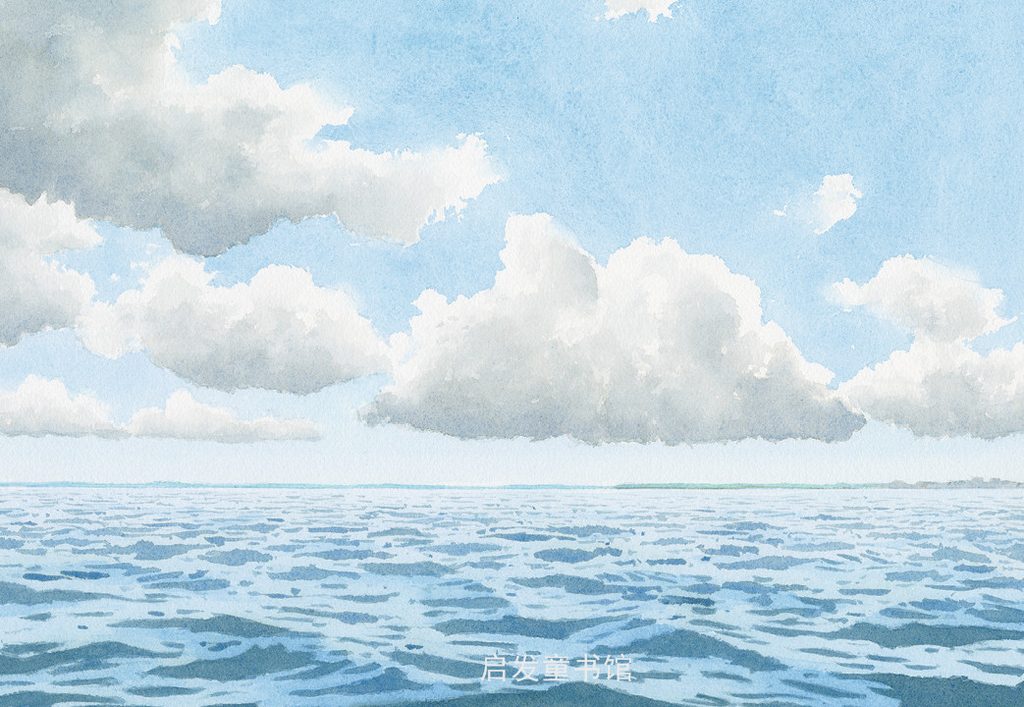


The story begins with a scene from half of the title page, similar to films like *Tuesday* and *The Secret of the Sea*, narrating like a cinematic sequence. Starting with a shimmering sea, the camera moves to a seemingly calm beach, zooming in to a small, three-story exhibition hall. Large posters on the exterior wall proclaim “Mermaid Girl” and “Ocean Wonders.” The text within the boxes reads, “Welcome to the ‘Ocean Wonders Hall,’ the domain of the god of the sea and storms, the kingdom of Neptune, the sea god…”“
The camera moves inside the Ocean Wonders exhibit, with text in a box continuing to narrate the story. The viewer sees the visitors and marine life, primarily children. The marine life itself seems ordinary, but the next shot shows a four-poster bed underwater. Judging from the furnishings and clothing beside it, it’s a girl’s bedroom—but underwater! Who would live here? Then, a close-up of a pair of astonished eyes appears—close-ups of eyes are common in David Wiesner’s books, such as in *The Secret of the Sea*, likely to remind the reader to look closely and widen their eyes.
Immediately, a Neptune appears on screen, the Roman god of the sea, wielding a trident—corresponding to Poseidon in Greek mythology. We see this Neptune sitting by a large pool in the aquarium, and with a swing of his trident, lightning flashes, thunder roars, and waves surge… apparently, the sea god is performing a miracle. Really? Anyway, after the show, this Neptune goes to the poolside to sell things. In the gift shop, there’s a special yellow T‑shirt with the words “Mermaid Girl” printed on it, priced at 10 yuan, cash on delivery. But where is the mermaid girl? Does she really exist?
Okay, there really is one. You see, in the first scene, a corner of the curtain by the pool is lifted, and a girl in the water is secretly peeking out. Then, turn to the next page, and the girl’s body appears completely in the whole picture. It really is a human body with a fish tail. She has long hair and stands in the water, with various sea fish swimming around her. The most special thing is that there is a big octopus next to her, with its eyes half-open and half-closed as if it is thinking.
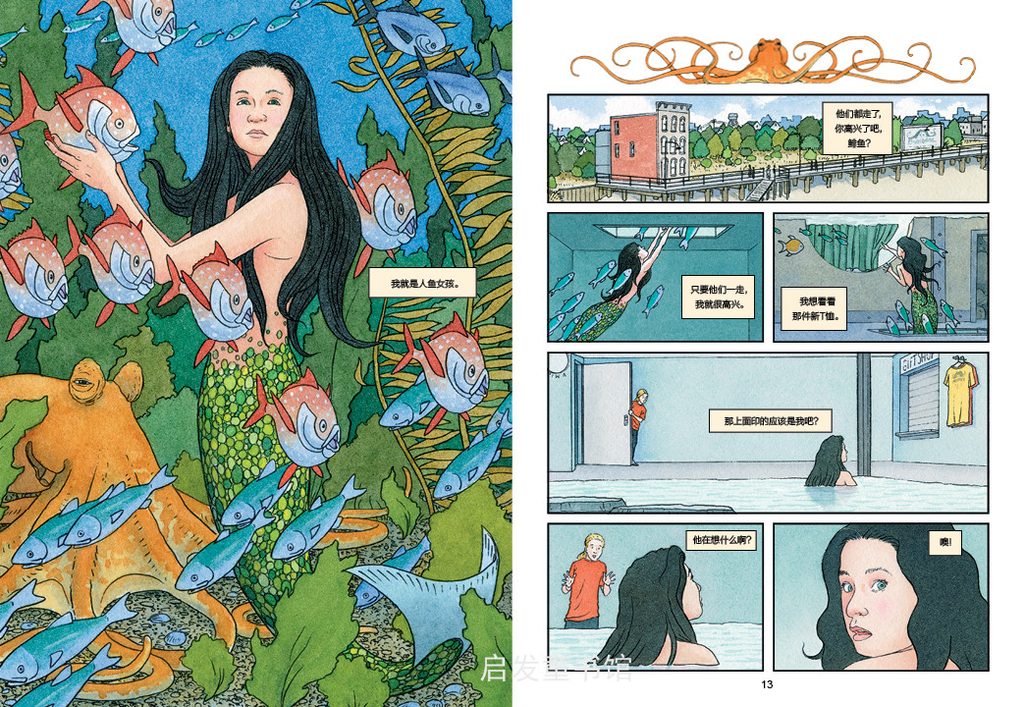
Speaking of which, I’ve only briefly mentioned page 12 of the book, where the story has just begun. David Wiesner is a master of visual storytelling; he uses cinematic techniques to clearly present the story’s development. Reading this story is like watching a movie. Readers who feel they’re not good at reading comics can try reading this book in a cinematic way. To be honest, it’s not difficult to clearly see what’s happening in the illustrations. For readers unaccustomed to reading comics, roughly follow this order: left to right, top to bottom. The text in the speech bubbles is dialogue, and the text in the boxes is thought processes—in a movie, we hear it with our ears, but when reading this kind of book, we need to respond to this dialogue in our minds, combining it with the illustrations to read the story.
The more challenging aspect is grasping the story’s structure. Readers accustomed to reading text often crave a quick overview of long stories. In fact, the creators of *The Mermaid Girl* are quite considerate; they subtly divide the main story into ten chapters. The section I just mentioned is the prologue; the story truly begins after the mermaid girl’s appearance. How are the remaining ten chapters divided? You can pay special attention while reading; each chapter’s opening page features an octopus perched at the top of the image, cleverly dividing the story slightly while also hinting at its crucial role. I’ll briefly summarize the story chapter by chapter, but I must reveal a little spoiler.
In Chapter One, from pages 13 to 27, a visitor, a girl named Livia in a red dress, discovers the mermaid girl. The mermaid girl, frightened, quickly hides and swims all the way to the bottom level of the large tank. This reveals the entire structure of the aquarium; it turns out the three floors are all part of one large fish tank. The reader then discovers that Neptune primarily profits from this girl.
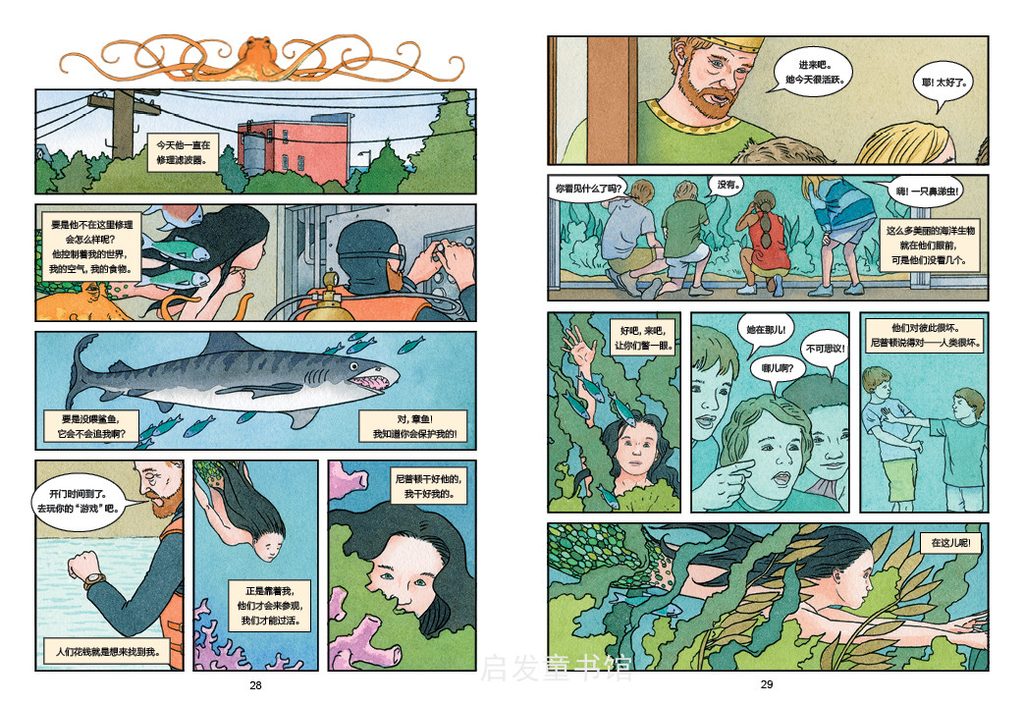
In Chapter Two, from pages 28 to 46, Livia returns and sees the entire mermaid girl hidden at the bottom. The two girls hit it off immediately. Although the mermaid girl cannot speak, she accepts Livia’s touch, gifts, and friendship. Livia is 12 years old, and the mermaid girl appears to be about the same age.
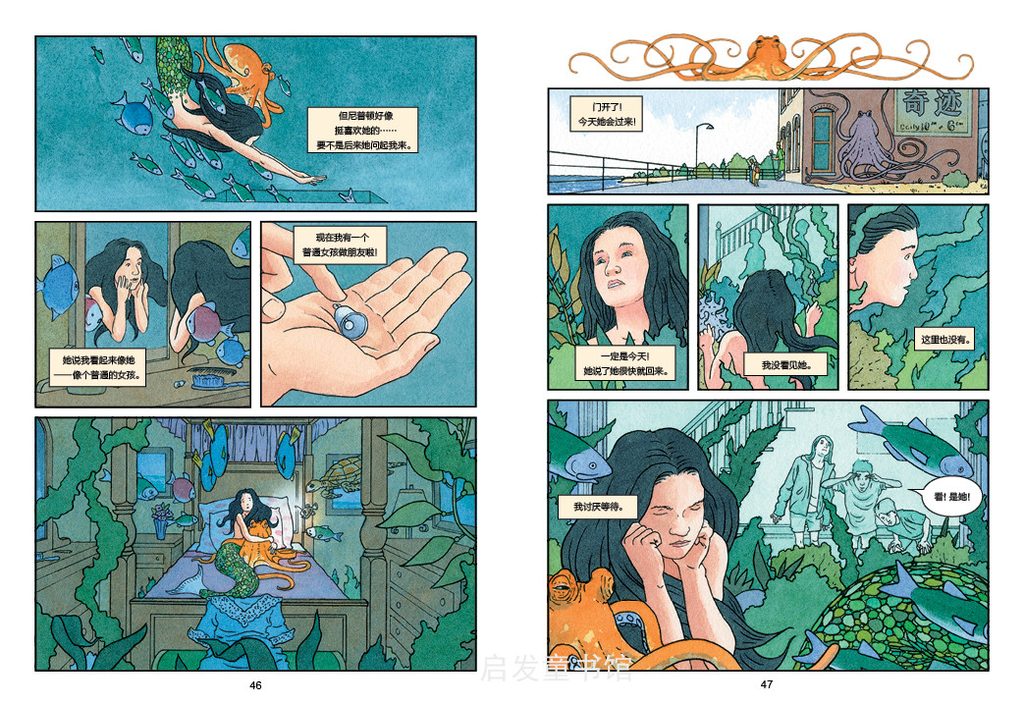
Chapter 3, from pages 47 to 63, introduces the mermaid girl’s curiosity about the outside world after meeting Livia. She also wonders how Neptune performed miracles, as she had always believed that Neptune was her savior and protector. However, after some investigation, she discovers that the waves in the pool were simply created by a machine.
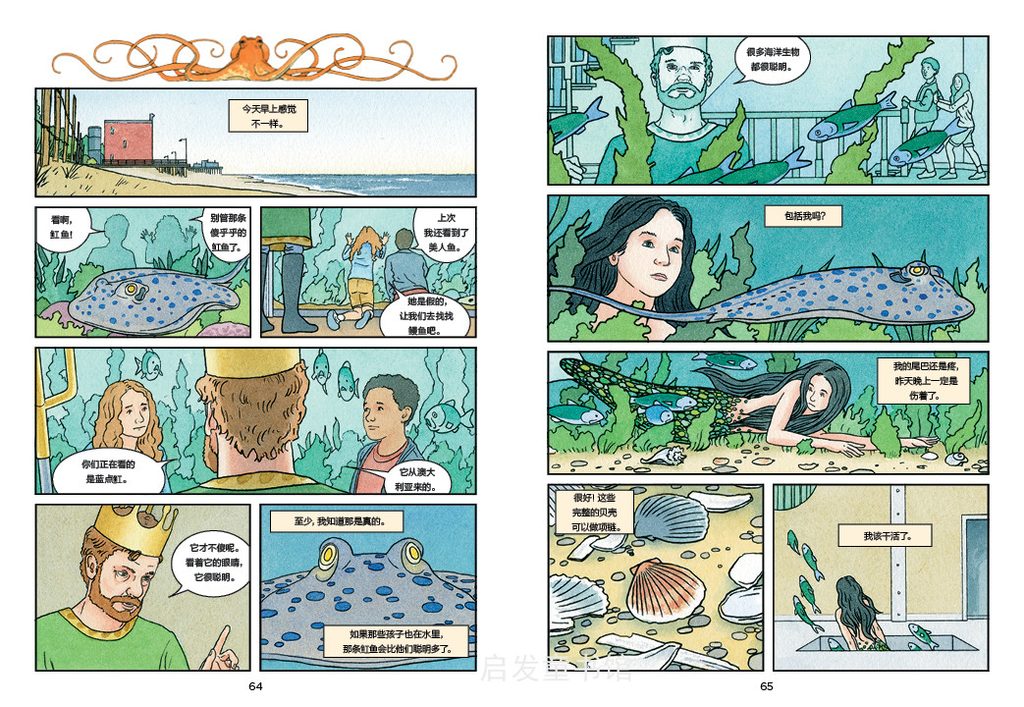
Chapter Four, pages 64 to 91, recounts how the mermaid girl, attempting to climb out of the pool, discovers many secrets. She discovers that if she stays out of the water for even a short time, her tail sheds its skin and transforms into human legs. She also finds a photograph of Neptune: it turns out Neptune was just a fisherman! And the one who saved her and protected her all along was that giant octopus!
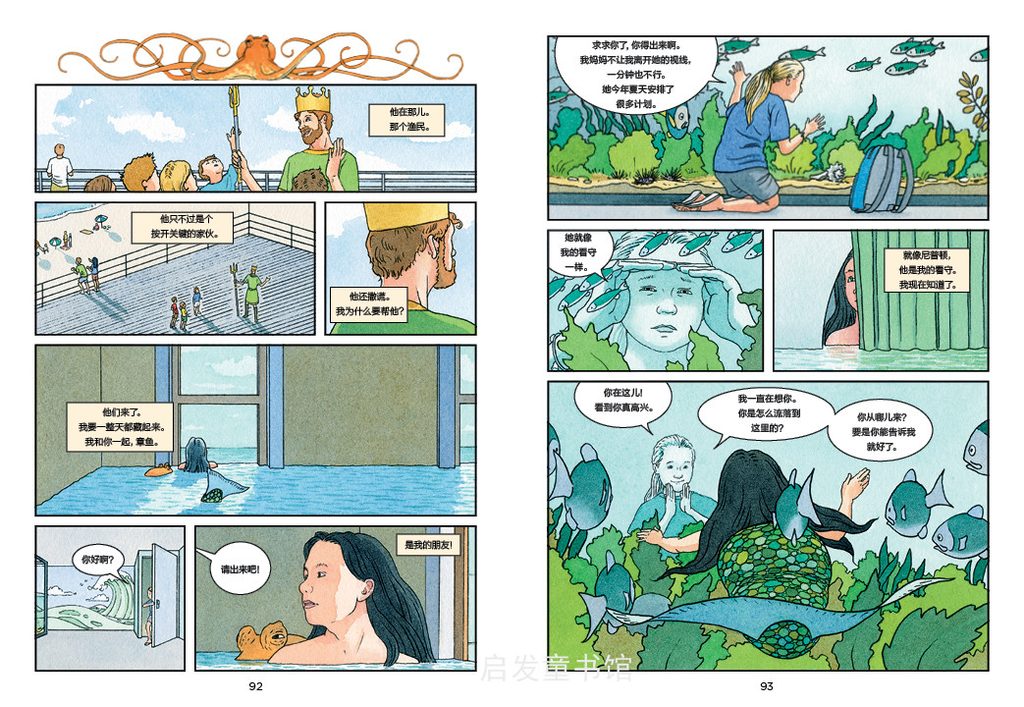
In Chapter 5, from pages 92 to 98, Livia returns. She names the mermaid girl Mira and teaches Mira about the outside world using pictures. When Livia is not around, Mira practices diligently and grows stronger.
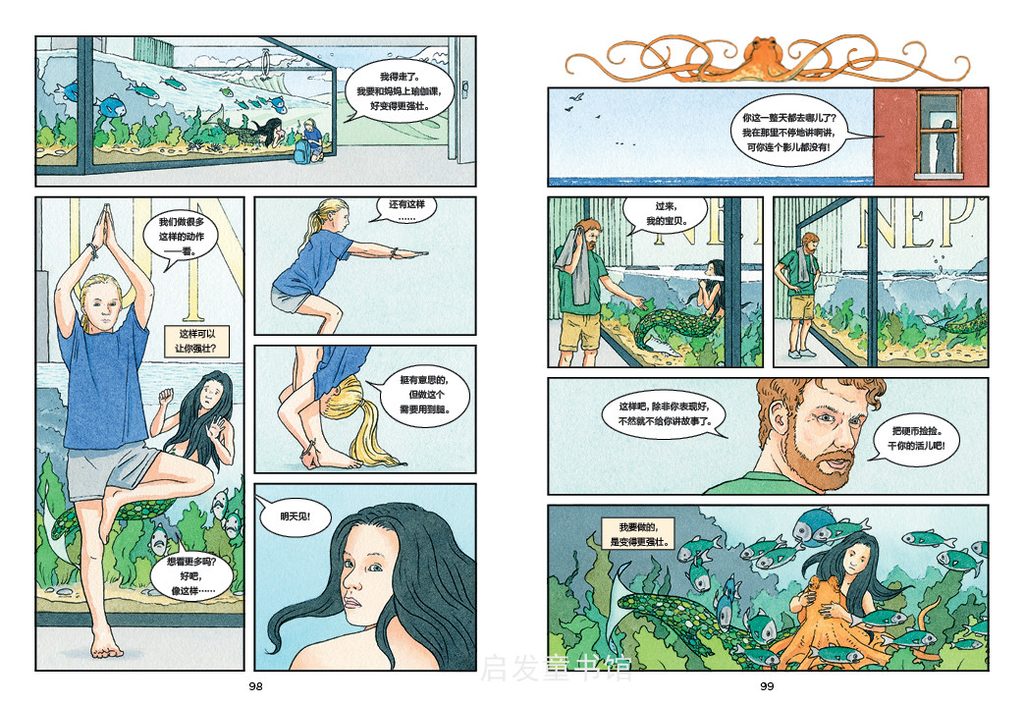
Chapter Six, from pages 99 to 101, describes how the mermaid girl Mila becomes increasingly distracted from her performance at the aquarium. She practices diligently, hoping for a chance to go outside the aquarium.

Chapter Seven, pages 102 to 116, describes how Mira finally slipped out of the Aquarium one evening while Neptune was home. She went to the deserted seashore, where she and the sea seemed very excited. When the water washed over her feet, her feet turned into a fish tail. But she didn’t want to go back into the sea, so she went back to the aquarium. However, to her dismay, the door was locked from the inside when she tried to leave, so she had to sleep there temporarily.
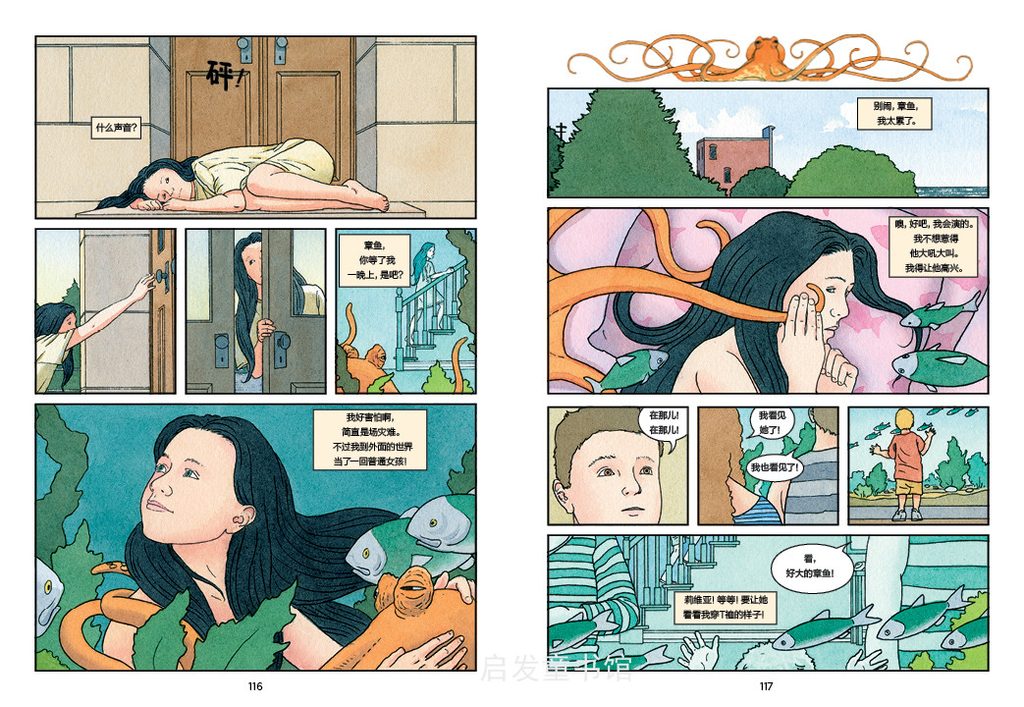
Chapter 8, pages 117–124: Before Neptune returned to the aquarium, Mira finally got back into the pool with the help of the giant octopus. Livia saw her secretly putting on a T‑shirt, and Livia felt that Mira was just a girl and wanted to do something for her. Mira was also becoming increasingly distracted at the aquarium.
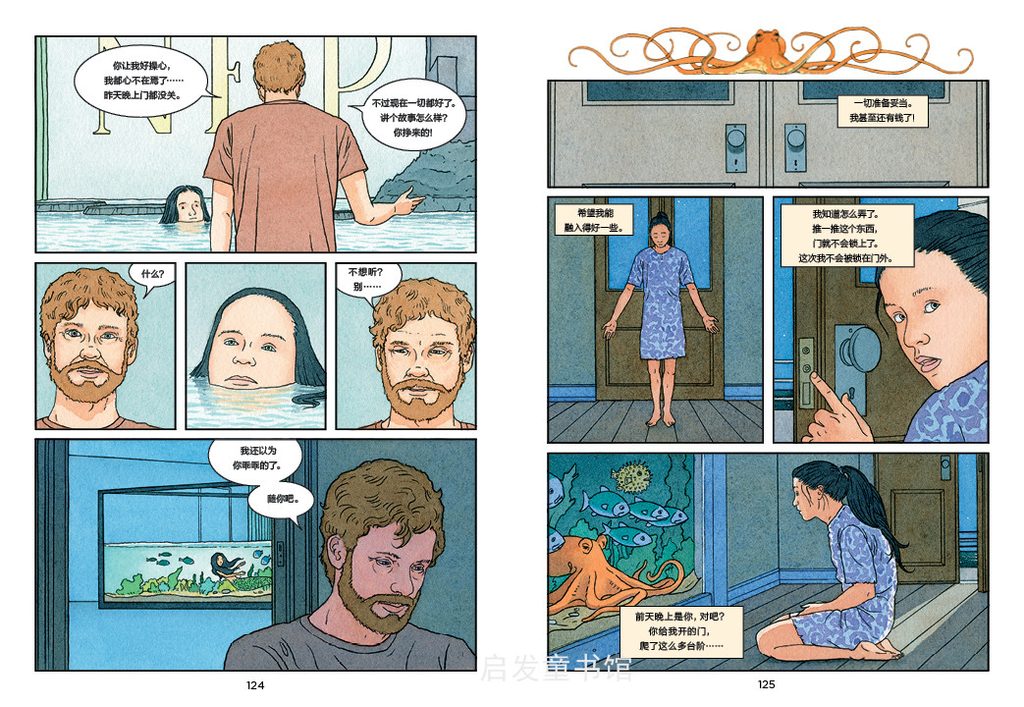
Chapter Nine, pages 125 to 137: That evening, Mila took advantage of the rain to leave the aquarium and wandered into the streets where people gathered. This was her first experience of human life, and I won’t go into detail about the various adventures she had. She encountered kind people and also a young man who might have had malicious intentions, but her tension and anger seemed to awaken the sea. After a surge of raging waves, she fled back to the aquarium.
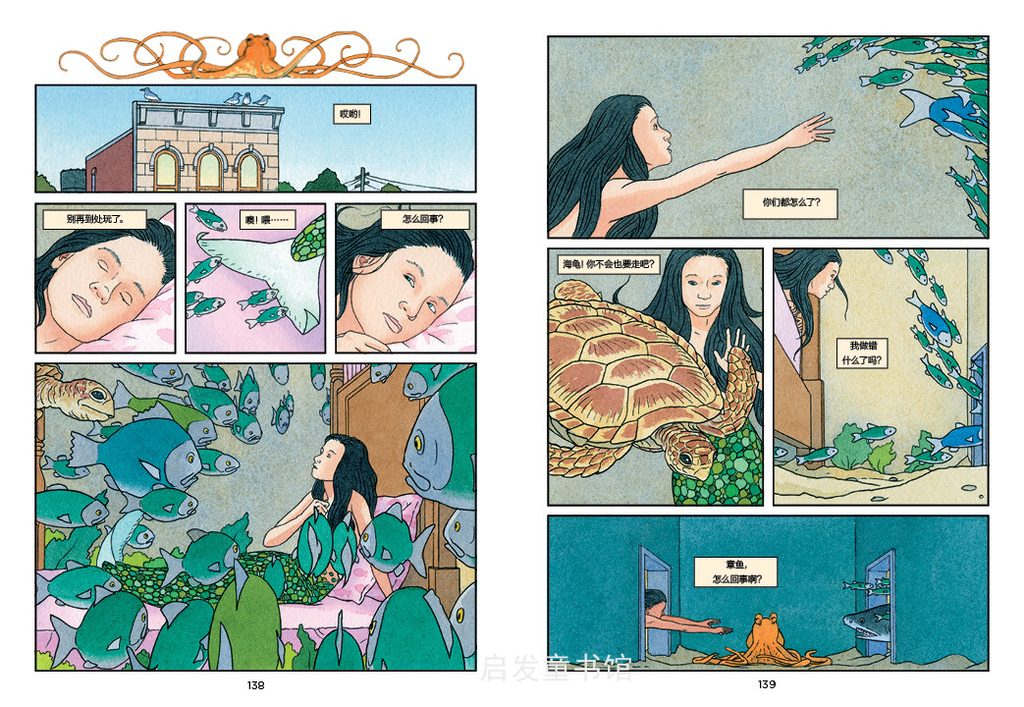
Chapter 10, from chapter 138 to the end, is the grand finale, the climax of the entire book, where many questions are answered. If you’ve made it this far, you’ll definitely be able to finish it in one go, so I won’t spoil anything. I’ll just reveal a little: there’s a tsunami, destruction, rebirth, a solemn farewell, a new home… In short, it’s incredibly exciting and heartwarming, unexpected yet perfectly logical.
Here, I’ve given a brief overview of this 190-page graphic novel. For readers who enjoy David Wiesner’s picture books, especially his wordless books, a little patience is all it takes to read the entire book, which offers a wealth of information—equivalent to a medium-thick children’s fantasy novel. Because there are so many details in the illustrations, repeated viewings will reveal even more information.

David Wiesner created this book because he loved comics from a young age and had a passion for imagination, fantasy, and science fiction/mythological fantasies. The story is clearly influenced by Greek and Roman mythology and Hans Christian Andersen’s “The Little Mermaid,” but it also possesses a cool, modern feel and offers readers many valuable insights. David Wiesner probably also wanted to tell parents and teachers that comics, when used well, can be a very valuable resource.
That’s all for this book for now. We’ll continue in the next installment.