

Last time we talked about David Wiesner’s masterpiece with text, Art & Max.Today we’ll talk about this wordless book master’s more recent work, “I Got It!”
This new book, published in 2018, consists of only two sentences: “I caught it!”, which in English is “I got it!”, but can also mean “I understand” or “I get it.” Since the book depicts children playing baseball, focusing on the moment of catching the ball, “I caught it!” is certainly appropriate. However, whether it also implies “I understand” is up to the reader’s interpretation.
Okay, enough chit-chat, let’s look at the story first. This book should be examined starting with the cover and the cover itself. Many picture books come with covers, and the illustrations on the cover and cover are the same, so I’ve seen some people just flip to the inside pages to read the story. This book won’t work; you need to peel off the cover and see what’s different between the cover and the illustrations on the front and back covers:


The book cover illustration depicts a blue sky with white clouds, a flock of birds flying in from the left, and the book title “I Caught It!” next to a baseball in flight. At the bottom of the picture, a hand wearing a baseball glove rises into the sky, facing the direction of the baseball’s trajectory as it falls, giving the impression that it’s really about to catch it.
The cover and back cover illustrations, surprisingly, lack a title. Instead, they depict a very unfortunate boy who has missed catching a baseball; the ball has hit the ground! And the boy? He’s being carried by a flock of birds, some tugging at his feet and shoelaces, some grabbing his body, some pulling his hair, and some tugging at his glove. He’s dangling precariously in mid-air, desperately reaching for the baseball. And his baseball cap? Even worse, the purple cap lies on the ground, where three tiny birds have made a nest.
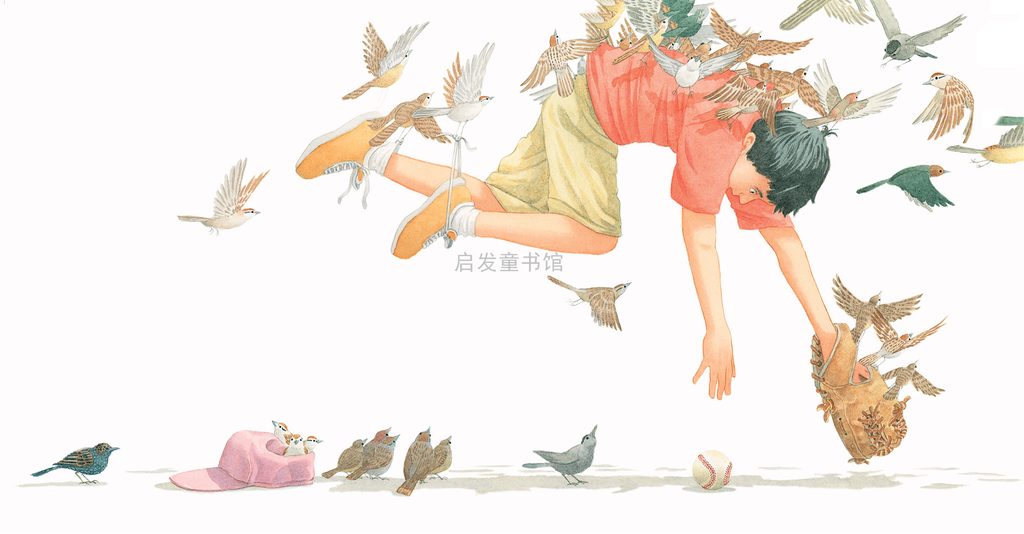
You see, the image on the cover is obviously fantastical, impossible in reality, while the image on the book jacket is a realistic scene, the hand reaching out powerfully, filling one with hope. Here, the book’s tone is already set: half realistic, half fantastical. How does David Wiesner differentiate them? He uses a mix of acrylics, watercolors, and gouache to paint this book. He typically uses watercolors and gouache for the backgrounds, while for the figures and related parts, he primarily uses acrylics for realistic scenes, resulting in more vibrant and intense colors, while for fantastical scenes, he switches to watercolors and gouache for lighter, softer colors… This is the rule he set for himself when painting this book.
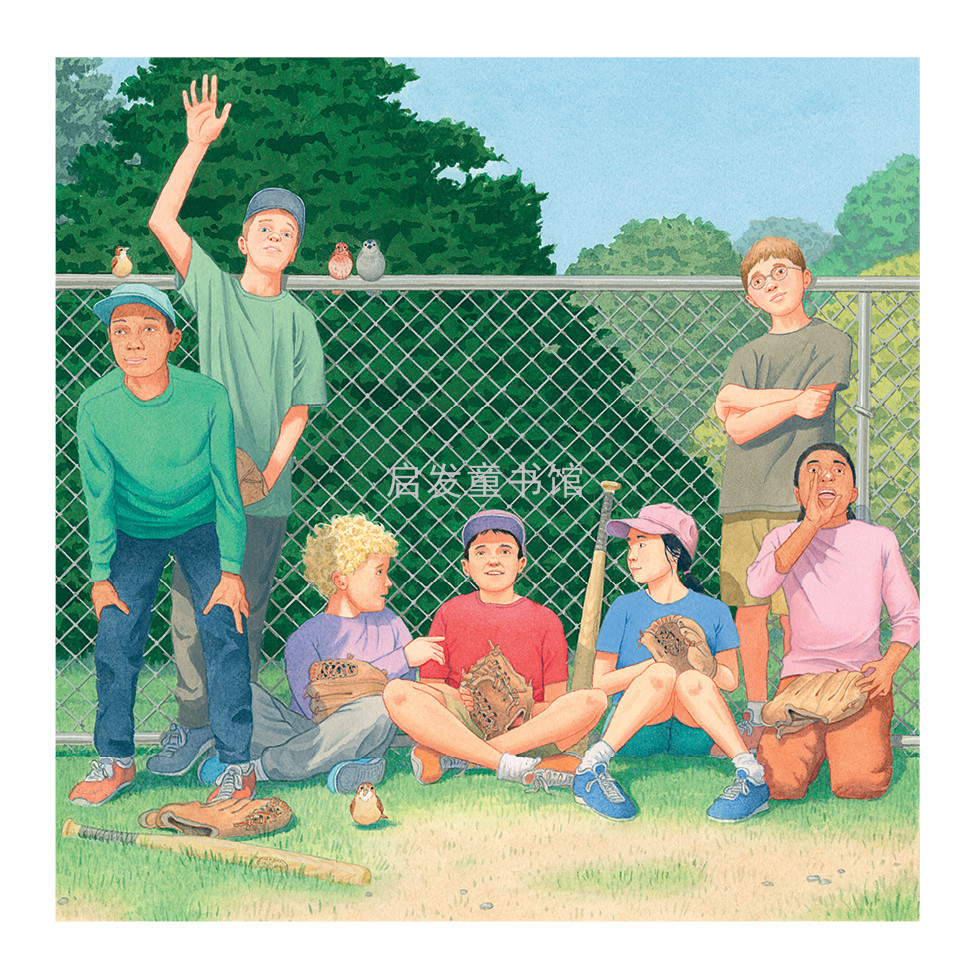
Okay, let’s continue looking at the half-title page, which is the page after the endpapers and before the title page. Many books don’t have a half-title page, but David Wiesner preferred to use this page, like in a movie prologue, where the boy in the red shirt and purple hat, already wearing a baseball glove, appears behind a wire fence watching a group of kids playing baseball on the grass, clearly wanting to join in.

Turning to the large double-page spreads on the title and copyright pages, the boy in the red shirt has already entered the circle of baseball players on the grass. Approaching the group of children, we can see nine of them discussing something, seemingly deciding how to start the game. This is somewhat similar to when we were kids playing soccer. A group of people run onto the field, ready to divide into sides for the game. But how do you divide them? Usually, first, two team captains are chosen, then the two captains play rock-paper-scissors to select their players, then they choose sides, the order of the first pitch, and finally, the game begins.
To fully understand this wordless book, it’s best to first learn about the basic rules and gameplay of baseball. In the United States, baseball is second only to American football in popularity, even surpassing basketball. Therefore, this book is particularly easy for American children to understand. However, Chinese readers generally don’t know much about baseball, and reading this wordless book might be a bit confusing for them.
Generally, in a formal baseball game, there are at least 10 players on the field: one batter for the offensive team and nine defensive players. Of course, once the offensive team reaches base safely, the second batter can enter the field. However, the defensive team always consists of nine players: one pitcher, one catcher, one baseman each for first, second, and third base, one shortstop, and three outfielders (left, center, and right). Usually, when kids play on their own, they’ll put average rookies in the outfield to fill in, since they don’t really expect much from them anyway.
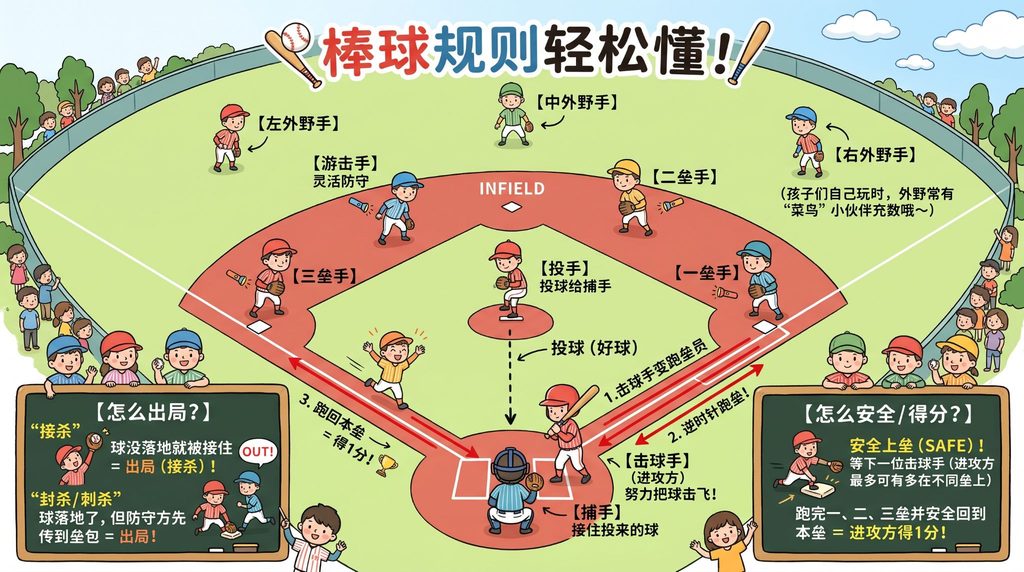
After the game begins, the defensive pitcher throws the ball to the catcher, and if it’s a strike, it’s within the batter’s hitting range. The batter swings and hits the ball as far as possible within the arc of the baseball field, and then begins running the bases counter-clockwise. If the defense catches the ball before it hits the ground, it’s called a “catch,” and the batter is out. If the ball has already landed, the defense must throw it back to those bases, and the running batter must reach that base before the ball is thrown back. If the defense throws too slowly, the batter reaches home plate and scores a run. That’s roughly it. You can look up the details of the rules yourself. But knowing this is enough to understand the book.
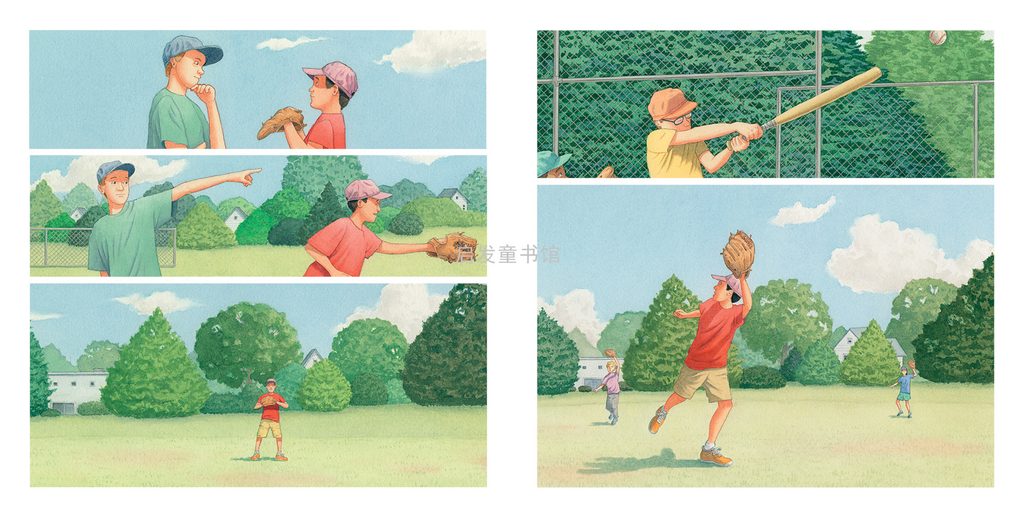
Returning to the book, the boy in red saw there were only nine people on the field and asked to join; they needed one more to start playing. The boy in green, clearly the captain, pointed from afar and sent the boy in red to the outfield, obviously not very confident in him, just to make up the numbers. The boy in yellow with glasses was the batter, and he successfully hit the ball far away, sending it right to the outfield, near the boy in red. We can also notice the two children next to the boy in red: a boy with blond hair and a girl in blue and a blue hat; they are both rather short, making a total of three outfielders.
Okay, next, the boy in red shouts “I caught it!” and is about to “catch and kill” his opponent. Notice this double-page spread: the left page is a realistic scene, while the right page becomes a fantasy scene with faded colors, right? This is a technique David Wiesner often uses, instantly shifting the story into fantasy mode. The boy in red trips over an imaginary tree root on the ground! The next page shows his teammates covering their faces in disbelief. Count them; including him, there are exactly seven—everyone running on the field except the pitcher and catcher is here.
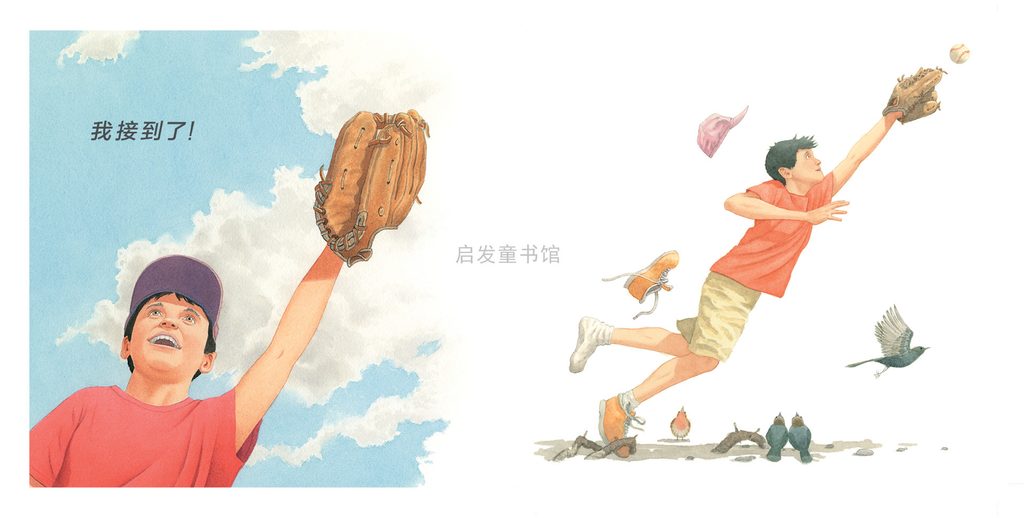
Then, on the next page, the scene repeats itself, with reality on the left and fantasy on the right. Behind the boy, this time there is the girl, but in the imagined scene, he is blocked by tree roots and branches, and then falls heavily onto the tree.
Again and again, the camera repeated itself for the third time, the left side realistic, the right side imagined, with a blond boy appearing behind the boy, and all three outfielders were present. This time, in the imagined scene, the baseball became enormous, completely exceeding the frame.
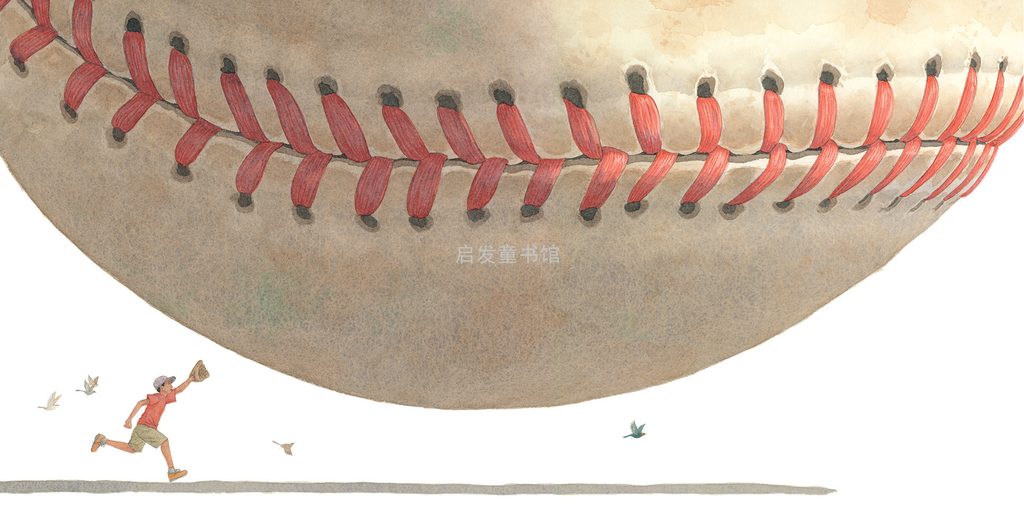
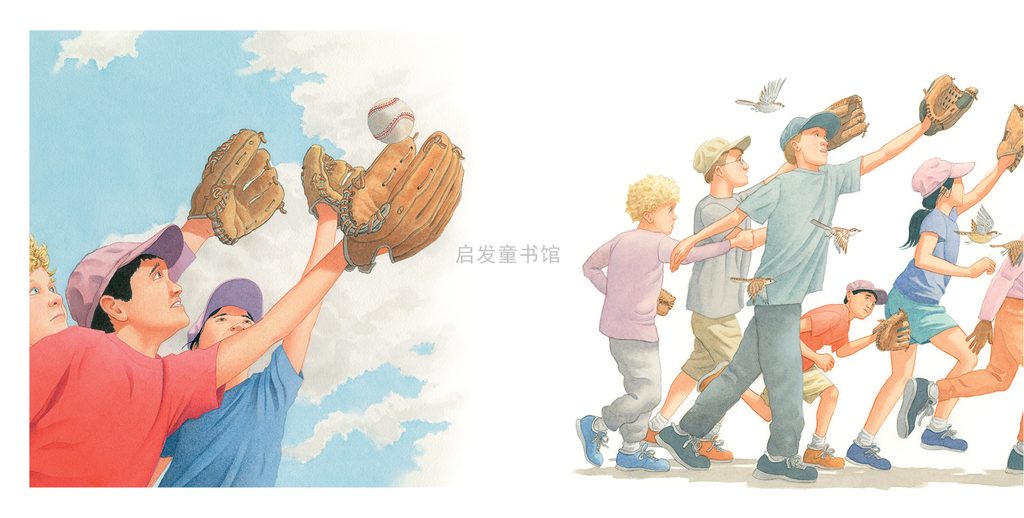
The scene repeats for the fourth time; the three outfielders have gathered together, all three hands reaching for the baseball. In the imagined scenario, it seems all the team members are there, and they’ve all become enormous. The boy in the red shirt climbs onto his teammates’ heels, grabs their shorts, and leaps over their heads, performing several spectacular jumps. At the last moment, surrounded by the hands and birds, he soars into the air and finally catches the baseball. “I caught it!”“
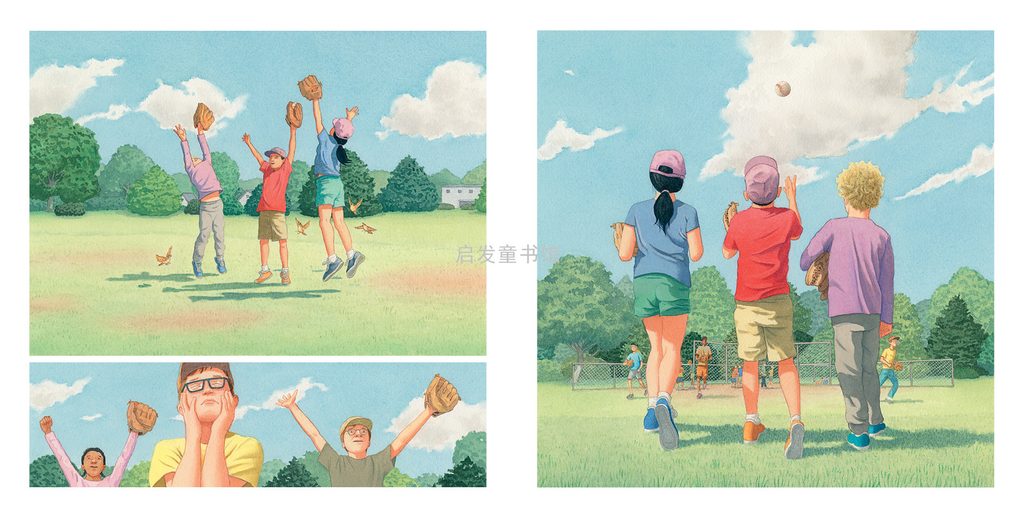
Now, back to the realistic scene: first, the three outfielders jump up and cheer, and the other team members cheer too… Oh, wait, the boy in the yellow shirt and glasses is covering his face, looking utterly dejected. Why? He was caught and out!
Having read this far, let’s revisit the rules of baseball: the boy in the yellow shirt, as the batter, hits the ball. If the boy in the red shirt misses the ball on his first and second attempts and falls to the ground, the boy in the yellow shirt might score or reach base. Therefore, the story in this book is essentially a batting and catching sequence; the boy in the red shirt’s supposed fall is all in his imagination. In the real world, he becomes an overnight sensation. Look at the final scene: his two outfield teammates are watching him, especially the girl, who clearly looks at him with admiration, while the boy in the red shirt is still basking in the immense happiness of his success.
This book, *I Caught It*, is quite unique among David Wiesner’s works. Its stories are relatively short, focusing on describing a mere few seconds, blending realism and fantasy, but lacking the complex logic and intricate plot threads of his previous pieces. He seems to be challenging himself on how to describe that crucial moment, finding the feeling of “a fleeting instant being eternal.” I know many David Wiesner fans feel the stories in this book are too short, but I think this book is precisely another important breakthrough for him—using his masterful techniques for depicting fantasy worlds to reflect on the realities of childhood.
He wrote a very detailed creative journal, which you can find in the book’s introduction, so I won’t go into detail here. What I want to add is that this book is a culmination of his own childhood experiences and his daughter’s unique insights while playing softball in high school. There’s a deep connection between them, reflecting his profound contemplation on the purpose of childhood games and sports. The “beautiful silence” he described while playing softball in an article is precisely the core state depicted in the book *I Caught It*.

In fact, children grow up through games and sports. But have you ever thought about what those games and sports actually bring them? David Wiesner showed us how a shy and insecure boy, in a moment when no one believed in him, accomplished a near-heroic feat on the field. That experience can be a lifelong treasure, because that experience of success is an experience of surpassing oneself, affirming oneself, being accepted by others, and integrating into the whole team.
I believe that although Chinese children generally don’t know much about baseball, those who love sports, especially team sports like football and basketball, will find inspiration and motivation in this book. I am truly grateful to David Wiesner for creating this beautiful and special book.
That’s all for this book for now.We’ll talk about the next book in the next episode..