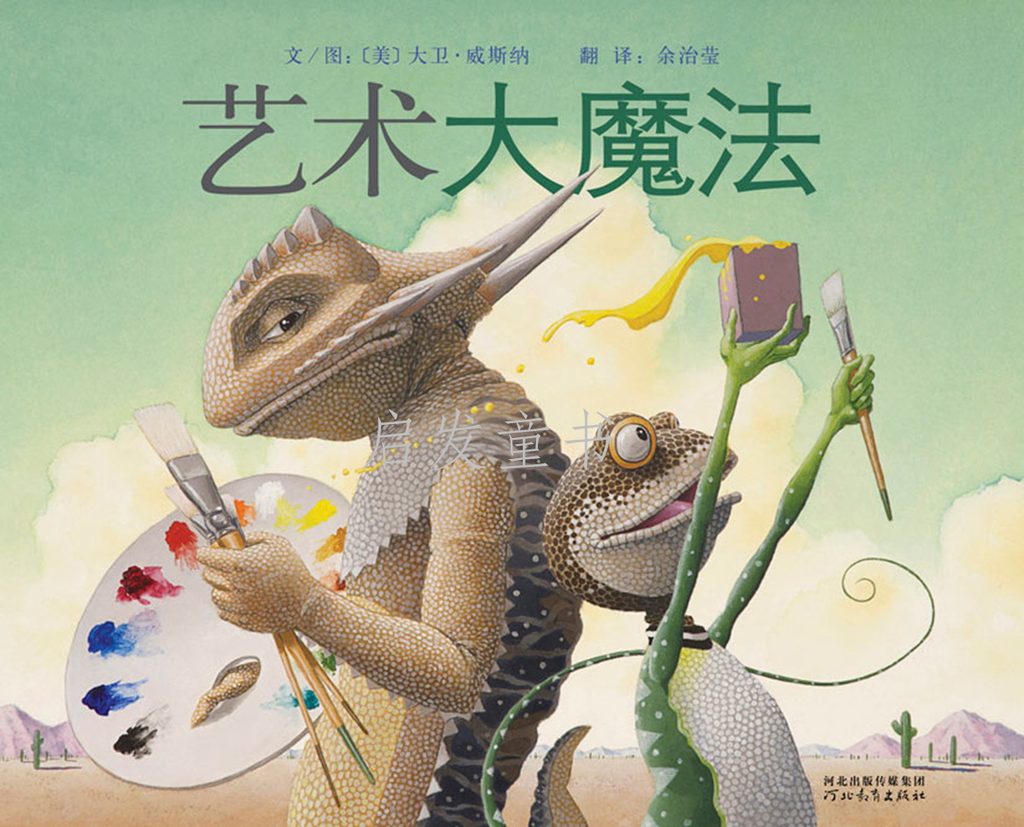
Last time we talked about David Wiesner’s wordless masterpiece, *Mr. Wuffles!*, which won the Caldecott Honor.Today, let’s talk about one of his representative works with text, “Art & Max”.
This picture book, published in 2010, didn’t win any major awards, but it’s been recommended in many important book lists, and it’s especially loved by children, parents, and teachers alike. It’s perhaps the most approachable of David Wiesner’s works; almost everyone can enjoy it instantly. Perhaps because David Wiesner has won so many awards before—including three Caldecott Medals—he wasn’t given a major prize this time. However, readers were very supportive; it topped the children’s book bestseller list on Amazon.com in the US that year.
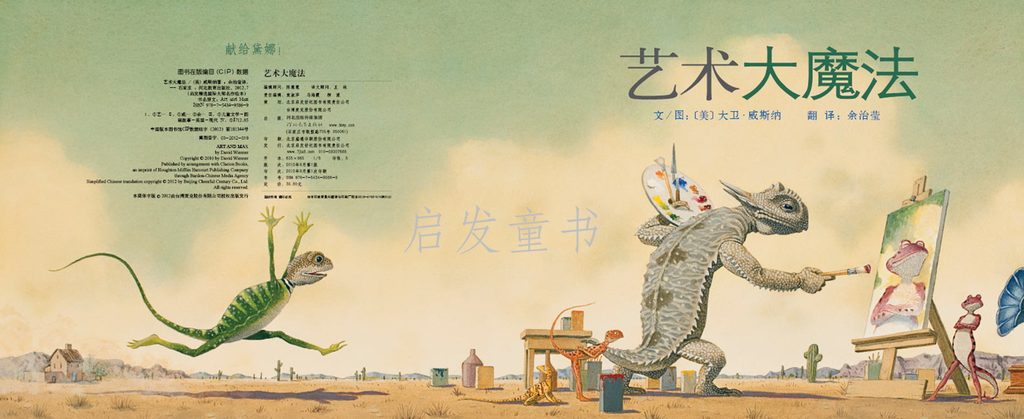
Let me start by telling you the story of this book. The story begins on the half-title page before the title page: a green lizard is running across the desert from left to right, as if rushing to do something. In picture books, moving from left to right is usually the direction of travel, so we can infer that this lizard is going to do something positive.
Turning to the double-page spread that includes the copyright page and title page, on the right side of the image, a larger gray lizard is painting, drawing portraits of other smaller lizards, while two smaller lizards watch. Where is the frantically running green lizard? He’s raising his hands, his eyes wide, as if he’s discovered something particularly strange.
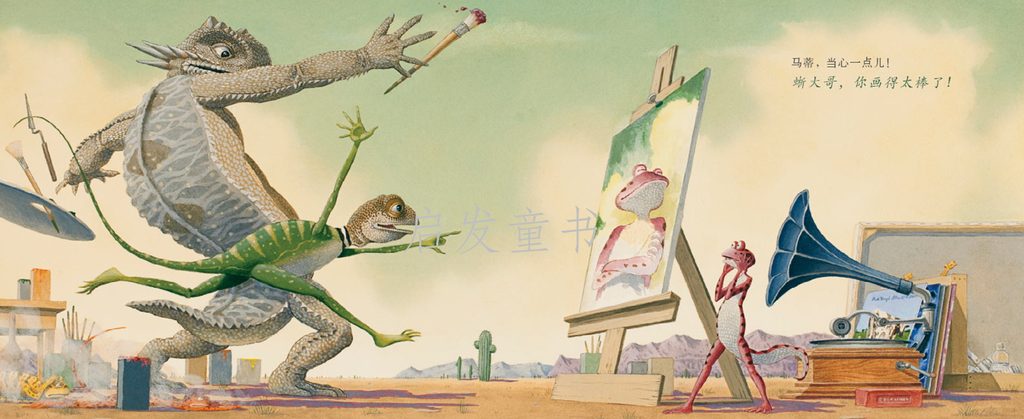
Turning to the next page, the green lizard rushes to the easel, pointing at the painting and shouting. The gray lizard, startled by the little green lizard, drops his brush and palette. Looks like they’re going to fight? Not really. Listen to their conversation. The gray lizard yells, “Marty, watch out!” The green lizard shouts, “Brother Lizard, you paint so beautifully!”—It turns out they know each other, and the green lizard excitedly ran over to express his admiration for the gray lizard’s artistic achievement.
Okay, let’s step back from this story for a moment and talk about the species of lizards in the book. Look closely; there are two types of lizards depicted. One type is small, including green, red, and brownish-yellow lizards—these are ring-necked lizards, often considered the most beautiful type because they have a ring around their necks. The other type is a large, gray lizard, the angular and cool-looking horned lizard. Both types of lizards are abundant in the deserts and Gobi of the southern United States. The green ring-necked lizard in the book is named Max, which might remind you of the Fauvist artist Matisse; the gray horned lizard is named Arthur, nicknamed Art. The English title, Art & Max, is a direct translation of “Art and Max,” a title I believe most Chinese readers might find unfamiliar. Therefore, translator Yu Zhiying made a very creative change, changing the title to “The Great Magic of Art” and naming the two main characters “Matti” and “Da Vinci” – which easily reminds us of two art masters, Matisse and Da Vinci.
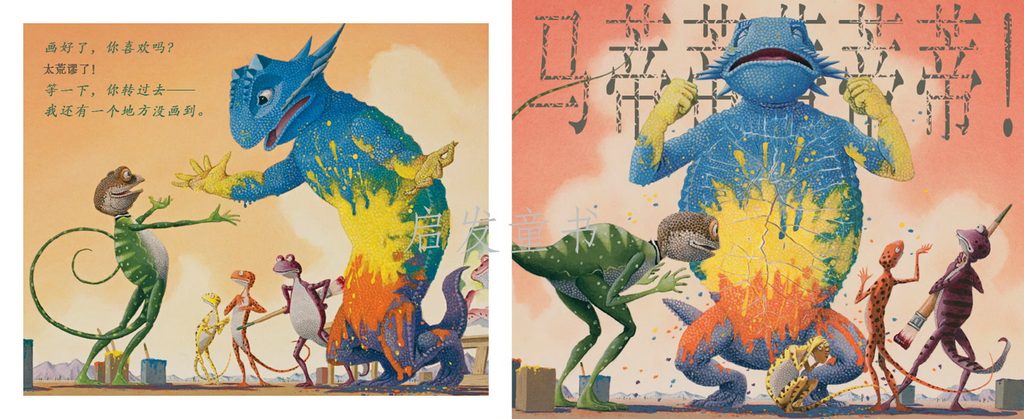
In this story, Da Vinci the Lizard is actually a painter. His portraits are already remarkably lifelike, so little green lizard Marty runs over, exclaiming in amazement. Naturally, the newcomer Marty declares, “I can paint too! I want to paint too!” Doesn’t this resemble a child suddenly bursting with artistic enthusiasm? Da Vinci is quite skeptical, saying, “You can paint? Don’t be ridiculous!” But seeing Marty’s dejected look, he changes his mind, “Okay, you can try. But don’t bother me.” Doesn’t this sound like a great painter? Or perhaps, an adult dealing with a mischievous child?
Next, Marty imitated the Da Vinci lizard, hanging a canvas on the cactus with great seriousness, taking out his brushes and paints to ponder, but looking completely bewildered—he didn’t know what to paint! Then he bothered the Da Vinci lizard again, “What should I paint?”—Well, the Da Vinci lizard casually replied, “You can paint me.” He obviously meant to paint a portrait of himself, but Marty completely misunderstood; he simply grabbed the paint and started brushing it all over the Da Vinci lizard. His understanding of “paint me” was simply “paint on me.” Well, the result was hilarious; the originally gray Da Vinci lizard was now covered in a riot of colors.
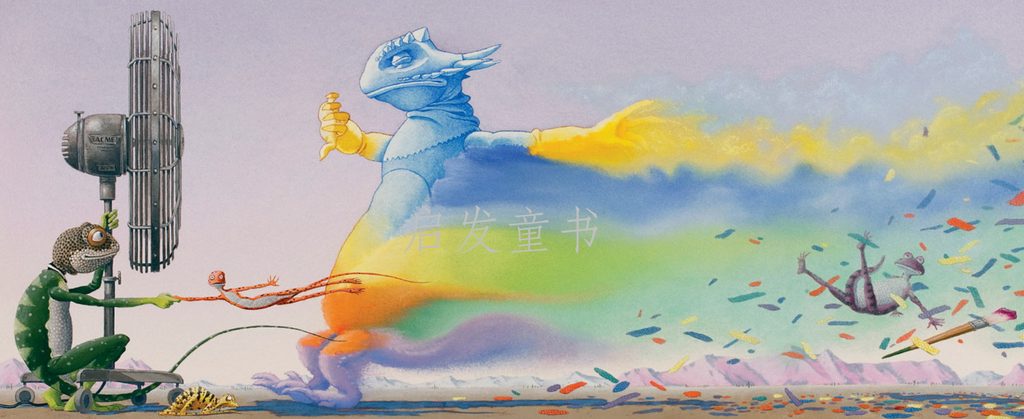
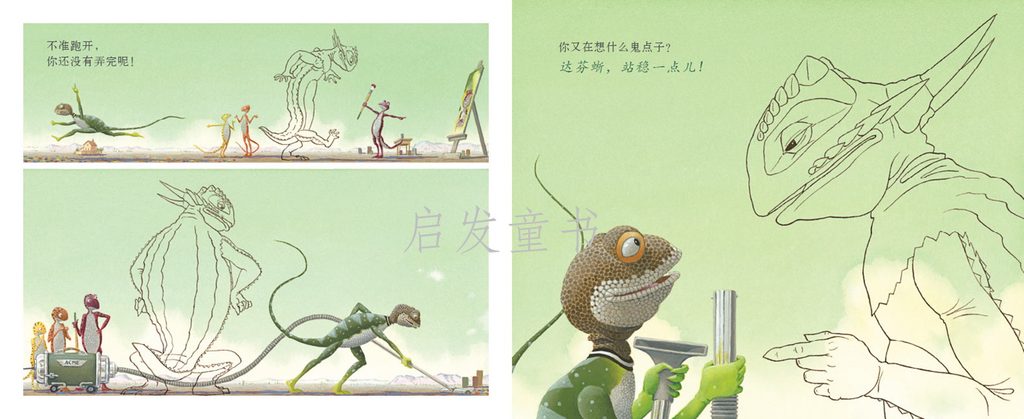
Even more miraculously, the thick layer of colored paint cracked on the Da Vinci lizard’s body! The Da Vinci lizard went berserk, or rather, the cracked paint exploded, and the colors on the Da Vinci lizard became smooth and soft. Marty said, “Fantastic!” but the Da Vinci lizard wasn’t satisfied. What to do? — No problem, Marty had too many clever ideas. He got a large electric fan and blasted it with air. Okay, most of the color was blown away. The Da Vinci lizard became a lighter color, but it still looked strange. It couldn’t help but want to drink water, and Marty poured a lot of water into it until finally, oh my god, all the color was gone! Marty shouted, “Amazing!” because the Da Vinci lizard was now just a few outlines, completely transparent!
At this point, art enthusiasts might have guessed David Wiesner’s intention in creating this book. He’s actually showcasing the artistic creation process, allowing us to see lines and colors within this seemingly absurd story, their relationships, and how they construct an image. The Da Vinci lizard, reduced to a jumble of lines, forms the foundation of the image. But David Wiesner wasn’t satisfied. He has Marty, who seems to have many mischievous ideas but always seems to be making things worse, continue his whimsical escapades, first shuffling all the Da Vinci lizard’s lines, then exploring and reassembling them, sometimes creating grotesque shapes, but ultimately basically restoring the image. But how to color it this time?
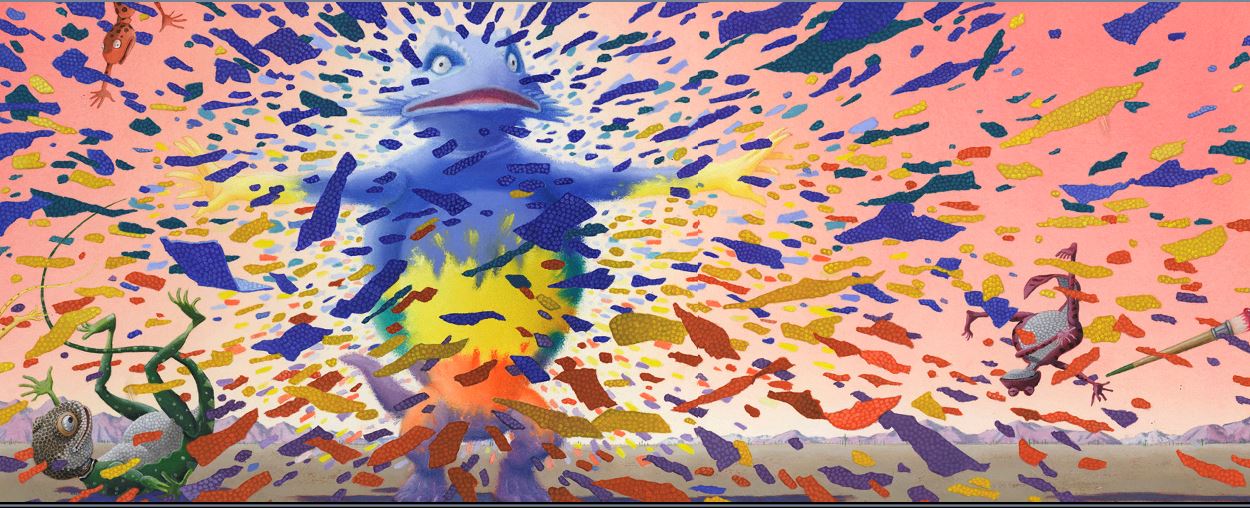
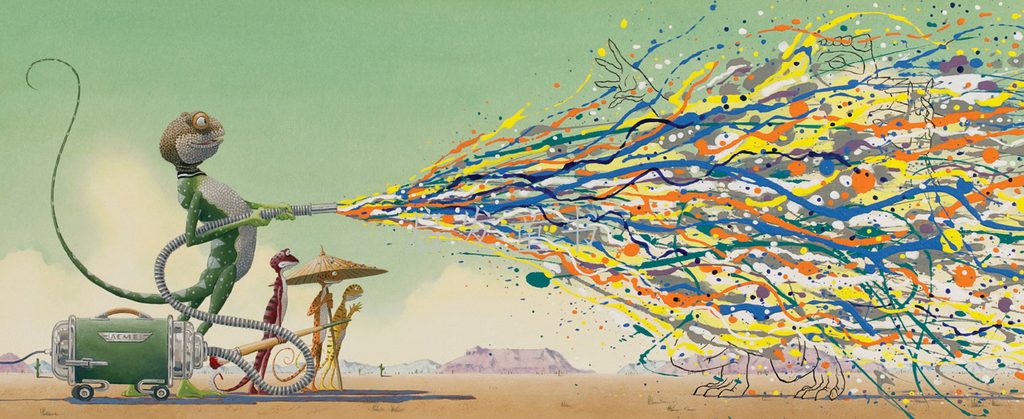
Marty somehow acquired a super-functional vacuum cleaner, first sucking up all the paint that had been blown all over the floor, then blowing it back onto the Da Vinci lizard. This time, the lizard’s colors gained a remarkable texture, completely in the pointillist style of Seurat. The lizard was, of course, very satisfied. After this ordeal, Marty could be considered to have completed his apprenticeship. Finally, the two passionate artists, Marty and the Da Vinci lizard, picked up their brushes and began creating. Marty painted portraits on the canvas using Seurat’s pointillist technique, while the Da Vinci lizard directly splashed paint onto other lizards and cacti, employing a style reminiscent of the American abstract expressionist master Pollock—action painting, the “drip painting” method of flicking paint. Compared to his earlier, more classical portraiture, this was a completely different realm.
Now that the story is over, let’s summarize briefly. *The Great Magic of Art* tells a super absurd and hilarious story, yet it also depicts a series of artistic creation processes, showcasing a mix of various art styles. As mentioned earlier, it demonstrates lines as the foundation of painting, while also presenting the relationship between color and lines. Marty, initially appearing as a troublemaker, first intrudes into a rather traditional art world. The initial painting of the Da Vinci lizard has a classical feel—solemn, nostalgic, and accompanied by an old record player. Marty, however, first haphazardly smears colors, then wreaks havoc, blowing away and washing off the paint. Restoring the initial lines isn’t enough; he completely deconstructs them, messing up all the lines before reassembling them all from scratch. In the story, children may find it to be a series of funny and mischievous events, but if viewed from the perspective of art history, what Matti did was exactly what many contemporary artists did, such as Picasso, Dali, Matisse, Duchamp, Kandinsky, Mondrian, Pollock, and so on. These artists disrupted the old order, paid more attention to the expression of individuality, and were more willing to express their artistic feelings in a more personal way.
Returning to the book itself, the desert landscape that appears from the very beginning serves as the background for the entire story. David Wiesner painted it in watercolor, and its style is heavily influenced by the works of Dali, giving it a surrealist feel. However, it is also deeply influenced by the fantastical and sci-fi background landscapes of contemporary French comic book master Moebius.
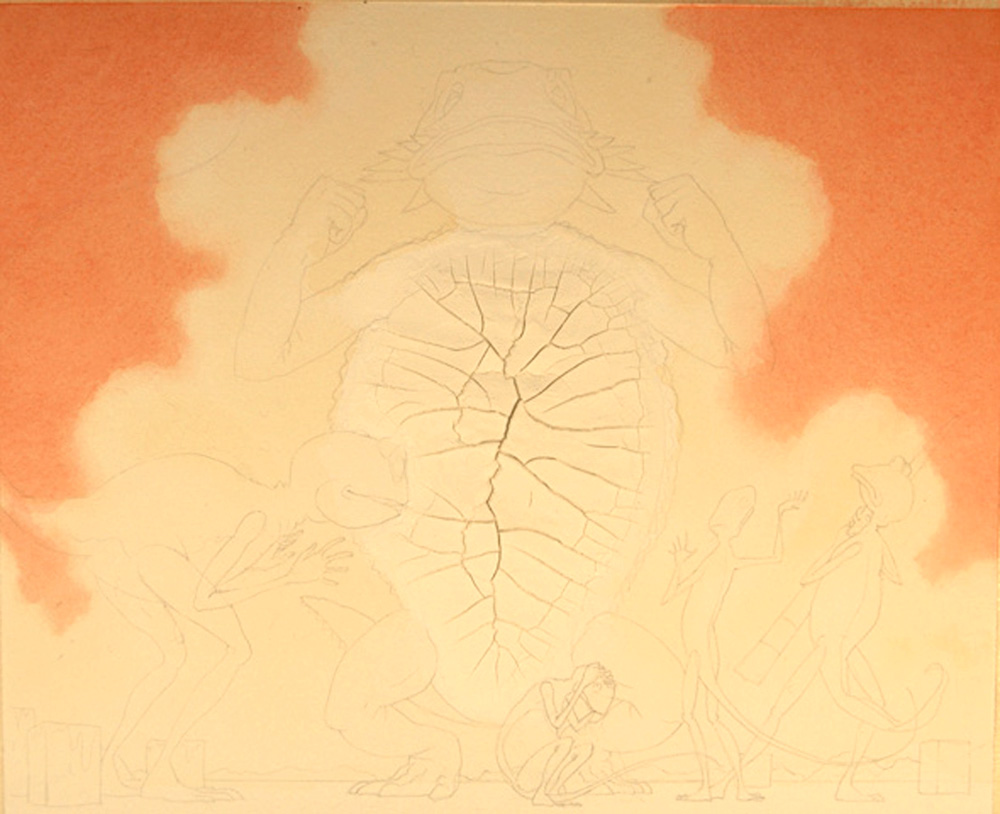
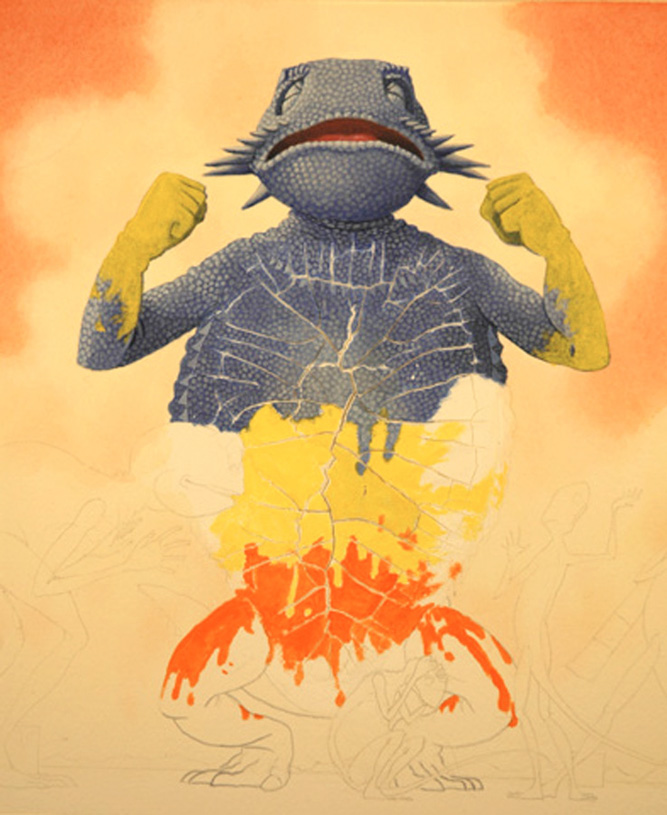
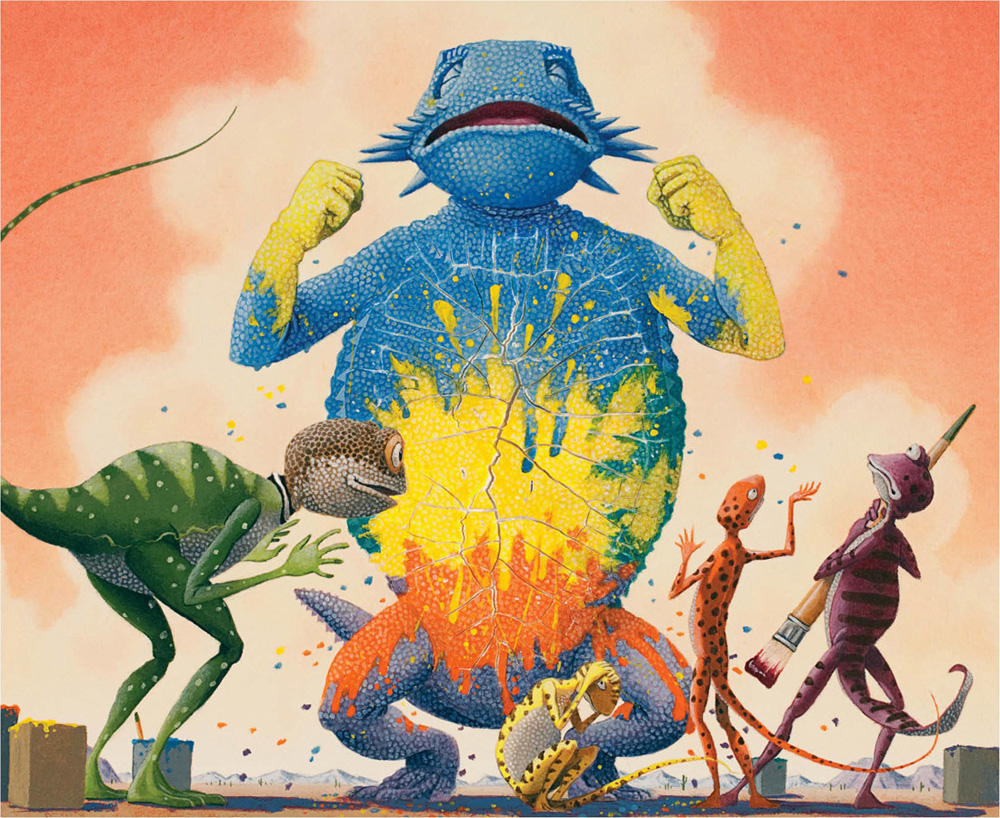
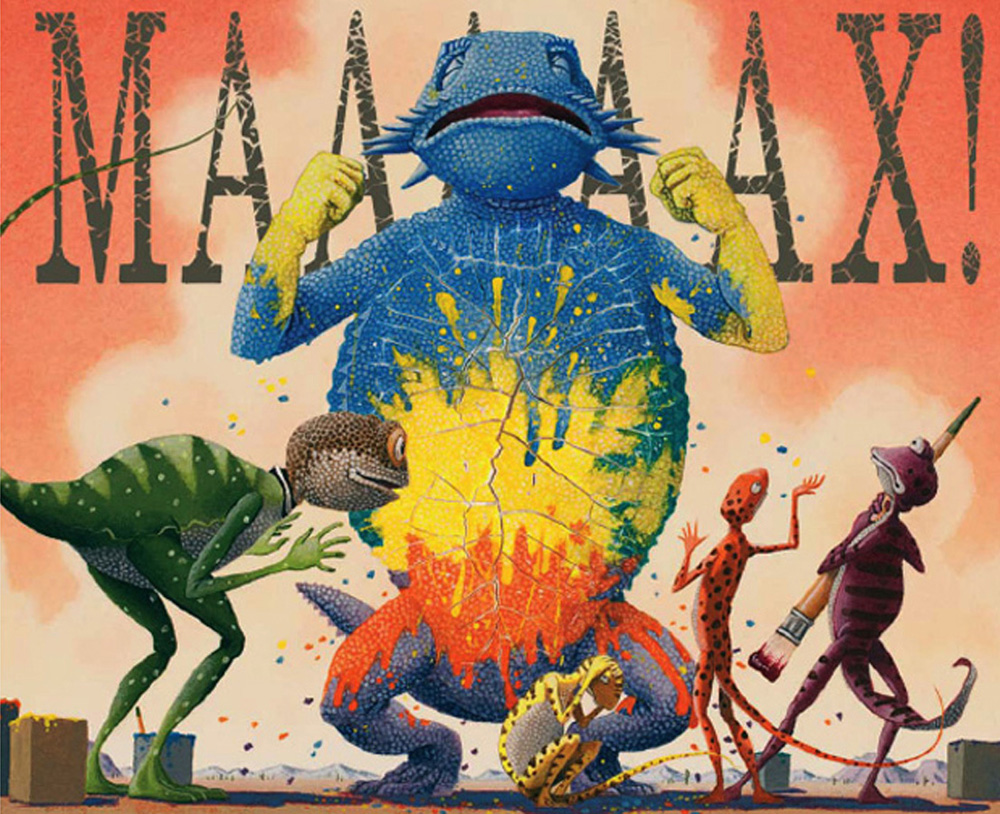
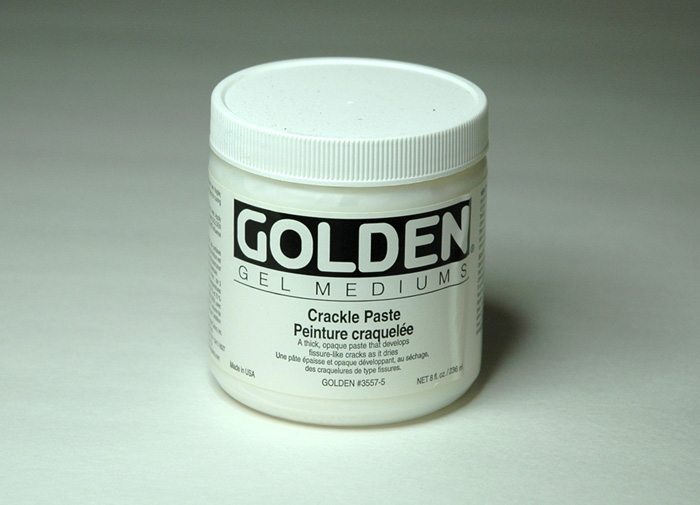
The characters in this book are all painted with acrylic paint, creating an effect similar to oil painting. After Marty haphazardly smears colors, the paint on Da Vinci’s lizard begins to crack, mimicking the effect that occurs after classical oil paintings dry and age. Later, some people, mainly French, specifically attempted to achieve this effect in their paintings. David Wiesner specifically consulted another renowned children’s book author, Lane Smith, and then repeatedly tested paints specifically designed to achieve this effect from online art stores before finally creating the effect seen in the book. After the colors exploded and gradually faded, David Wiesner began experimenting with abstract and post-impressionist techniques, ultimately bringing in Seurat and Pollock, who transformed into two mad lizards to perform for children.
Therefore, the overall process of this book is somewhat like using a crazy game to recreate how various schools of contemporary art have entered people’s lives. When children read this story, they don’t need to know this “ism” or that school; they only need to experience this passion and the legitimacy of its existence. If possible, viewing some artworks by relevant artists and schools will be helpful, and the two will complement each other, which should be very inspiring.
David Wiesner’s story is so popular with children because the characters of Marty and Da Vinci are so vivid and interesting. They seem to be at odds at first; at least Da Vinci doesn’t like Marty, always thinking he’ll cause trouble and destruction. Marty, on the other hand, is always full of energy and boundless creativity, and correspondingly, his destructive power is immense. As the story progresses, Marty’s mischievous ideas turn into brilliant ones, and Da Vinci gradually accepts him.
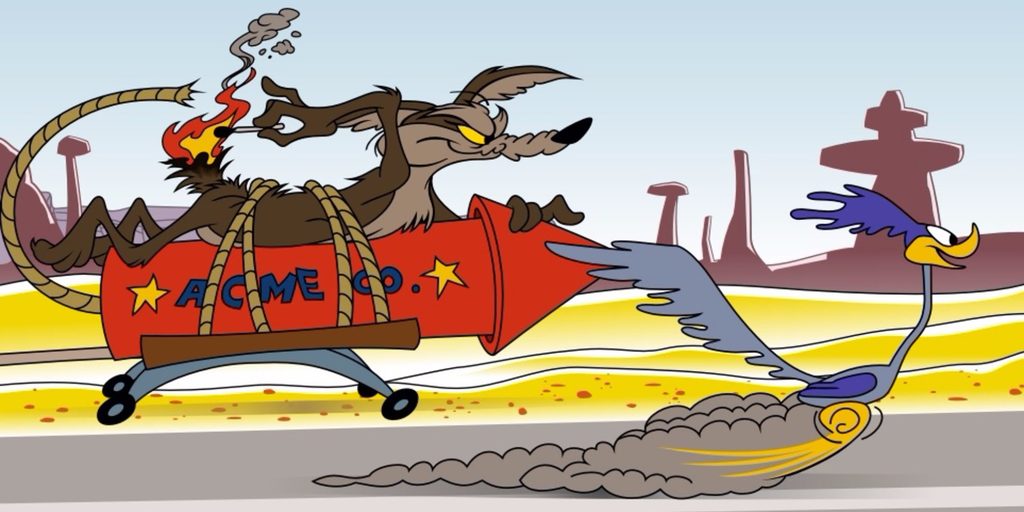
The story of these two characters is heavily influenced by a classic American animated series, “Wile E. Coyote and the Road Runner,” also known as “BB Bird and the Wicked Wolf,” somewhat similar to the “Tom and Jerry” series. Willie the Wolf, obsessed with catching the Road Runner, always comes up with outlandish and seemingly ingenious schemes, but the Road Runner always manages to outwit him. The most amusing aspect is that all the equipment Willie the Wolf uses must be produced by a fictional company called ACME. In *The Great Magic of Art*, ACME equipment appears at least three times, clearly a tribute from David Wiesner to “Wile E. Coyote and the Road Runner.”
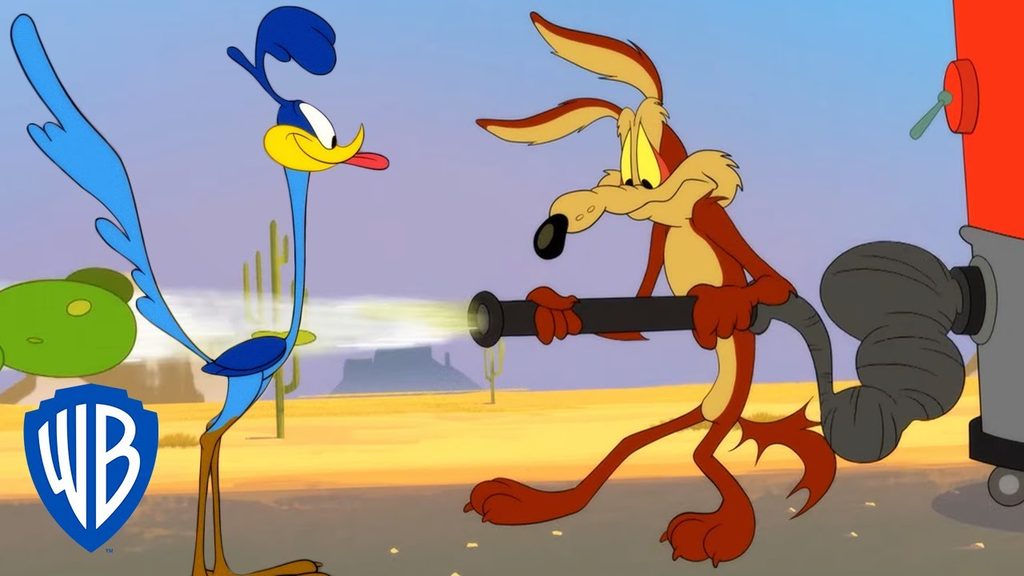
Can you find ACME equipment in the book *The Great Magic of Art*? A special preview: ACME makes another mysterious appearance in David’s latest wordless book, *Room 239*…
Okay, that’s all for today.We’ll talk about the next book in the next episode..