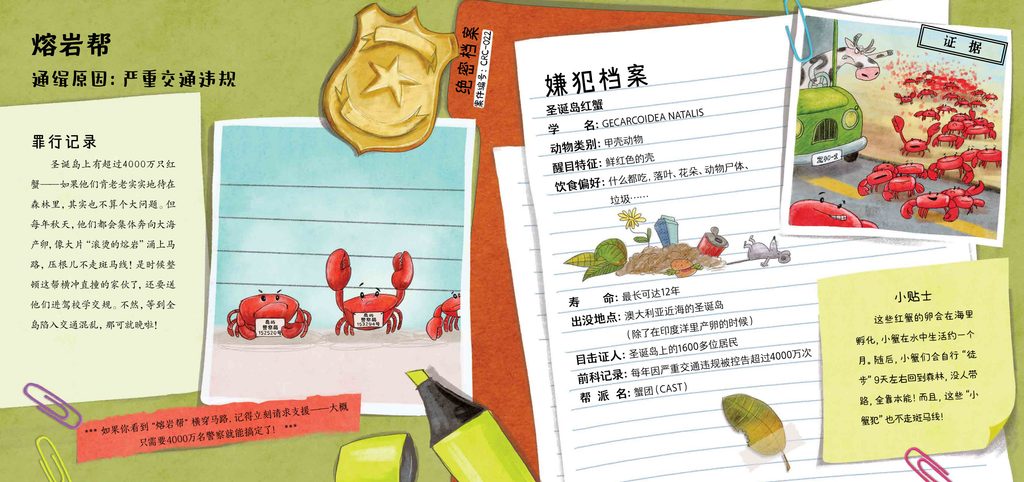
What would happen if one day all the red crabs on Christmas Island that cross the road were sent to driving school to learn how to use crosswalks before being allowed to lay their eggs at the beach?
The enrollment work alone at this driving school would probably exhaust the principal.Animal Kingdom WantedIn *Wanted Criminals of the Animal Kingdom*, Inspector X takes this matter quite seriously. He believes these traffic lawbreakers need to be dealt with properly; if you see them jaywalking, call for backup immediately—it would probably only take forty million police officers to handle!
Okay, hold off on calling the police. Why did the crab cross the road?
They need to go to the sea to reproduce.
So, should red crabs prioritize obeying traffic rules or following their own life rhythms? We teach children to “use crosswalks when crossing the street,” which is certainly correct. But why does applying this statement verbatim to the world of red crabs suddenly seem so unreasonable?
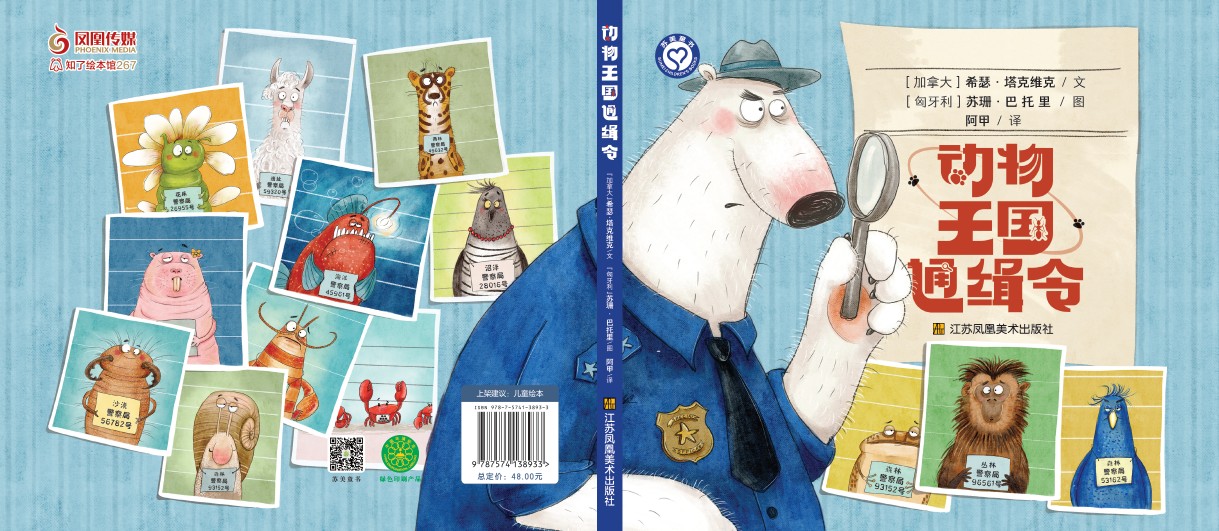
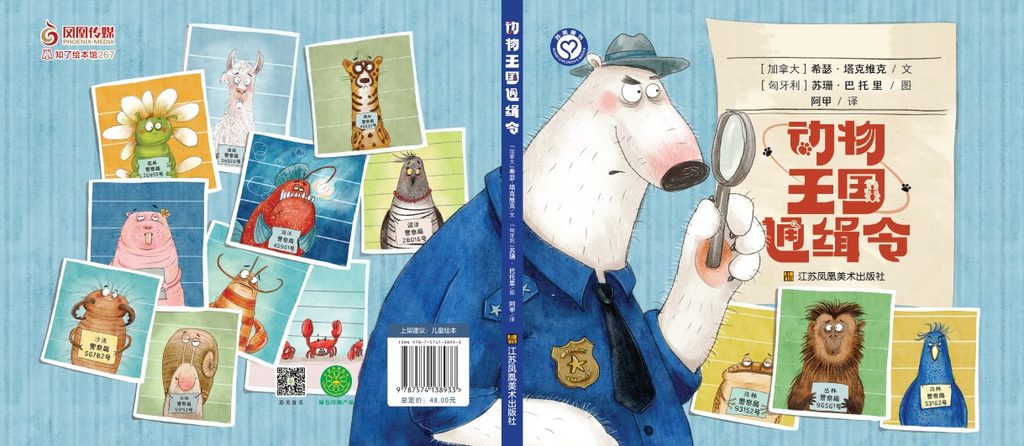
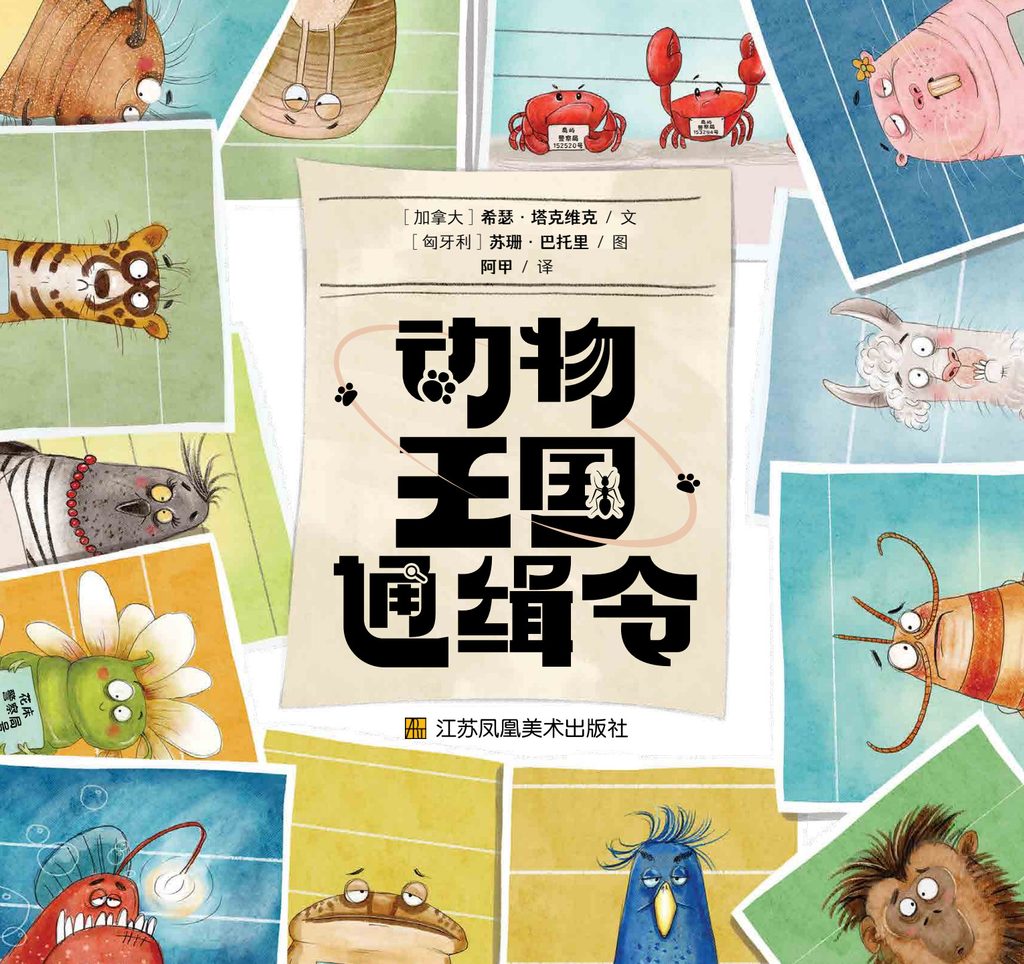
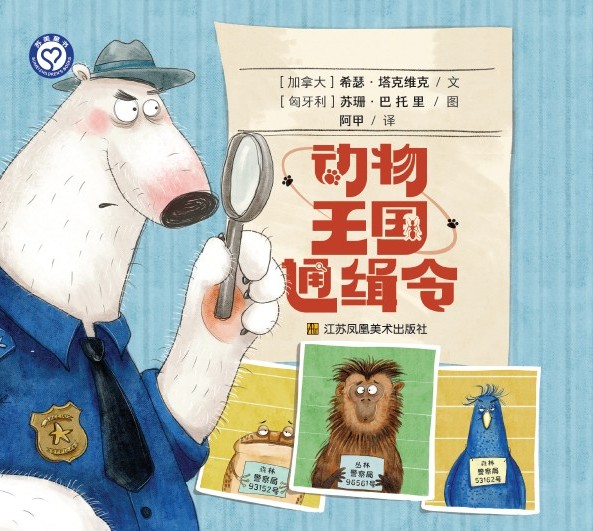
Canadian author Heather Takwick(Heather Tekavec) andHungarian illustrator Suzanne BartóryThis book, a collaboration with Susan Batori, excels at this kind of quirky, thought-provoking mismatch. It features thirteen animal case files, with “suspects” ranging from deep-sea swimmers to rainforest creatures, from underground dwellers to flowerbeds—each with their own unique skills and crimes. A polar bear-like Inspector X, armed with a magnifying glass, is ready to capture them all.
As you read on, you might find that while the animals did indeed do those things, what Detective X said doesn’t seem to be the whole story.
An overly confident detective
At their first meeting, Detective X’s imposing presence was immediately apparent. His uniform, badge, and serious eyebrows, along with his detective academy graduation certificate hanging behind him, were striking. Meanwhile, on a corkboard, photos, footprints, and notes were pinned, and the headline of the *Animal Daily* proclaimed: “A Crime Storm Sweeps Through the Animal Kingdom!”“
The atmosphere for the investigation has already been set, and readers only need to follow the detective.
However, two small questions remained on the sign: “Who is guilty?” and “Why?” Squeezed between the prominent news and the suspect’s photo, they weren’t nearly as eye-catching as the headlines. But if you truly took these two questions to heart, the rest of the reading would be quite interesting.
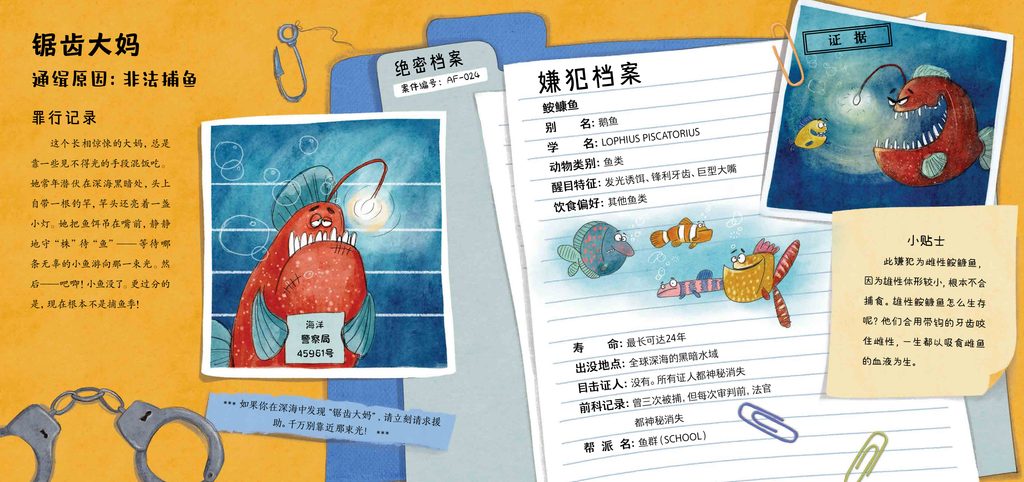
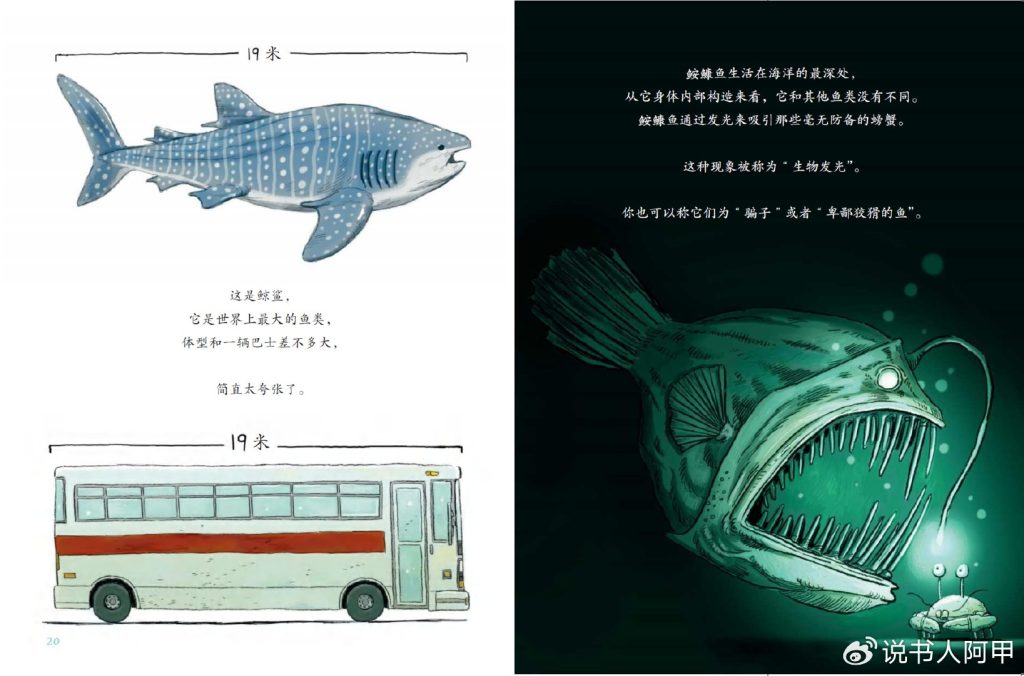
Let’s look at the first case. The “sawtooth auntie” lit up her bait in the deep sea, luring small fish before swallowing them whole. The charge was “illegal fishing.” The detective was particularly furious: It’s not fishing season at all!
The little fish getting eaten is one thing; a fish eating another fish having to abide by the human fishing season is quite another. The humor lies where these two things collide. The detective didn’t get the word “eat” wrong, but he confused who should follow which rules. The more serious he is, the easier it is for the reader to spot the discrepancy.
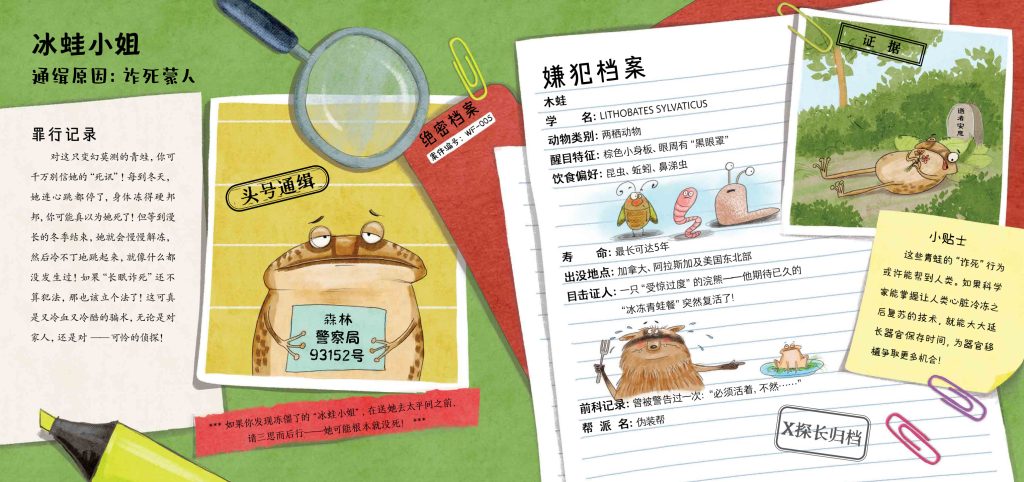
By the time of the Wood Frog case, this crack was almost impossible to close. “Miss Ice Frog” froze in winter and revived in spring, and the detective accused her of “faking her death to deceive people,” even angrily saying, “If ‘faking death in eternal sleep’ isn’t a crime, then it’s time to enact a law!”“
It turns out that even he himself knew that this law might not exist at present.
That angry remark is quite apt. Someone who’s supposed to investigate according to the rules, when faced with a life phenomenon that the rules can’t cover, first thinks of adding a new rule to bring it to justice. We initially thought we were reading a bizarre tale about animal crime, but at this point, we’re starting to see the flaws in the detective’s approach to the case.
The suspense in the detective story has moved.
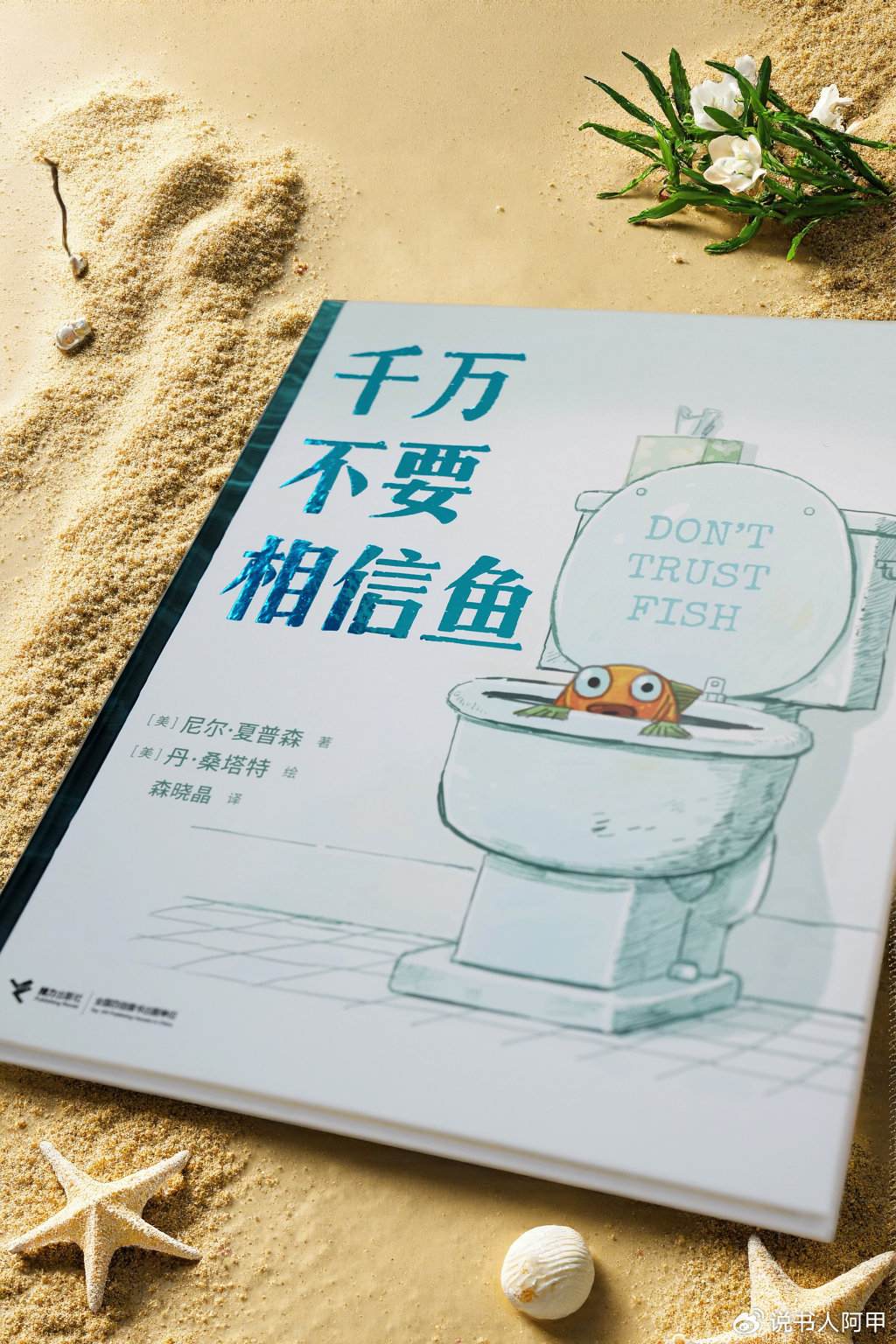
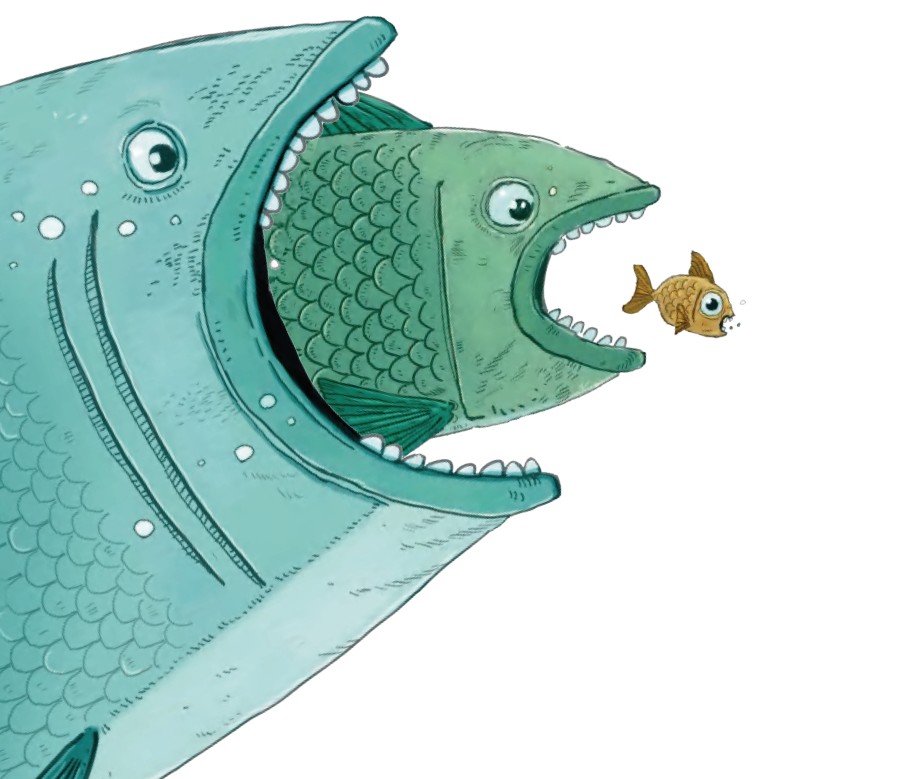
Speaking of this kind of fun, I think ofNever Trust FishBoth books make a big joke about animal knowledge and both feature a very confident narrator who urges readers to take their side. One repeatedly shouts, “Never trust fish,” while the other lays out its contents as if the animal kingdom is full of villains.
But they use different methods to trick readers.
“Never Trust Fish” begins with seemingly serious animal classification, but gets increasingly outrageous, even using illustrations to present a seemingly plausible fish conspiracy. Readers are not only required to examine what is being said, but also to ask: Who is saying this? And why is it said this way? The identity of the narrator is a mystery left for the reader to discover.
“Animal Kingdom Wanted” introduces the detective right from the start, revealing the animals’ names, behaviors, and “crimes.” The suspense doesn’t lie in who the killer is. What’s most thought-provoking is how we interpret what we’ve witnessed.
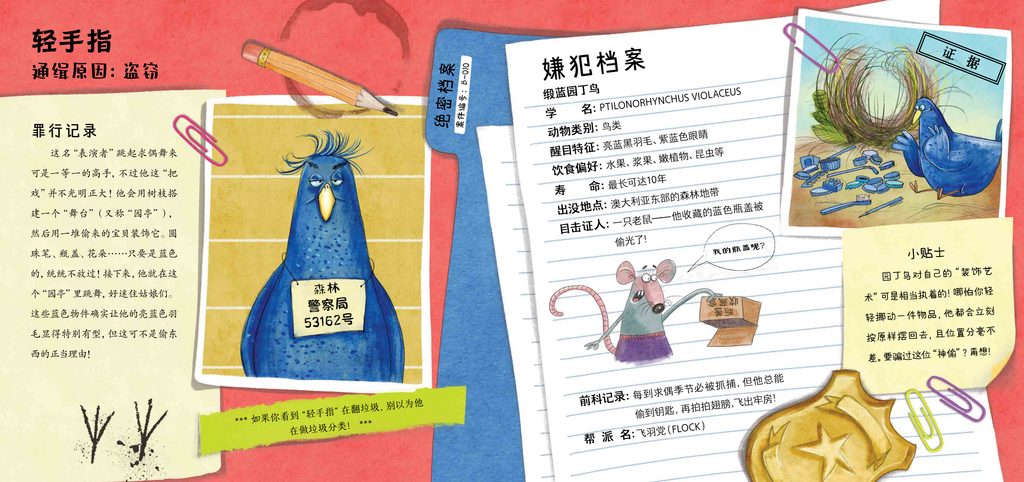
The red crab did cross the road; the bowerbird did take the little blue object; the wood frog did lead the detective to believe she was dead. These events don’t disappear simply because the charges are absurd. However, there’s a long road between “what happened,” “why it did it,” and “whether it’s guilty.” The detective takes three steps at a time, but the reader can slow down.
The similarity between the two books lies in the fact that they both create a slight distance between the reader and the storyteller. We can listen to him continue, or we can silently interject, “Wait a minute.” This reading pleasure is more enjoyable than guessing the answer to a riddle. Because once you guess the answer, you often finish the book; but once you start to doubt the way the story is told, you often want to go back and check it again.
How many interpretations are possible on a single tabletop?
Of course, a ridiculous idea alone isn’t enough to get readers to this position. The book’s appeal largely stems from its presentation.
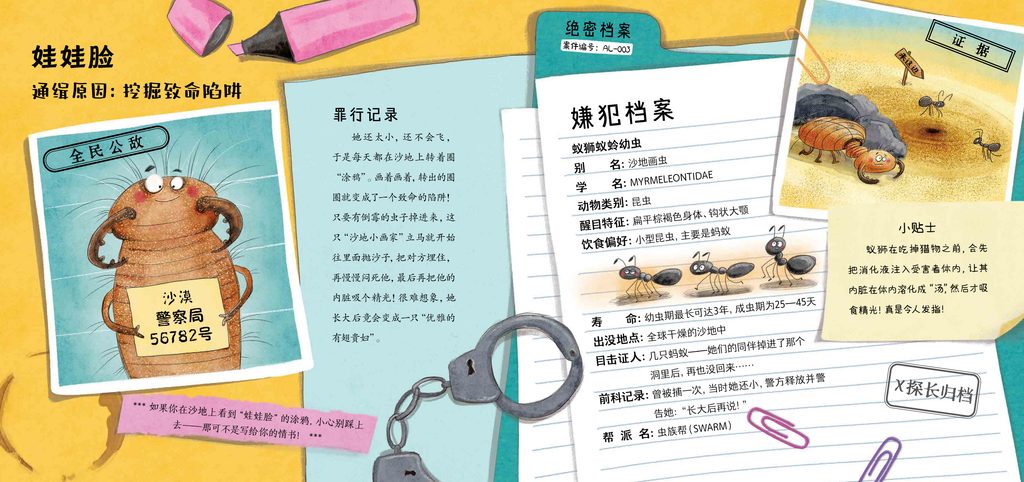
Each double-page spread resembles a detective organizing his desk. Files are weighed down by clipboards, slips of paper are tucked in at an angle, photos are secured with paper clips, and badges, pencils, handcuffs, and magnifying glasses are scattered among them. Behind each suspect’s photo are height lines, and animals hold up numbered tags, half-closed eyes, pouting, or with an impatient “It’s me again!” expression. The bright background and slightly irregular edges of the paper soften the gloom of the police station, adding a touch of childlike liveliness.
In an interview, Bathory mentioned that the idea for this tabletop layout came from art director Marie Bartholomew, who added props such as a police badge, magnifying glass, pencil, and handcuffs. It turns out that the seemingly casually laid-out table was meticulously arranged.
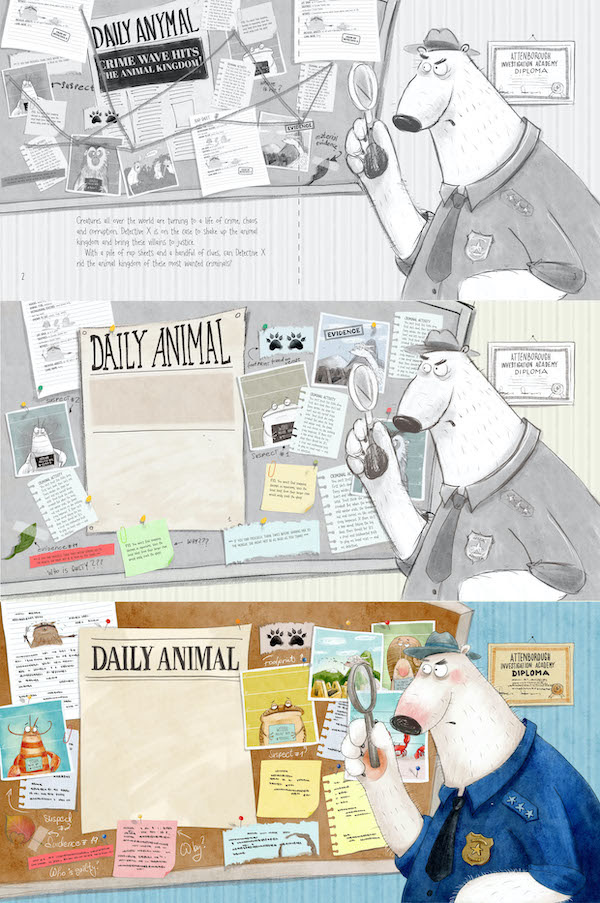
The good arrangement lies in the fact that the eyes have a path to follow, but don’t have to take the same path every time. You can be hooked by the nickname first, or look at the “evidence” photo; if you want to know what kind of animal it is, you can check the file; if you get tired of reading long passages of text, there’s a little tip next to it. Turning to the next case, you’ll recognize familiar sections and quickly find what you want to see.
Thirteen animals, originally belonging to vastly different habitats, are compiled into the same file. This gives readers the opportunity to make comparisons: how many of these “crimes” are related to eating, how many to courtship, and how many are simply trying to survive the winter? The repetition of the files not only gives the jokes rhythm but also connects the knowledge between them.
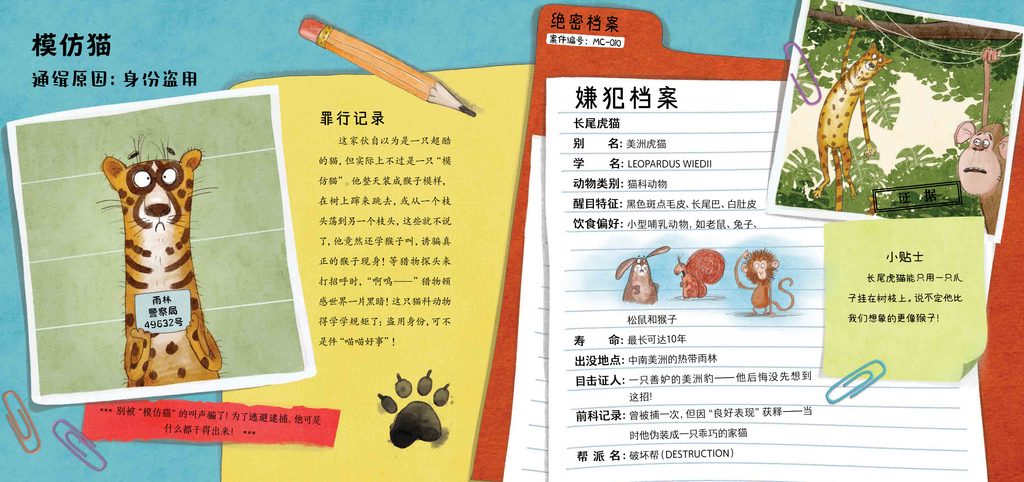
What’s even more noteworthy is that the tone of the text on a single file isn’t always the same. Sections like “Dietary Preferences” and “Locations” describe the animals; but when it comes to “Eyewitnesses” and “Criminal Records,” a humorous twist emerges from the otherwise formal format. A long-tailed ocelot was released by pretending to be a well-behaved house cat; the alpaca’s guard, fed up with mopping the floor, simply helped him escape. Just when you’re about to treat this file as reliable information, it winks at you again.
This requires readers to constantly change their reading approach. On the same page, one sentence provides knowledge, another is acting, and yet another continues the joke using knowledge as a pretext. Of course, it won’t work if you take everything seriously; but if you treat the whole page as nonsense just because there’s a joke, you’ll miss many interesting discoveries.
The illustrations also joined the performance. Suspects were used to give animals the faces of “criminals,” handcuffs and seals bolstered the detective’s authority, and small scenes in the corners played out the unfinished jokes from the case files. Especially those pictures stamped with the word “evidence”—how solemn they looked! However, a picture depicting a bowerbird taking a bottle cap cannot be used to convict it based solely on that action.
The saying goes, “A picture is worth a thousand words,” but here we need to add another step: to see clearly what the picture actually proves.
Whose loss is counted?
The section on “Eyewitnesses” is the part of the book that I particularly wanted to read a little longer.
Some witnesses were simply unable to appear in court. In the deep-sea fishing case, all the witnesses “mysteriously disappeared,” including the judge who presided over the case. This is, of course, an exaggeration of the large mouth and appetite, incidentally turning the dangerous predation into a police comedy. Other witnesses, however, deserve thorough questioning, such as the raccoon that was “overly frightened” by the revival of the wood frog.
Was his fate pitiful? Look at the small drawing next to him: a raccoon with a knife and fork, waiting for his meal; but the frog in the plate has come to life. His long-awaited “frozen frog meal” is gone just like that.
From the raccoon’s perspective, the meal was ruined; from the woodfrog’s perspective, she survived. It’s not difficult for the reader to decide who to sympathize with. But if that’s the case, why does the frightened “witness” in the case file have more right to complain than the woodfrog who escaped with her life?
This little joke highlights a key question in the book: whose side is the detective really on?
A red crab blocks a car, and the people inside complain; an alpaca sprays a tourist, and the tourist is naturally annoyed; a caterpillar disturbs a flower petal, and the gardener complains. These complaints aren’t necessarily fabricated; the trouble and losses may be very real. However, if we only listen to the unhappy party in every situation, animals can easily be portrayed as villains.
The Blue Bowerbird is particularly interesting. Known as “Light Fingers” because of its penchant for collecting blue objects to decorate its courtship pavilion, this blue landscape architect appears quite pleased with himself in the picture. Meanwhile, a mouse, clutching its “bottle cap collection box,” frantically searches for its bottle cap. The creator has even provided the “owner” for this case. You can appreciate the bird’s skill and understand the mouse’s frustration, but you don’t have to agree with the detective turning the courtship area into a den of thieves.
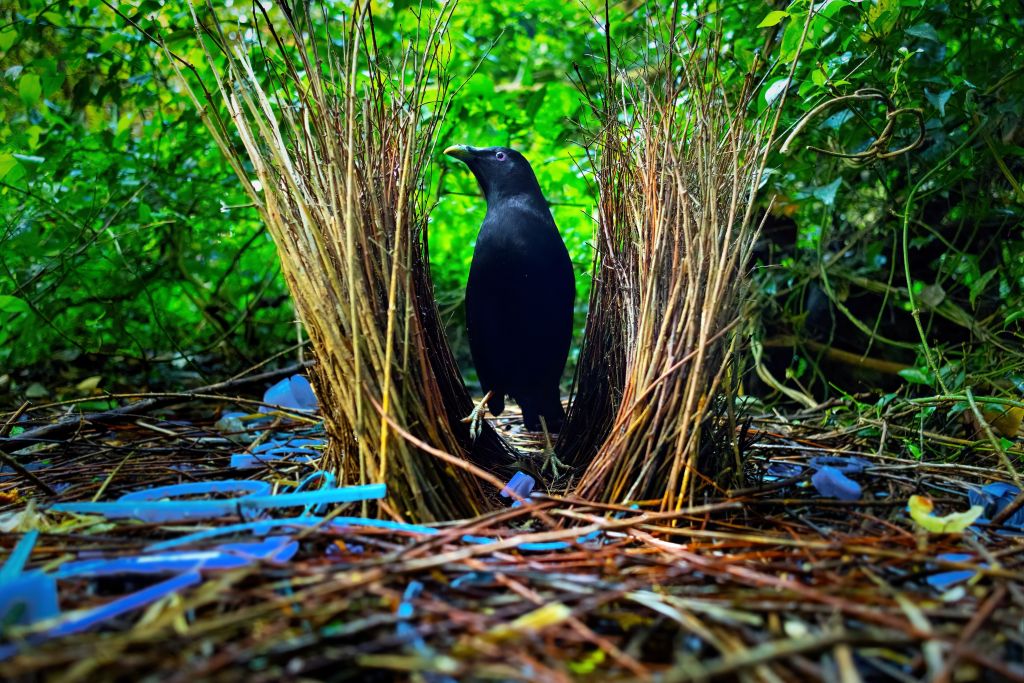
Bathory said that when she first read about the blue bowerbird, she thought it was an animal made up by the author. The little thing is funny in itself: a book that is deliberately silly, the material that most seems like a fabrication, happens to surprise even the person who illustrated it.
Nature is already busy enough with its wonders. Sometimes our explanations actually narrow our understanding of it.
After training the animals to be obedient
This also sets “Wanted in the Animal Kingdom” apart from typical stories about animal morality.
Animal fairy tales we’re familiar with often portray foxes as cunning and ants as industrious, using animals to illustrate human life. Readers know these characters have human temperaments and bear human responsibilities. But in this book, the fictional police station closely resembles real animal behavior. How cuckoos reproduce, how wood frogs overwinter, and how caterpillars camouflage themselves—these are all questions about understanding animals; once the detective takes charge, they become about laziness, deception, and vandalism.
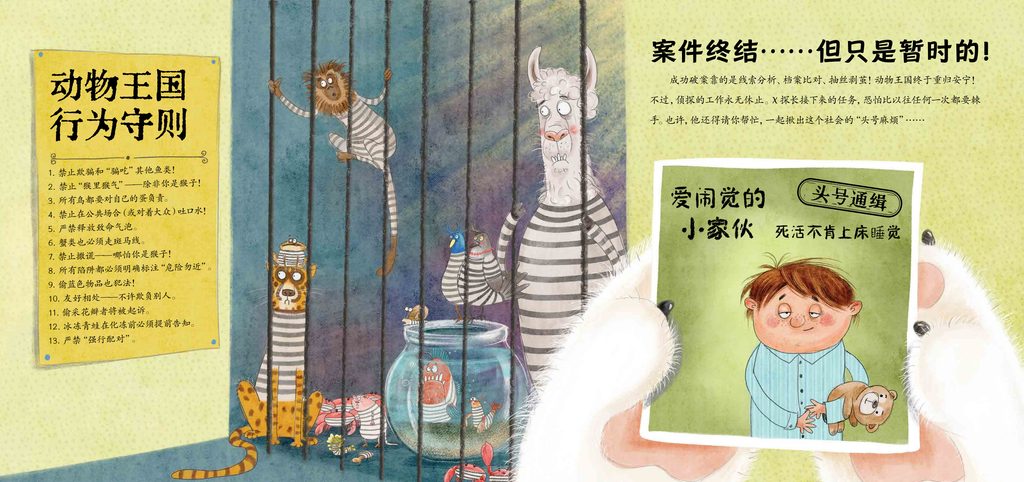
What will we get if we push this misalignment all the way to the end? The “Code of Conduct for the Animal Kingdom” on the wall at the end provides a rather surprising answer.
““All traps must be clearly marked ‘Danger, Keep Out of the Way.’ ” Imagine an antlion erecting a warning sign at the edge of a sandpit, waiting for prey to avoid it. There’s an even more considerate rule: “Frozen frogs must be notified in advance before they thaw.” The wood frog, busy recovering its movements, apparently doesn’t forget to inform the raccoon with its knife and fork!
These rules transplant the safety, politeness, and order familiar from human society to another realm. Each rule, when read individually, seems to protect everyone’s interests; but when put together, they forbid predators from hunting, forbid camouflagers from camouflaging, and require hibernators to report their revival in advance. If the animal kingdom were truly organized in this way, it would probably be so peaceful that even the sounds of life would be scarce.
But the scene didn’t offer any relief. The animals, now dressed in striped prison uniforms, peered out through the cell bars. Alpacas, monkeys, bowerbirds, even the fish in the tank, were all confined to the same system of imprisonment. Stripes covered their fur, feathers, and scales; the animals’ appearances remained, but their identities were unified as prisoners.
The detective announced that peace had finally returned to the animal kingdom. After seeing this, are we still willing to applaud?
I think this is precisely the less lighthearted, yet all the more meaningful, aspect of the book’s appeal. It keeps us laughing, but ultimately fails to deliver a happy ending with the detective admitting his mistake and the animals being released. The story has already accomplished its goal, but the reader can still feel it wasn’t done right. The storyteller’s period isn’t necessarily our period.
The last wanted poster
The detective wasn’t finished yet. He held up another photo, asking readers to help him catch the next “number one troublemaker.” This time, the photo showed a child in pajamas holding a toy.
Reason for the arrest warrant: “Refuses to go to bed no matter what”.
Now, the case has truly come to our doorstep. If we’re reading together before bed, the adult might pause here to glance at the little one beside them. The child might laugh, protest, or think the detective is meddling too much. In any case, the case file that was just separated from the reader by rainforests, deep seas, and sandy beaches is suddenly right next to the pillow.
This ending leaves adults with a small temptation: wouldn’t it be perfect to use the detective’s badge to scare a child who refuses to sleep? However, if the previous cases have already made us laugh and wonder, this trick won’t work so well. We can’t exactly laugh at the detective letting crabs into driving school while simultaneously using his badge to urge our children to go to bed.
Sleeping certainly requires discussion, but the little one in pajamas doesn’t become a criminal. If readers can speak up for this child, they also have a chance to turn around and think about the animals. It turns out that there’s a distance between finding someone’s behavior troublesome and truly understanding that behavior. This ending shortens that distance and makes it easier for us to see where we were standing before.
Of course, no joke can guarantee that every reader will interpret it in the same way. Will the “terrible mother” remain in their memory before the cuckoo’s reproductive methods? Will those horrific “crimes” make young readers genuinely believe that animals are intentionally evil? This risk certainly exists. When reading together, it’s worth lingering a bit longer at parts that the child finds strange, exploring different ways to interpret the same case. Rushing to declare “this book teaches us critical thinking” and drawing conclusions for the child would be a waste of the space the author has left for them.
“Never Trust a Fish” makes us pay attention to the voice desperately trying to dissuade people from believing in fish; “Wanted in the Animal Kingdom” makes us take a closer look at the detective busy maintaining order. He investigated so many animals, yet he never seemed to think that his own judgment was worth investigating as well.
Fortunately, the two questions on the corkboard from the beginning are still there: “Who is guilty?” “Why?”“
Before closing the case file, I thought I’d move the magnifying glass aside. I’ve observed the animals long enough.
Inspector, could you please tell me why?
[Appendix] Illustrator Susan Bathory discusses the book’s layout collaboration and the interesting stories behind the creation of the Blue Bowerbird, in an interview published by Elizabeth Dulemba on July 9, 2020:Susan Batori’s WANTED! CRIMINALS OF THE ANIMAL KINGDOM.
[Reference Translation]
Susan Bathory and the picture book “Animal Kingdom“Arrest warrant》
In the creatively imaginative new book, *Wanted in the Animal Kingdom*, popular science nonfiction presents a refreshing and engaging approach. The book’s illustrator, Susan Batori, traveled all the way from Hungary to share the creative story behind the book!
e: Could you tell us about the creation process of “Wanted in the Animal Kingdom” and the media used?
Susan: Actually, the process of creating almost all my books is similar. The first step is always to search online for reference photos of the various animal characters in the book. This book is a bit special because the animals involved are not commonly seen and rarely appear in typical storybooks.
After finding some references, I started drawing the character design. I usually use Photoshop for digital drawing and rarely draw paper pencil sketches.
The next step was page design, where all elements began to take their place. The art director and I had reached a consensus early on: each double-page spread in the book should visually resemble an investigator’s desk, filled with wanted posters, crime files, investigation notes, sticky notes, and so on. Therefore, I spent a considerable amount of time refining these designs. Once the sketches were finalized, only the final step remained—coloring. With a shout of “Done!”, the entire book was successfully completed.
e: You’ve filled each double-page spread with information, and in a lively, engaging, and captivating way. Was this layout your own idea, or a suggestion from the art director? (If it was your idea, how did you come up with it?)
Susan: When I start working with a publisher, I usually receive a PDF layout sample (comp pages) containing illustration captions and text. I need to know how much text will be on the page and how much space is allocated for illustrations.
In this book, art director Marie Bartholomew first showed me her concept for the layout. I then added some details, such as a sheriff’s badge, a magnifying glass, a pencil, and handcuffs, which made the whole scene more humorous.
Although I prefer to lead the page design myself, this was a fantastic collaboration because Mary and her team were incredibly open and receptive to my ideas, making the entire process very enjoyable.
e: What has your publishing journey been like?
Susan: In 2012, Good Illustration contacted me, expressing their desire to represent me because they really liked my portfolio on Behance (a platform for artists to showcase their work). I happily accepted. We established an excellent rapport and collaborated very smoothly; they treated me like family. Since then, I’ve received more and more illustration commissions from different publishers around the world.
e: Were there any unique or fun anecdotes during the creation of “Animal Kingdom Wanted”?
Susan: Yes! At first, I thought one of the characters in the book was fictional. I assumed the author, Heather Tekavec, made it up herself—because I’d never heard of the “Satin Bowerbird” before, a bird that only collects blue things! It’s so interesting how you learn something new every day, haha!
e: What do you think makes illustration so magical? It’s what I often call “Heart Art”—the kind of work that makes readers want to look at it again and again and savor it endlessly?
Susan: Yes, I understand this artistic state deeply. It comes from the heart, flowing naturally without any deliberate effort. There are no rules, limitations, or constraints to hinder your creation. When creating, I feel utterly free, and the viewer can truly feel this—it’s as if my soul is holding the paintbrush.
e: Oh—that’s so beautifully said! “It’s as if my soul is holding the paintbrush,” that’s absolutely brilliant. So how do you usually promote yourself (or do you do promotion at all)?
Susan: I feel very lucky because my agency handled all of these matters for me. I also run my own Instagram and Facebook accounts, where I can connect with my followers and promote my new illustrated book.
e: As a creator, what is your favorite or most challenging part?
Susan: Interestingly, for me, my favorite part and the most challenging part are the same thing: being alone in the studio. Sometimes I feel incredibly comfortable working alone; other times, the opposite is true. I worked as an art director early in my career, always in a team, so I occasionally miss that collaborative atmosphere. However, this creative life still holds a lot of magic for me.
Oh, strictly speaking, I’m not entirely alone; I also have a “desk mate”—my cat, Kamilla. :)
e: Furry little animals are indeed excellent employees! Regarding “Wanted in the Animal Kingdom,” is there any special meaning that you hope readers will understand? Perhaps some deeper meaning that is not obvious at first glance?
Susan: Nature is so beautiful and unique because of these strange and adorable species; it is our responsibility to protect them, because their existence enriches our lives. I sincerely hope that children will discover and understand this sentiment when reading this book.
e: What project are you working on next? Or, what would your “dream project” be like?
Susan: I’m currently working on a very funny book about a bear and a woodpecker. My next project is about the friendship between a whale and a little penguin.
As for my dream story? As long as the story is humorous and interesting, and the main characters are animals, any theme is fine. Making me happy is actually very easy! :)
e: Thank you, Susan, for sharing your joy with us! We look forward to seeing more of your wonderful work in the future.
Susan: Thanks again!