Last time we talked about the upbringing of Caldecott Medal darling David Wiesner.This time, let’s talk about “Hurricane,” a picture book with a lot of text by the artist who is known as the “master of wordless books.”

How many words are in this book? I’m the translator, so I know the exact number: over 1500 words in Chinese. That’s relatively long for a typical picture book, but not exceptionally long. However, it’s probably the most text-heavy of David Wiesner’s self-written and illustrated works. This book is special; it’s a quasi-autobiographical story about his childhood experiences. The story isn’t complicated—it tells how his family survived a hurricane. This is quite ordinary for people living near the coast, but David Wiesner imbues it with a fantastical quality, and the childhood depicted in the book is particularly enviable. This book can be seen as good material for understanding David Wiesner’s creative sources, and it also gives us a glimpse into what a “perfect childhood” might look like.
The book’s cover depicts two boys and a cat looking out a window during a stormy day. The boys gaze intently at the sky, while the cat seems to be peering sideways at something below. This is a classic David Wiesner narrative style: the scenes and characters seem immediately obvious, but a closer look at their actions and expressions reveals a hidden story, a touch of mystery that compels you to wonder: what happened?
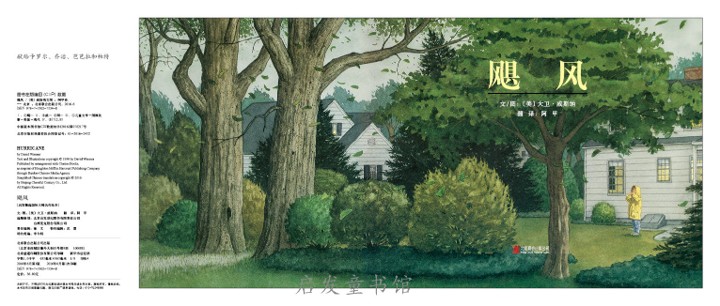
Turning to the title and copyright pages, the illustration shows a boy in a yellow raincoat standing in a yard. The copyright page is dedicated to Carol, George, Barbara, and Pat. Who are these four? They are David’s older brother George and his three older sisters, Carol, Barbara, and Pat. So, where is the youngest, David? He’s the boy in the yellow raincoat, and the older boy is George. To simplify the plot, the three sisters are omitted from the book, leaving only the two brothers. In reality, the events in the story are shared by all five siblings.
When David Wiesner won the Caldecott Medal for the second time in 2002, he specifically mentioned in his acceptance speech, “Although most of the time my older siblings treated me like a naughty little brother, they always took my creativity seriously. They shared their artistic knowledge and wholeheartedly encouraged me to continue my studies.” Later, when he went to art school, he learned that many of his classmates had experienced huge and painful family struggles, so he looked back at his warm and harmonious family environment and felt particularly grateful.
Okay, let’s continue reading the book. The story begins by showing the family’s preparations before the hurricane arrives. The mother is returning home from the grocery store with groceries, the father is reinforcing things in the yard, and the two boys are anxiously searching for their cat, Hannibal. The reader has already seen the black and white cat; it has likely discovered something and, despite the approaching storm, has taken it upon itself to track it down.
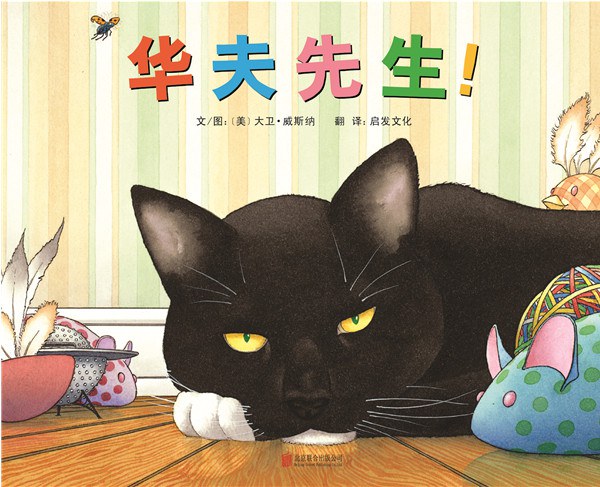
David Wiesner fans will notice at least two things: First, David loved cats from a young age. His Caldecott Honor Book, *Mr. Waffle*, features a black cat with white spots as its protagonist, and the model for that cat was actually one of David’s own! Second, the cat’s name is “Hannibal.” Does that ring a bell? Hannibal was a Carthaginian general during the Roman era, a military genius renowned throughout history who nearly destroyed the Roman Republic. The fact that two boys named their cat Hannibal suggests they have a fondness for history, especially war stories, and a yearning for distant lands.
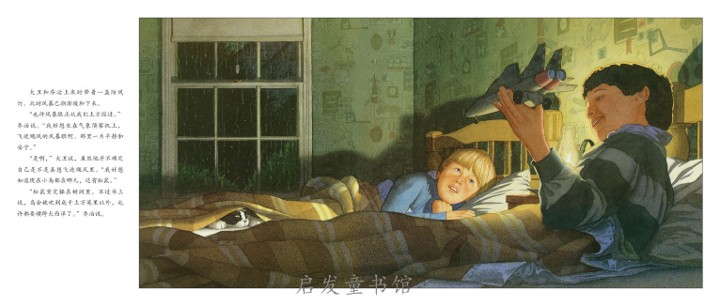
At this point, I suggest readers turn a few pages to the page where brothers George and David discuss storms and weather reconnaissance planes in their bedroom. Pay attention to the wallpaper. It contains a lot of information the artist wants to convey about their living environment. It includes books, a magnifying glass, an elephant’s head, a boat in bottles, medals, and so on. Some of the images are a little unclear to me, but it’s clear that it reflects the inner world of boys around ten years old. The text on this page, led by older brother George, discusses rather technical weather-related knowledge. This is part of David Wiesner’s upbringing.
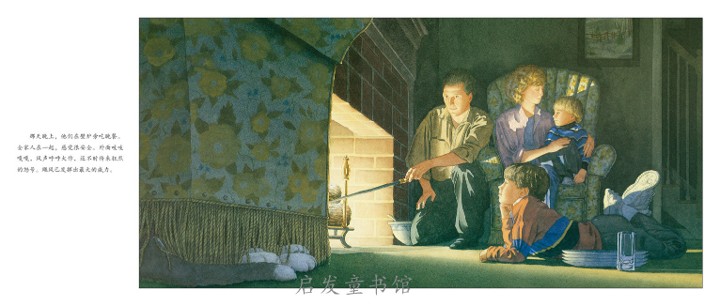
Turning to the front, a scene of the family having dinner by the fireplace is described in the text: “The whole family is together, and it feels safe. Outside, there’s a creaking, howling wind, and occasional fierce roars.” The image cleverly uses the perspective of a cat lying on the table to present the warm scene of the family gathered around the fireplace. Although the bad weather caused a power outage, the firelight in the fireplace was warm and reassuring. The father was in charge of tending the fire in the fireplace, the older brother was lying on the floor watching, and the younger brother was nestled in his mother’s arms on the sofa… David Wiesner’s father was an engineer, whom David proudly called a “scientist.” Although his father wasn’t particularly artistic, he was very supportive of his children’s interests in that area; and his mother’s attitude towards him was unconditional acceptance. She kept everything David had drawn as a child.
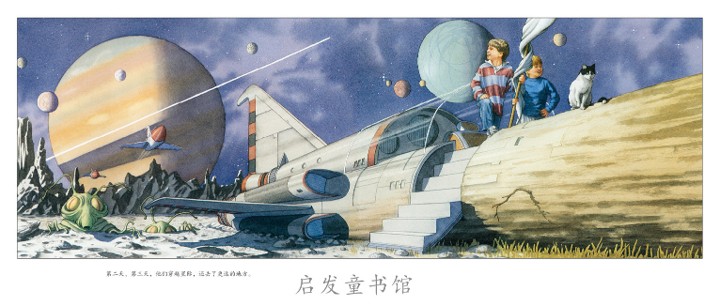
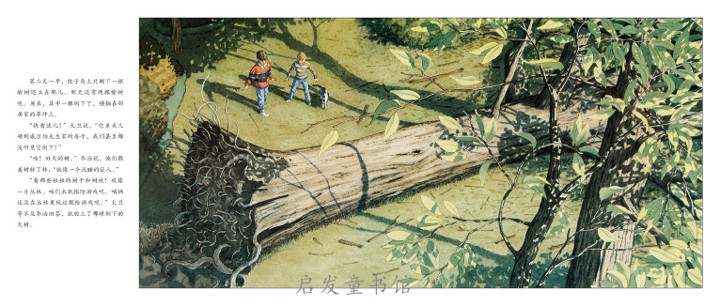
The first half of the book *The Hurricane* uses the backdrop of a raging hurricane to present a loving and spiritually rich family. After the hurricane, a large tree that has fallen in the neighbor’s yard becomes the focus of the story, and the two brothers and their cat Hannibal embark on an adventure across time and space. Three consecutive double-page spreads depict their journey: first to a jungle with elephants and leopards, then a large sailing ship sailing the seven seas, and finally, a space voyage landing on a planet inhabited by extraterrestrials.
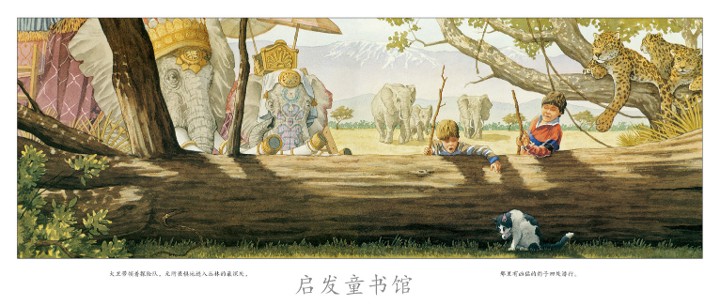
On the page with the elephants, there are elephants in the distance that appear to be from the African savanna, while in the foreground on the left, an elephant is depicted as a mount. Why this association? Readers familiar with history will know that when the legendary warrior Hannibal Lecter crossed the Alps, his army included a force of dozens of elephants. However, in this illustration, Hannibal is portrayed as a playful and gluttonous kitten, making this comparison quite humorous. Later, the pirates and octopuses at sea, and the spaceships and aliens in outer space, are clearly related to the adventure and science fiction books and films they regularly read or watch.
It’s particularly noteworthy how their game began and proceeded. Let’s reread the written account:
First, the older brother George exclaimed, “Wow, what a huge tree! It’s like a sleeping giant!” This sparked their boundless imagination and excitement.
So, David, the younger brother, imagined the thick tree trunk and branches as a jungle, and suggested playing an adventure game in the jungle, “leading the expedition team, fearlessly into the deepest part of the jungle, where fierce leopards lurk everywhere.” Where did the leopards come from? Look down, it’s just that little cat! The little cat leads to the image of fierce felines, and Hannibal’s name leads to the image of war elephants.
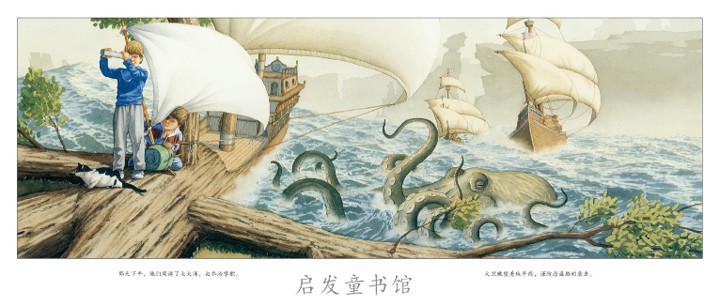
Next, they imagined the tree as a large sailing ship, sailing around the seven seas. This time, the older brother was in charge of steering, while the younger brother was in charge of keeping watch to prevent attacks from pirate ships. You can get a sense of this: in the brothers’ conversation and game, the older brother George was mainly responsible for the technical aspects, while the younger brother David was mainly responsible for the boundless and exaggerated imagination.
In the next space scene, the tree has transformed into a spaceship, and the two brothers are holding onto a large flag. What is that flag made of? It looks a lot like a bed sheet or a curtain!
Therefore, we can briefly summarize that the games children play tirelessly and endlessly in nature, even using a fallen tree, share several characteristics:
- The first is to use whatever is available locally;
- Secondly, they connect their existing knowledge with their preferred imaginative material;
- Thirdly, it often requires mutual inspiration among partners;
- Fourth, games are often invented randomly by the creators themselves, with creativity constantly accumulating;
- Fifth, the gameplay and rules are entirely determined by the player, sometimes based on the suggestion, but usually through natural negotiation and discussion, and roles and content can be changed at will.
So, the most amazing thing about this kind of game is that it blends perfectly with the environment, offering endless possibilities for imagination. And because it’s completely autonomous (not arranged or prescribed by others), children will never get bored. This kind of game is also very helpful for children to verify, exchange, and expand their knowledge.
On the next page, the two brothers, tired from playing, are hiding in the shade of a tree drinking beverages. The text reads, “That tree was a very private place, big enough to hold their own secret dreams, small enough for them to explore together.” Wasn’t it an ideal playground? Unfortunately, soon adults came and sawed it down and took it away; it was a large tree that had fallen into their neighbor’s yard. Finally, the two brothers leaned against the tree closest to their own yard, hoping that if it fell, it would fall into their yard!
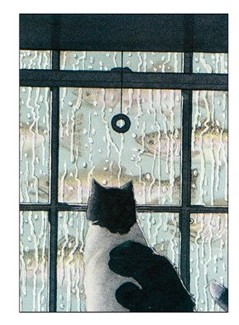
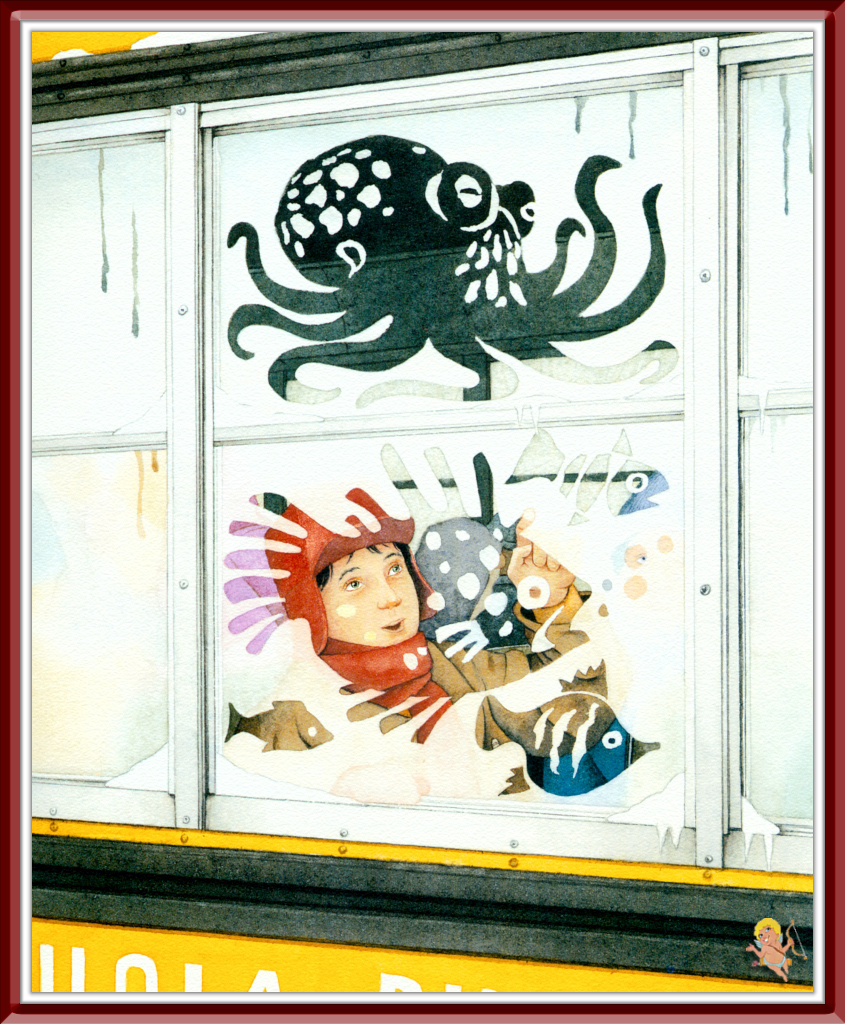
In the final wordless image, a kitten stares out the window into a storm, where rows of delicious fish seem to swim overhead. Readers will see similar fantastical scenes in his later works, such as *Dream Factory No. 7* and *Tuesday*.
While *The Hurricane* isn’t David Wiesner’s most representative work, it explains to his fans, in a quasi-autobiographical style, the source of his boundless and fantastical imagination. This imagination stems from his almost perfect childhood: a loving family with exceptionally harmonious sibling relationships, unconditional support among family members, and constructive inspiration. Moreover, while richly nourished by books and art, his living and playing environments were remarkably close to nature, providing him with constant opportunities to be nurtured by it. A devastating hurricane, however, became a cherished childhood memory for David.

David Wiesner’s path to adulthood was certainly fortunate, but not without its challenges. His most unfortunate experience came in 1983 when, at the age of 27, he and his wife Kim were struggling to make ends meet in Boston when a fire destroyed their apartment building. Everything he owned was gone, including the precious oak drawing table his father had given him. However, he quickly recovered, his work matured, and soon he had the opportunity to collaborate with Hollywood director Steven Spielberg, illustrating the novel and creating posters for the science fiction film *E.T.*. This improved his financial situation, allowing him to return to his signature style and achieve success. Therefore, a “perfect childhood” can actually instill a sense of security, confidence, and resilience, enabling one to face any setback with equanimity.
Let’s take a break first, and we’ll talk again in the next episode.