When it comes to giant pandas, the public often views them through a strong “cute pet” lens. People are used to watching these “national treasures” eat bamboo, tumble around, and act adorably under careful artificial care, outside the glass walls of zoos or in front of live streams. However, real wild giant pandas are by no means greenhouse flowers in captivity. They are large, solitary animals in the Hengduan Mountains with almost no natural predators, and they must face the laws of nature alone.
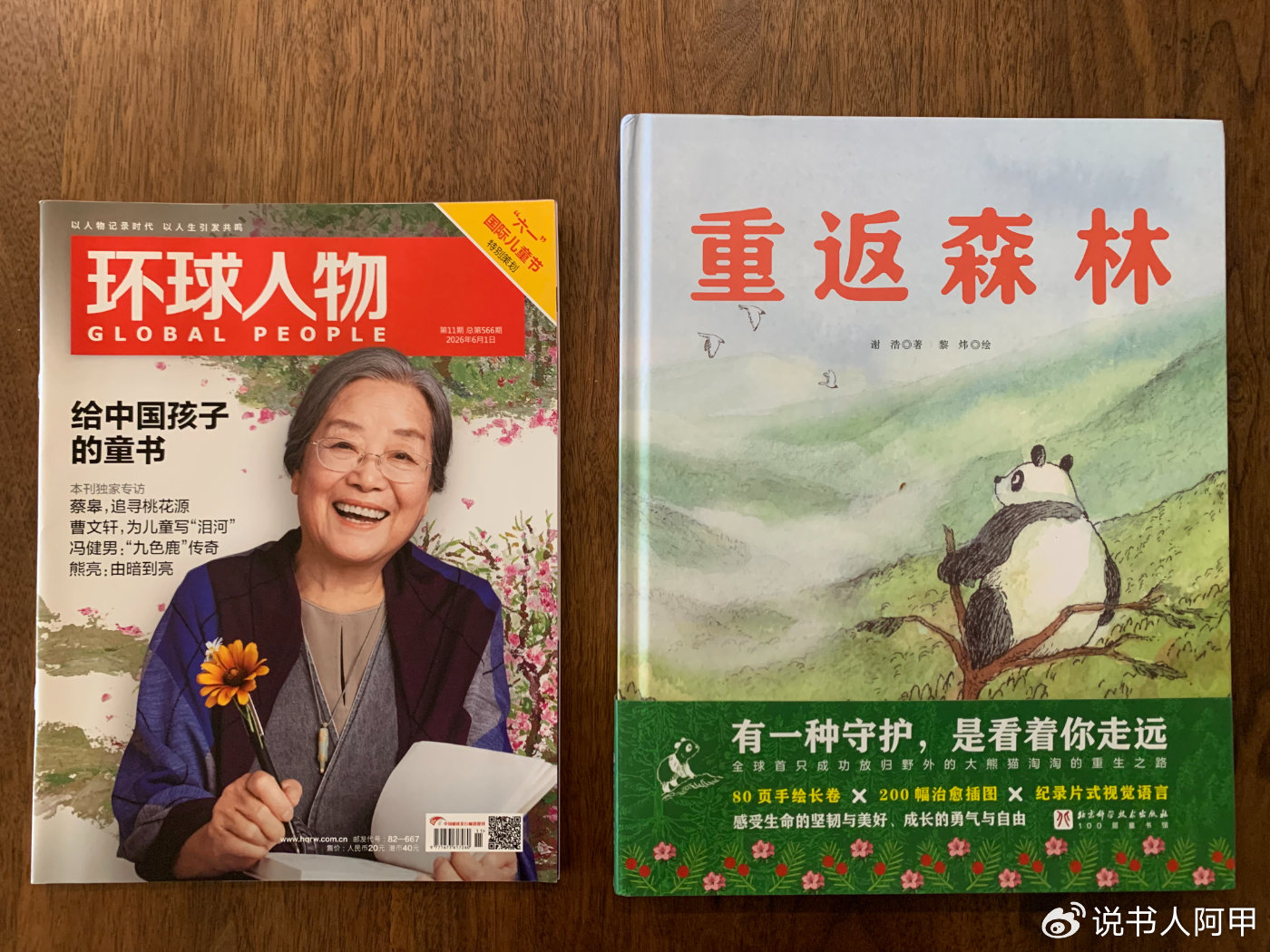
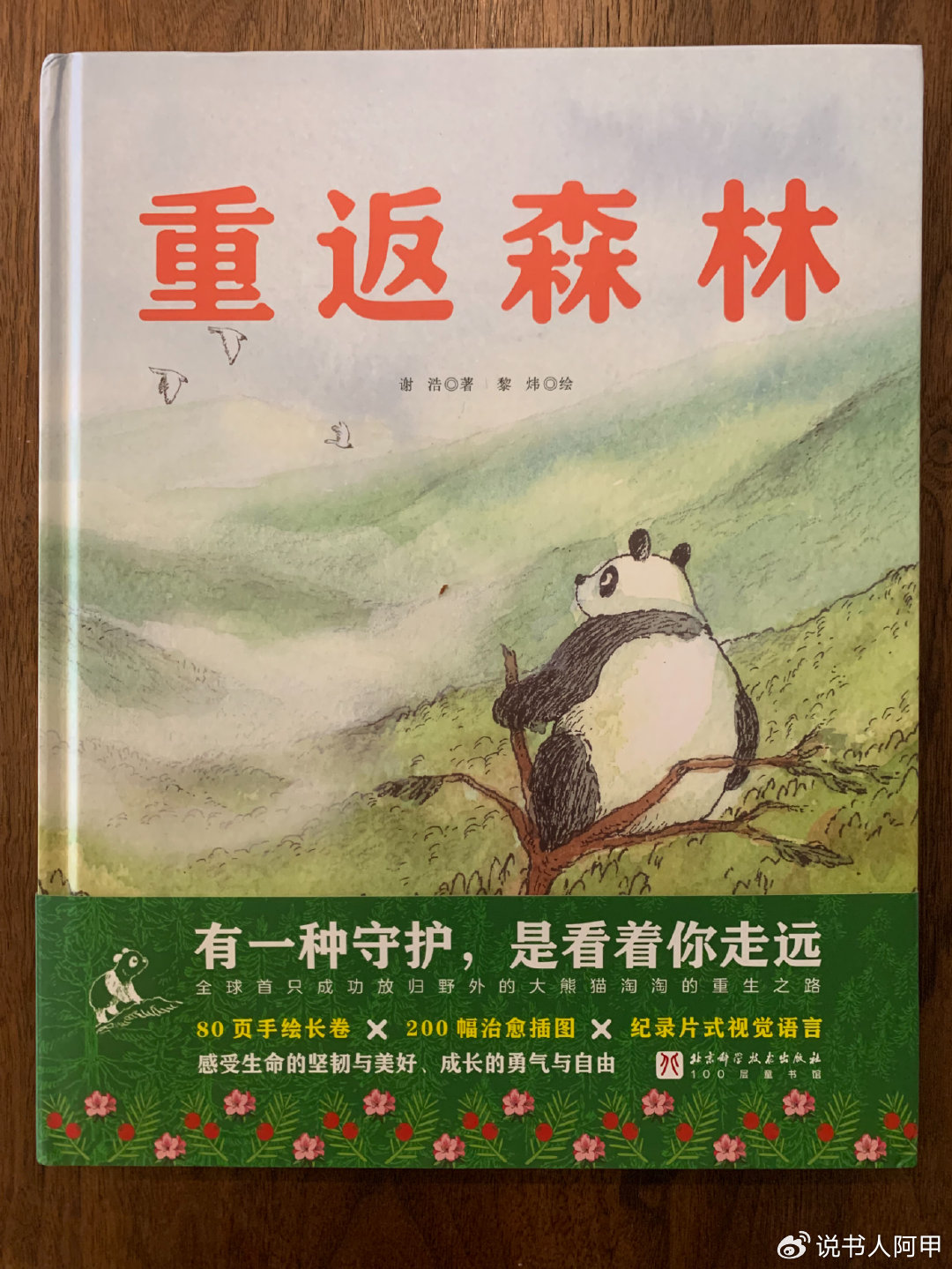
In recent years, with the strategic advancement of the giant panda conservation project from “ex-situ conservation” to “rewilding and release,” especially with the broadcast of CCTV’s documentary “The Wild ‘Tao Tao’ ” (and its sequel “Return to the Forest”), the growth and homecoming of “Tao Tao,” the world’s first giant panda born in a rewilding training base, has captivated countless viewers. The documentary’s depiction of researchers in specially made “panda suits” traversing the mountains and forests sparked widespread discussion and curiosity online. It is against this grand and exploratory scientific backdrop that the documentary graphic novel “Return to the Forest,” written by Xie Hao (one of the authors of “Tao Tao’s Diary”), a frontline researcher in giant panda conservation, and illustrated by cartoonist Li Wei, was born.
This lengthy 80-page illustrated narrative, including a table of contents and an afterword, breaks away from the common tropes of traditional animal picture books that “anthropomorphize” and “childishize.” Based on the real-life rewilding journey of the giant panda “Tao Tao” and her mother “Cao Cao,” it skillfully blends documentary data with poetic narrative, showcasing an experimental visual language and a profound emotional undertone. It poses a thought-provoking ecological philosophical question to readers: in order for wild animals to truly “become themselves,” humans must restrain their desire to intervene, take a step back, and even learn to be forgotten.
A fusion of documentary and poetic elements
The remarkable quality of *Return to the Forest* lies in its seamless integration of scientific archives and the epic story of a giant panda’s growth. The rewilding and release of giant pandas is a highly data-driven, monitoring-intensive, and logically rigorous system engineering project. Before “Tao Tao,” China had attempted the first generation of rewilded giant pandas, “Xiang Xiang,” primarily through “artificial assistance and independent training.” Xiang Xiang’s fate after release into the wild drew widespread attention. It is generally believed that his adaptability to the wild was insufficient, possibly related to a lack of maternal guidance and limited experience with complex environments and competition, ultimately leading to his unfortunate demise. This painful lesson prompted the Giant Panda Conservation and Research Center to shift to a new rewilding model represented by “Cao Cao” and “Tao Tao,” emphasizing “mother-led cub” care.
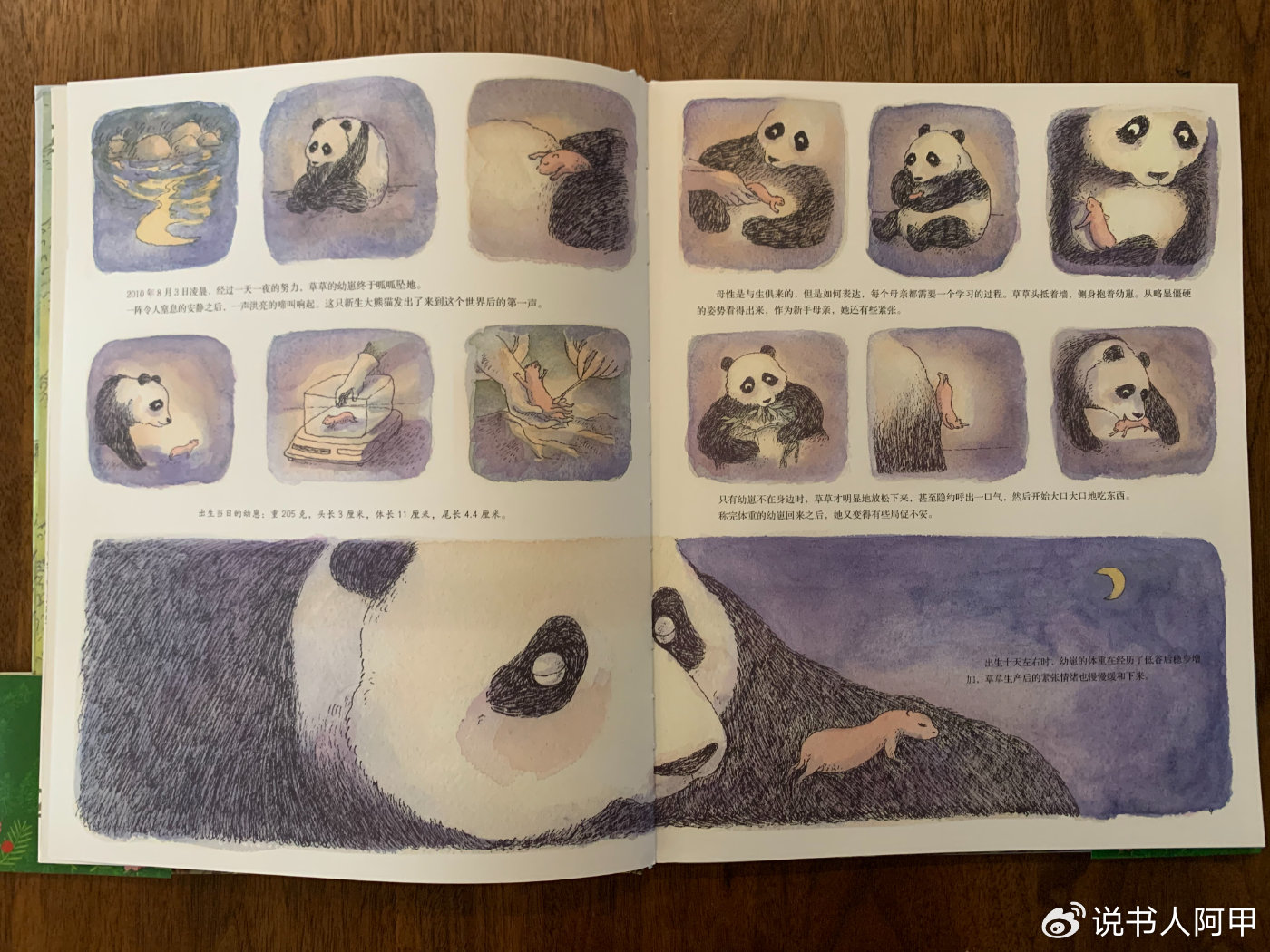
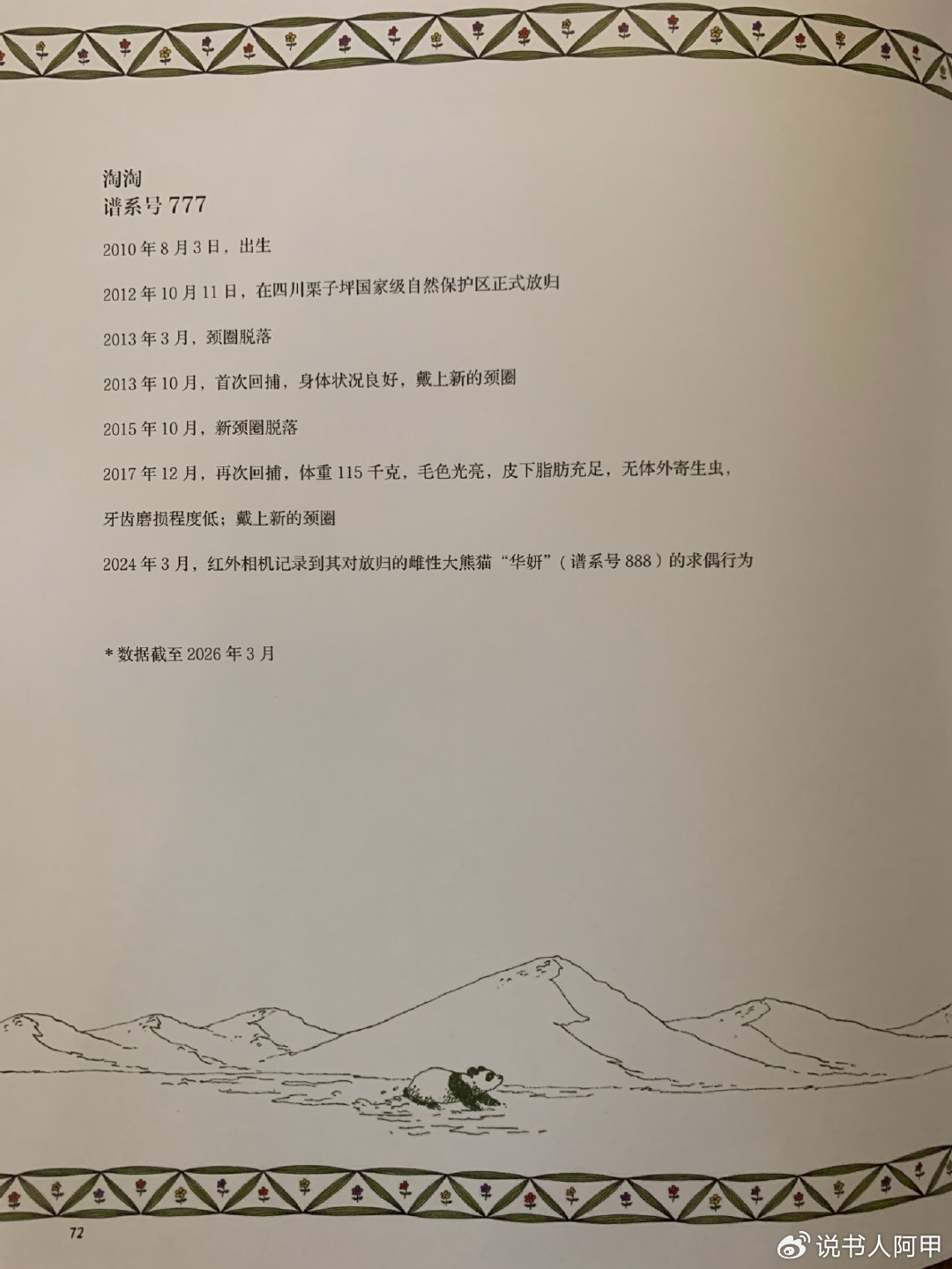
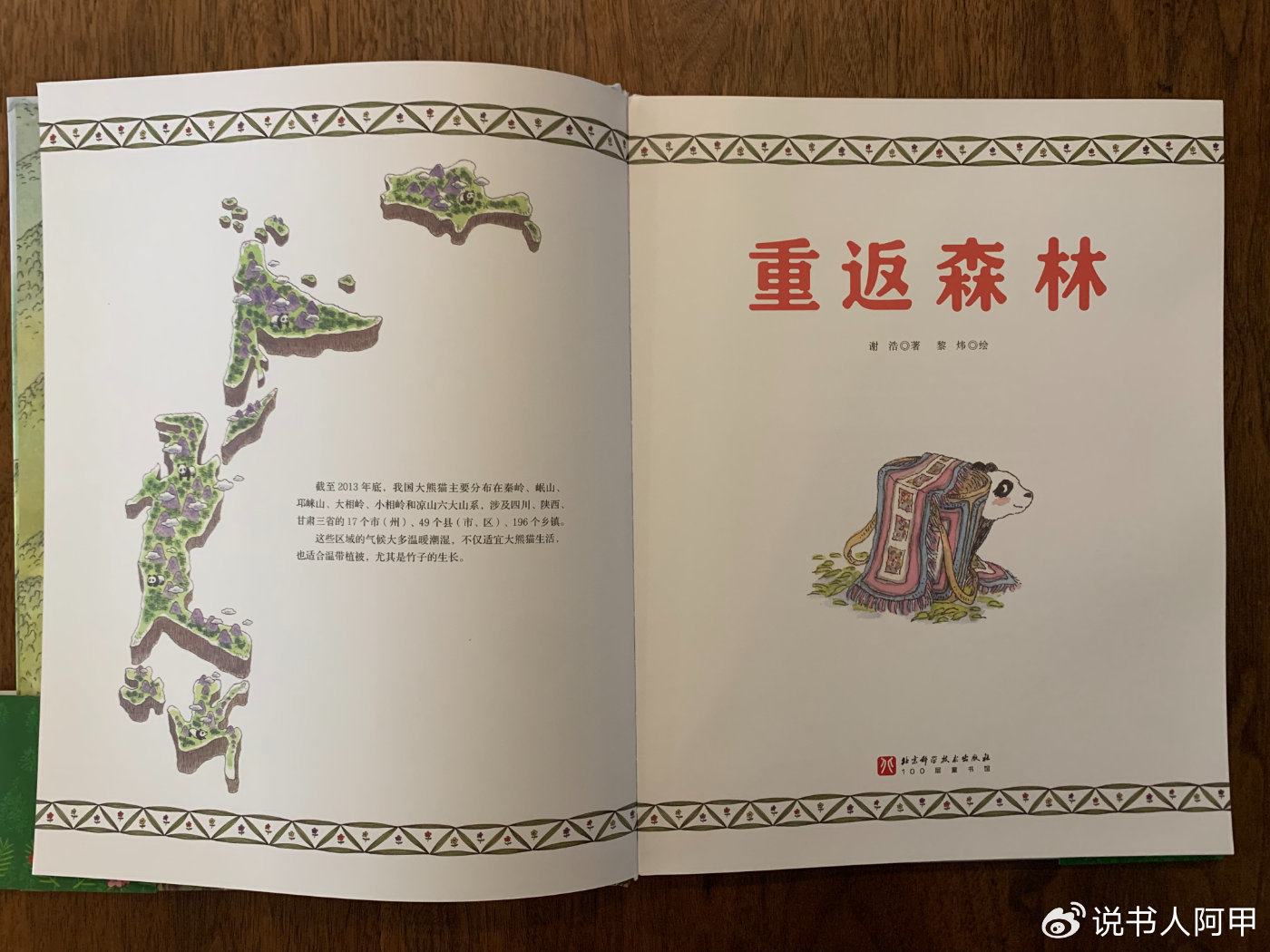
The work doesn’t shy away from these hard-core scientific backgrounds, but rather uses them as “time anchors” for its literary narrative. On the title page, the left side features a meticulously detailed map of the southwestern mountainous region of China and an explanation of its climate distribution, while the right side shows the red panda protagonist hiding behind a basket, establishing the tone of interwoven science and story from the very beginning. When recounting Tao Tao’s wilderness journey filled with unknown challenges, the text embeds precise physical data: at birth, it weighed only 205 grams and was 11 centimeters long; at two months old, it weighed 3350 grams; its pre-release physical examination showed it weighed 40 kilograms; and by the time it was recaptured in the wild at the end of 2017, it had grown into an adult male weighing 115 kilograms. These originally cold scientific records are transformed into milestones in Tao Tao’s life progression within the book.
Meanwhile, the text and images elevate the otherwise dry footage, reliant on 24-hour surveillance cameras, into a poetic tale of spiritual awakening. Real footage shows Tao Tao enduring torrential rain alone in the mud or seeking shelter in trees for extended periods (sometimes more than a day). In this book, these behavioral records become independent trials, each imbued with the spirit of a “hero’s journey.” Science ensures a solid framework for the story, while poetic narration gives it rich flesh and blood, allowing readers to truly feel the powerful vitality of wild animals building confidence amidst storms.
The real wilderness stripped of its “fairytale filter” through color experiments
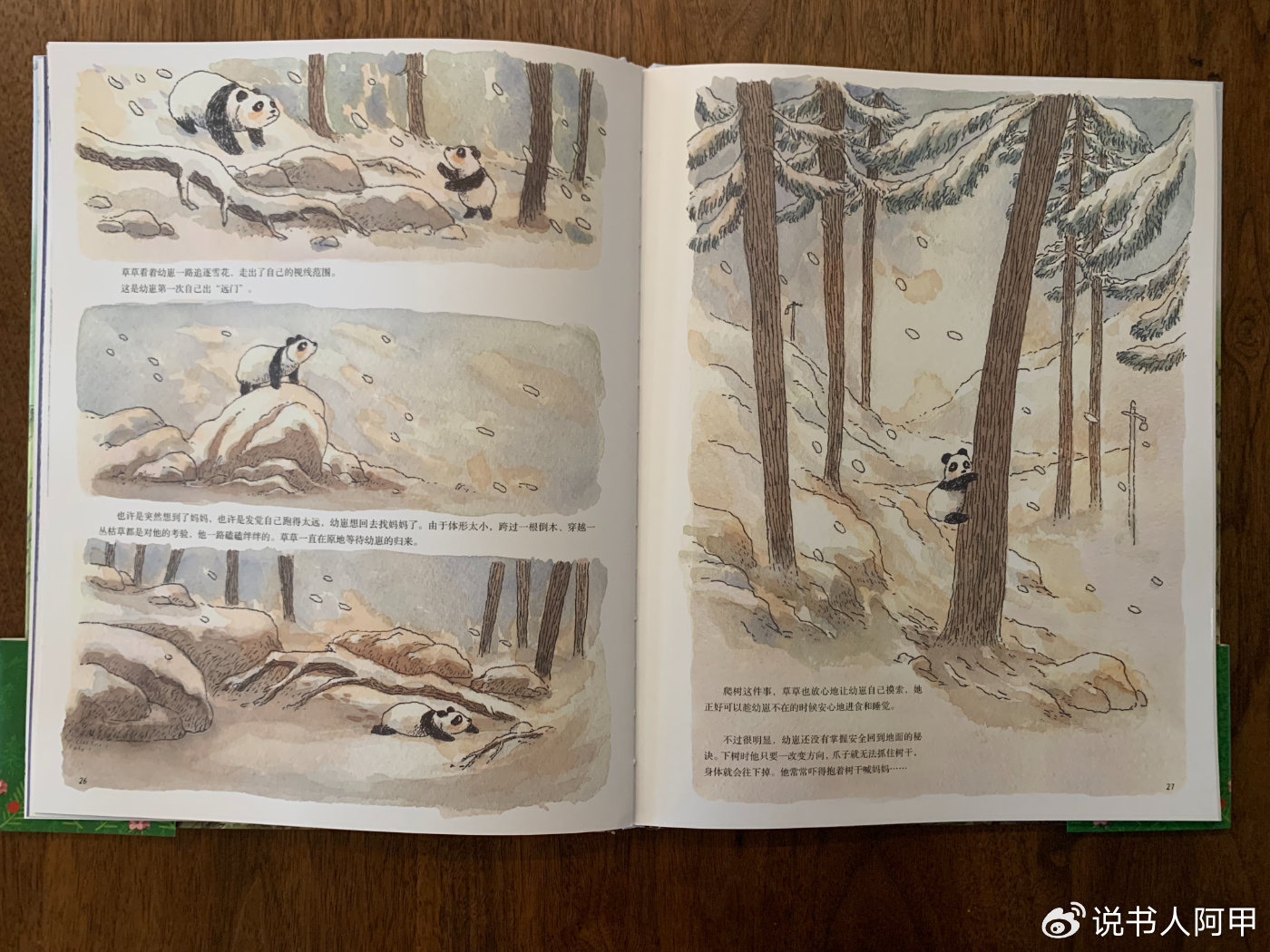
To highlight the authentic wilderness, *Return to the Forest* exhibits a highly experimental approach in its visual expression. The cartoonist abandons the conventional approach of romanticizing or childlikeizing the natural environment. Instead, he uses a combination of watercolor and line drawing to preserve the structural feel and the dampness of water stains, recreating the oppressive, complex terrain and soil texture of the Hengduan Mountains’ high mountains and deep valleys. This realistic treatment, which imbues the images with a touch of “discomfort,” declares to the reader that true nature is not a carefree paradise, but a testing ground where “survival of the fittest” is the ultimate test.
It’s worth mentioning that the book constructs an “ecological emotional system” that departs from the traditional black-and-white view, especially in its creative use of “purple.” Danger in the book is often represented by a purplish-blue hue, somewhere between warm and cool. When Tao Tao encounters a civet cat at night, or faces an unknown storm, the scene is shrouded in a layer of purplish-gray or purplish-blue light and shadow.
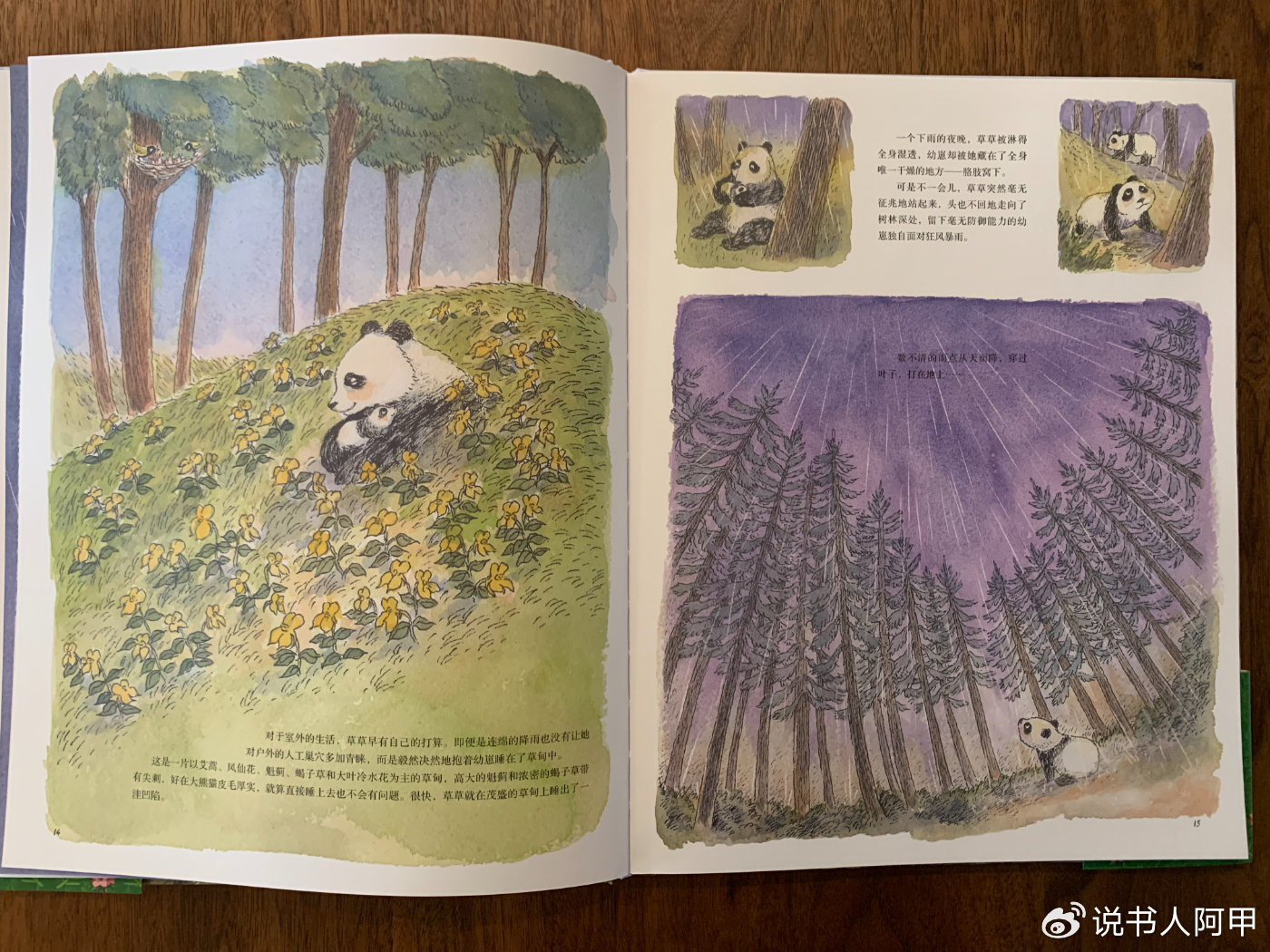
Here, purple doesn’t signify a fierce, substantial attack, but rather points to a “world yet to be understood” and “potential uncertainty.” It precisely captures the subtle psychological turning points in the growth of wild animals: when the world is no longer as absolutely safe as their mother’s embrace, the cubs must learn vigilance and judgment. As Tao Tao gradually adapts to the environment and takes control of its territory, the color palette transitions to a blue-green symbolizing “survival and vigilance,” and a bright, warm yellow-green representing “adaptation and integration.” This method of using color to depict psychological experience allows readers to attempt to measure the unknown wilderness from the animal’s subjective perspective.
““The Hidden Hand of Humanity””
Anyone who has followed the giant panda rewilding project or watched related documentaries will undoubtedly remember the researchers wearing black and white panda suits, sometimes even smeared with panda feces and urine. In public discussion, this is often seen as a form of exotic or slightly comical disguise, sometimes even sparking anthropomorphic jokes about whether pandas can actually see through humans. However, in the scientific community, this is a very serious matter of “dehumanization contact” and “imprint management.” Its core purpose is to ensure that cubs do not perceive humans as safe companions or food sources during their growth; otherwise, they would actively approach human settlements after release, facing significant danger and potentially unable to integrate into wild populations for reproduction.
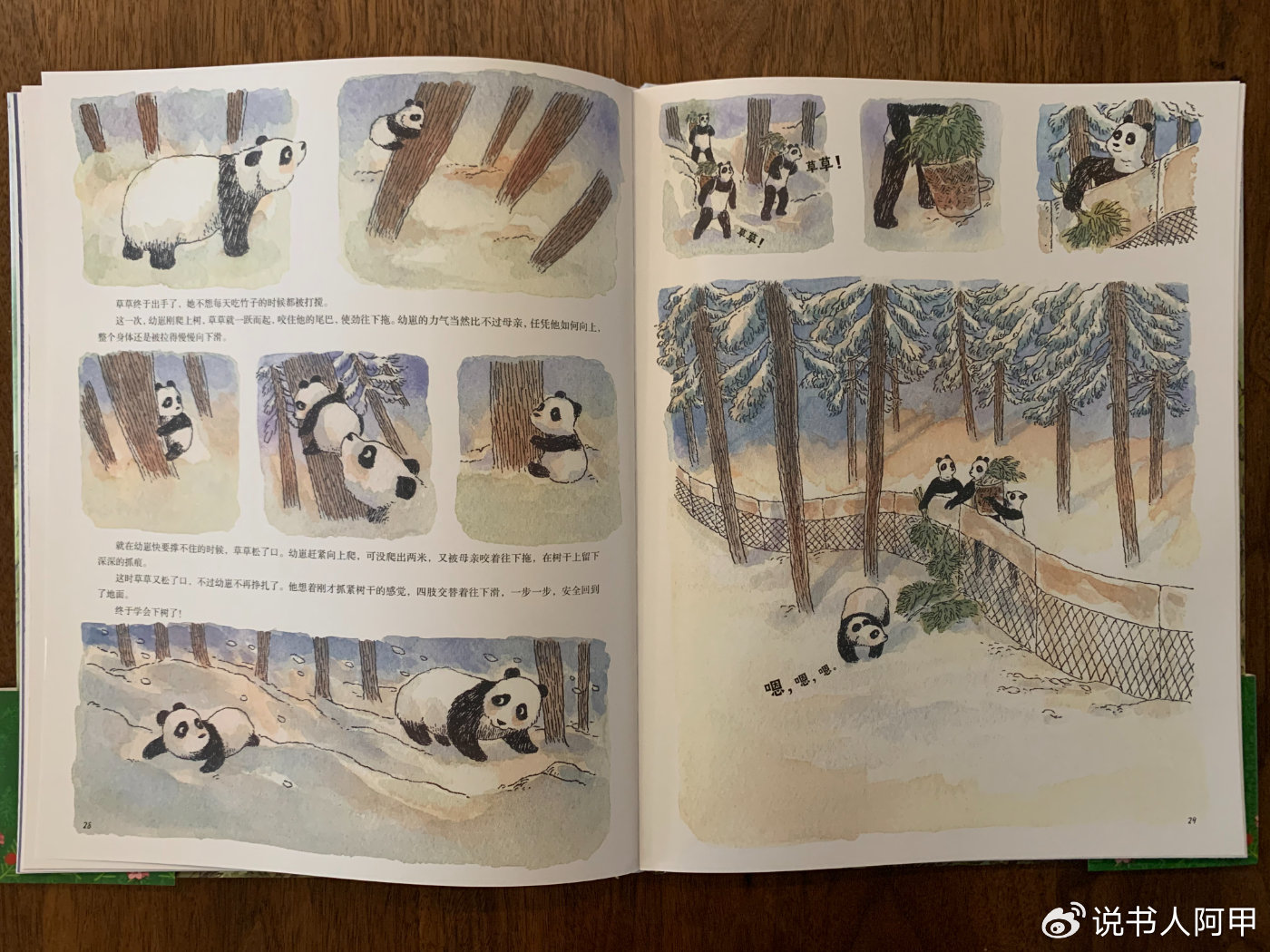
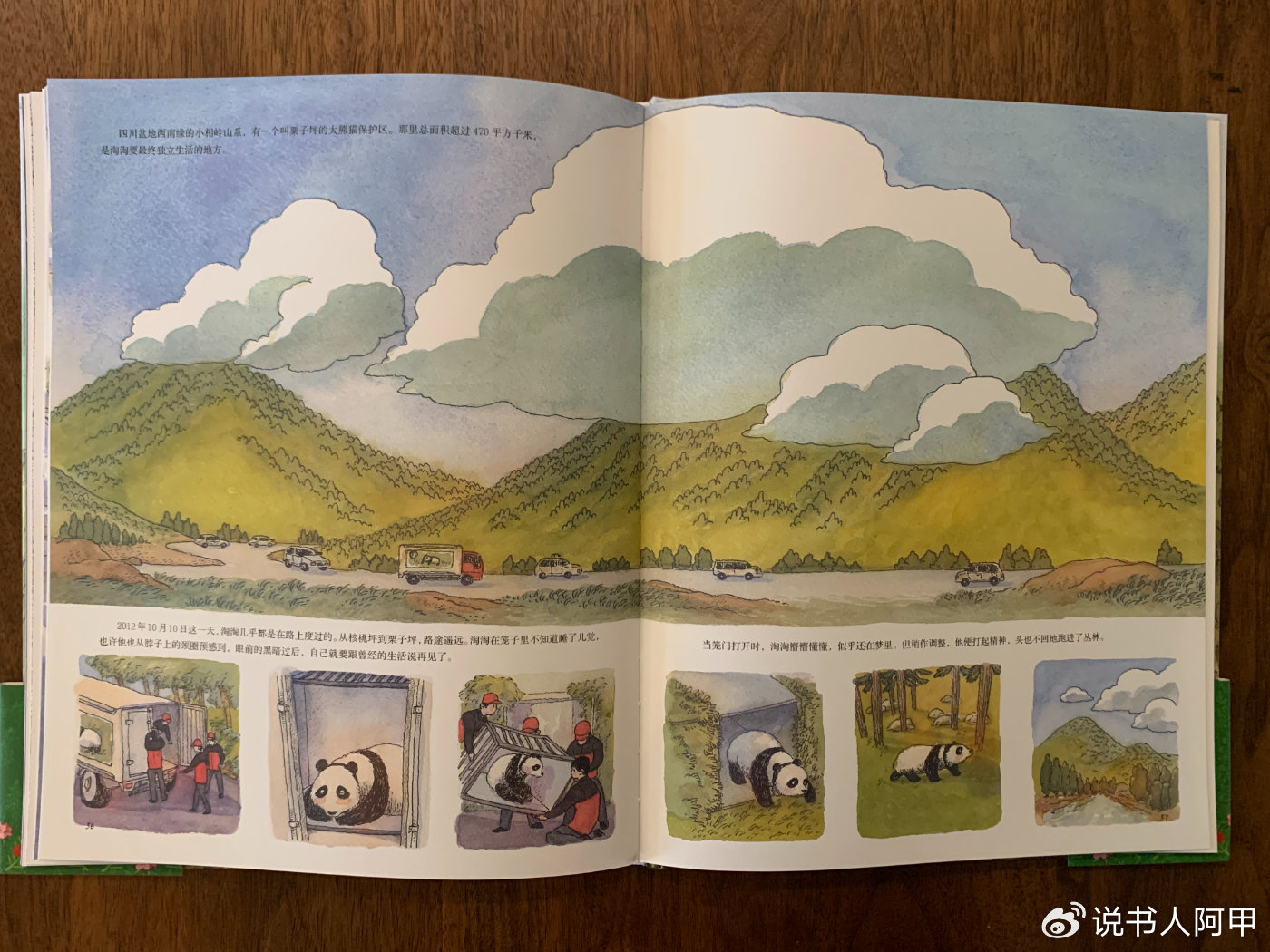
In this book, the illustrator presents a philosophically significant three-layered visual transformation of this “hidden human hand”: The first layer is “disguise”: In the early stages of the story, the staff feeding or checking the pandas are depicted as upright-walking “pandas,” even possessing a slightly anthropomorphic, fairytale-like quality. This perfectly aligns with the cub’s cognitive perspective—in its eyes, the world consists only of its own kind, not humans. This softens the harshness of human intervention while preserving the tangible traces of ecological restoration. The second layer is “alienation”: When large-scale habitat relocation or medical examinations are necessary, the true faces of humans finally appear. However, they are placed with extreme restraint at the top of the picture or in scenes after Tao Tao is anesthetized. The humans lack facial details and have no interaction with the pandas in their natural natural space. This suggests the existence of humans as ecological managers, but they have voluntarily relinquished the center of the narrative stage. The waving goodbye to Tao Tao is full of symbolism. The third layer is “erasure”: In the final release phase of the story, humans completely disappear from the picture, and pure wildness once again takes over the world.
This gradual imagery strategy responds to a supreme principle of ecological conservation: the purpose of human intervention in the process of animal rewilding is so that humans can one day completely withdraw from it. “In order for animals to become themselves, humans must not be seen”—this two-year-long systemic retreat is a painful process of self-mortification undertaken by humans in order to repair the ecological network they have damaged.
Breaking through the anthropocentric view of life
The book’s subtitle is “Tao Tao the Giant Panda’s Journey Home,” but this work completely overturns humanity’s inherent understanding of “home.” In anthropocentric narratives, “home” is often a fixed haven, a shelter from the wind and rain. However, for wild giant pandas, entering the wild is never about being transferred to a specific scenic spot, but rather “changing their way of being.”
The book clearly states that during the months of Tao Tao’s wilderness training, he moved to six or seven different places with his mother: “Life in the wild is never stable; migration can happen at any time.” A real home is full of uncertainty. Tao Tao had to learn to find dry shelter in torrential rain, quickly climb trees dozens of meters high when he heard the simulated call of a fake leopard, and learn to identify terrain and water systems in the unfamiliar Tiantai Mountain and Liziping.
As the story nears its end, when the grand, double-page spread offering a bird’s-eye view of the mountains and forests appears, “Tao Tao,” the absolute protagonist, sheds his heroic aura, shrinking and dissolving into the boundless green forest. He is no longer a “national treasure” imbued with special significance, but rather an ordinary node in the complex ecological network of the Hengduan Mountains. The subsequent appendix provides detailed illustrations of accompanying flora and fauna such as the tufted deer and the yellow-throated marten. This expansive perspective reveals to us that the giant panda is merely an equal participant in a vast food chain. Returning to the forest is not about conquering the wilderness, but about relinquishing one’s individual destiny to the vast land, to the cruel yet fair laws of nature.
Learn to let go and be “forgotten”.“
This is a moving documentary graphic novel, which, due to its emotional undertones, is a rather unconventional and restrained “tragedy”—the true price of rewilding is letting go.
This “growing pain” is first manifested from the mother’s perspective, “Cao Cao.” In the first half of the story, the mother and child’s bodies fill the intimate visual space, conveying a strong sense of security. However, as the rewilding process deepens, Cao Cao’s spatial position gradually shifts, transforming from a “close protector” to a “distant observer.” When Tao Tao is learning to climb a tree and is about to slip, the scene freezes on the moment when Cao Cao not only doesn’t immediately rescue him but actually “let go.” This behavioral restraint metaphorically represents the departure of nature’s greatest yet cruelest maternal role—true growth means no longer being held.
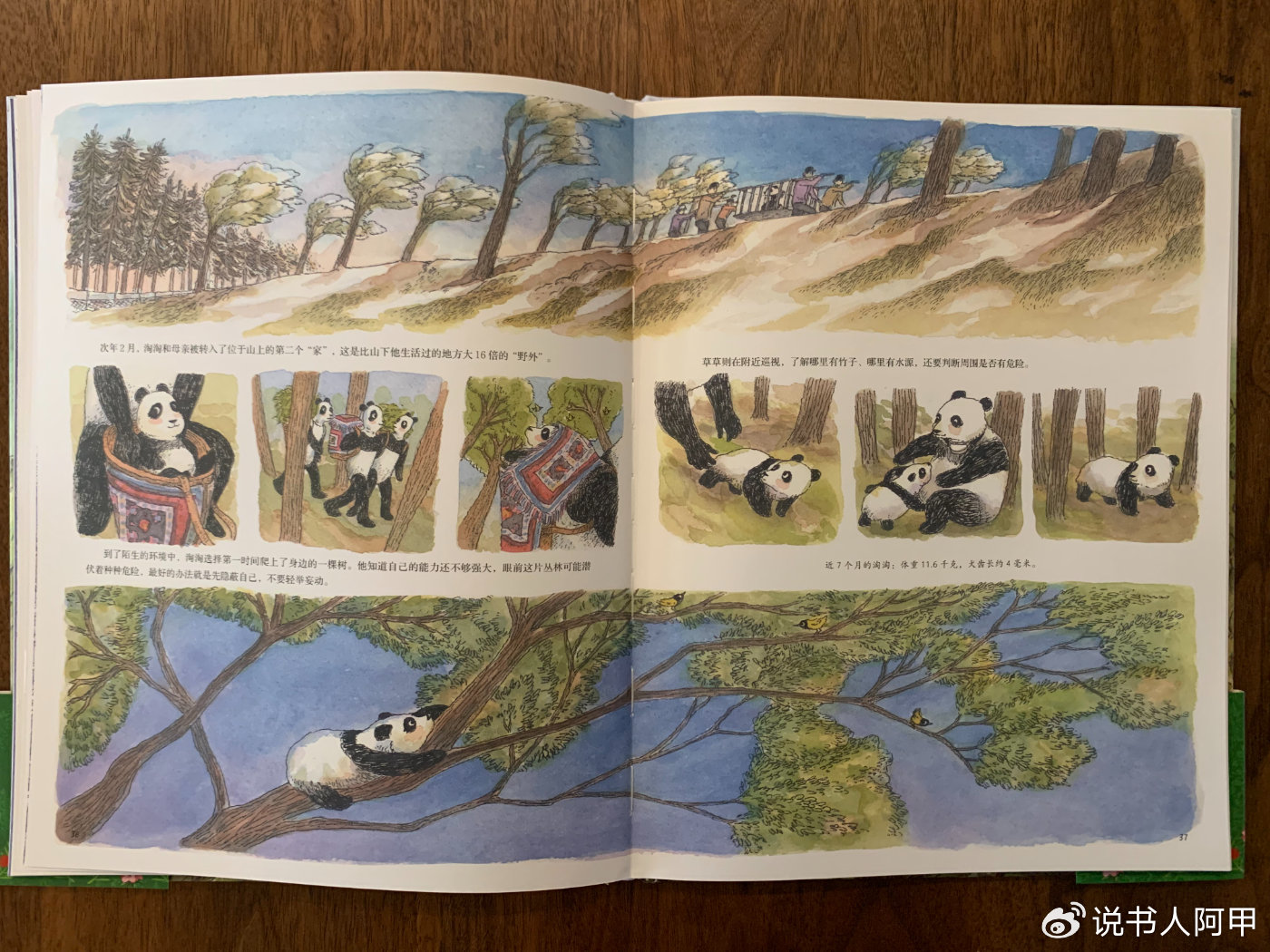
From the perspective of giant panda protectors and frontline researchers like Xie Hao, the author of this book, this emotional turmoil is even more moving. The documentary showed keepers hiding in the shadows, watching the newborn panda Tao Tao struggle in the mud and torrential rain, their hearts filled with unbearable pain yet forced to desperately suppress the urge to intervene. They poured countless efforts into raising it from a mere 205-gram pink ball of fur into a strong wild animal, but their ultimate love was to sever all ties and send it into the vast, uncharted mountains, fraught with unknown risks.
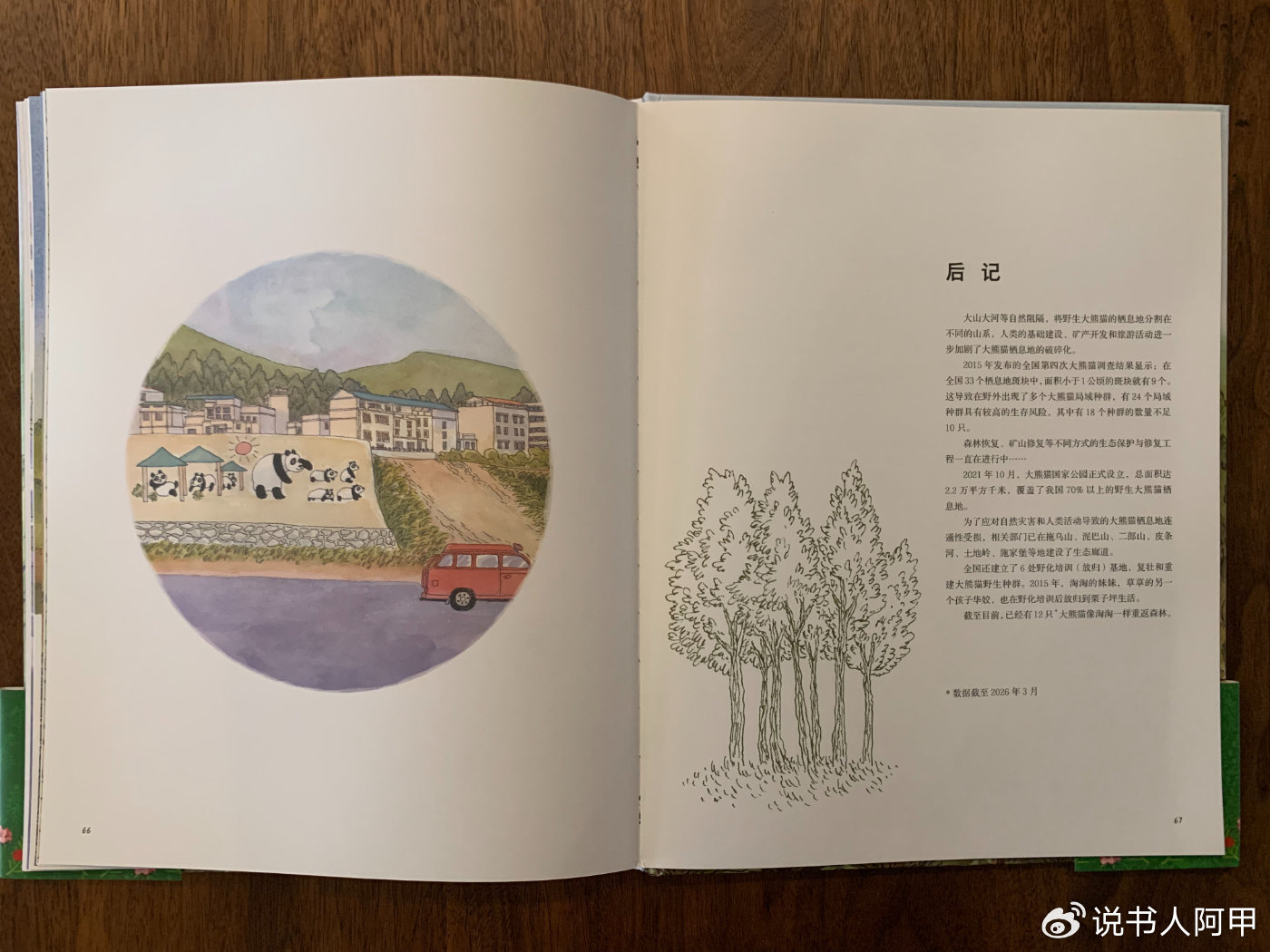
At the end of the book, after listing a series of calm, rational, and hard-hitting science reports on habitat fragmentation and alarming population decline, the researchers finally couldn’t help but reveal a profound sense of compassion. Looking deep into the mountains, they uttered poignant confessions unique to humankind: “If only it were him,” “No, he wouldn’t remember me…” These soliloquies make us realize that researchers have silently swallowed enormous ethical sacrifices and the pain of separation in their efforts to repair ecological fractures. Humanity has poured out all its energy and exhausted the youth of generations, yet its ultimate desire is simply to “completely disappear” from the lives of the animals it so deeply loves.
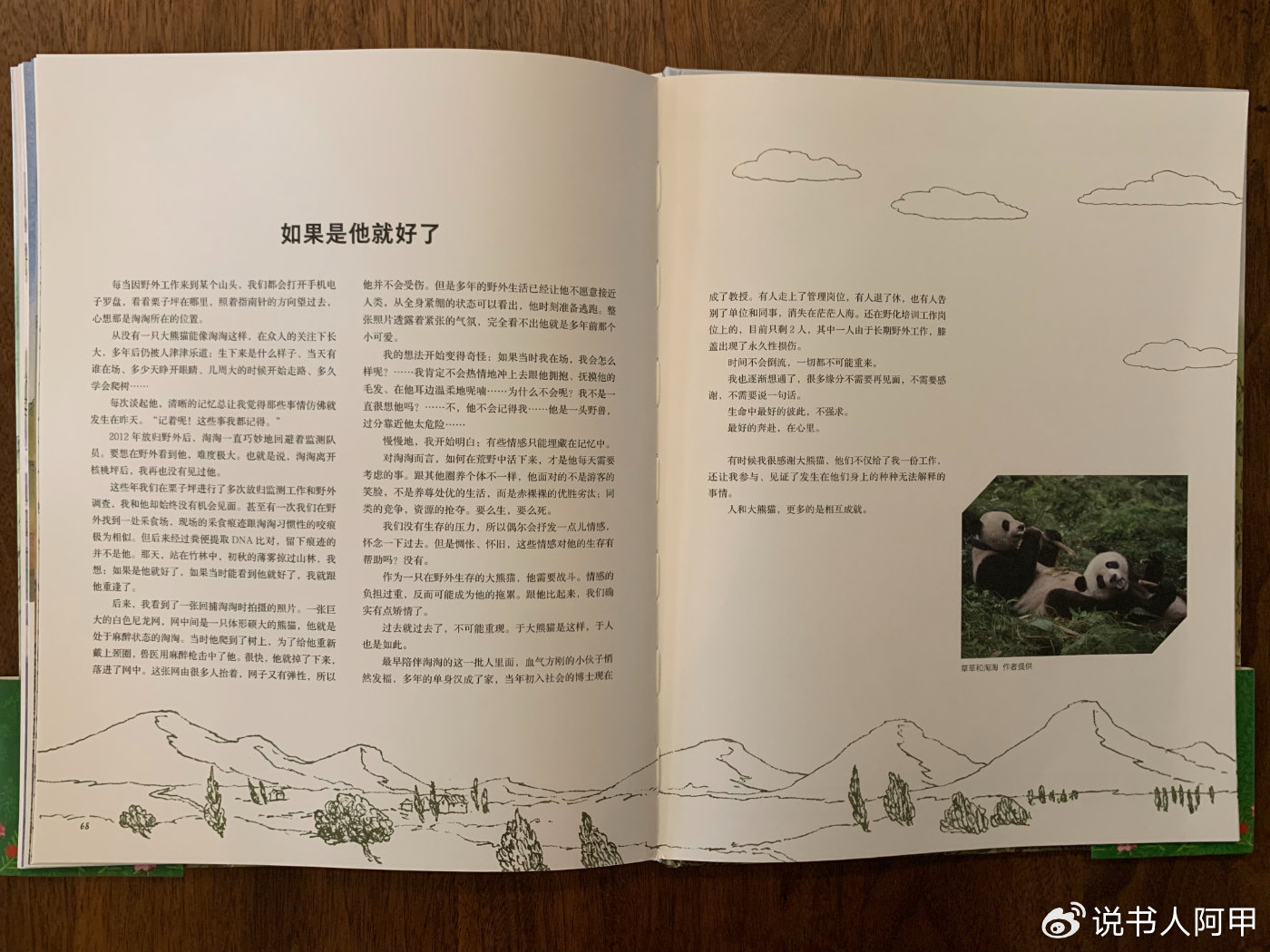
“Return to the Forest” makes a valuable exploration in the creation of science-themed graphic novels. Through the ingenious fusion of scientific documentary and groundbreaking visual expression, it elevates a book suitable for sharing with relatively young readers to the level of ecological ethics and philosophy of life. It guides humanity to respect the wilderness with an equal gaze and to view intervention with restraint.
This also offers profound insights into human growth and education. True affection is never about imprisoning wild creatures for mere observation, but rather about granting them the right to struggle in the wind and rain, and silently watching them roam freely from afar.
Even after that, they never remembered us again…
Written by A‑Jia on March 24, 2026 in Beijing