


🎂 1924 – Born: Charles Keeping
A renowned British children’s picture book author, illustrator, and lithographer (1924–1988). He was one of the central figures of the 20th-century British visual expressionist revolution in picture books, alongside Brian Willsmith and John Burningham. He pioneered the introduction of complex lithography techniques, modernist geometric abstraction, distorted and powerful lines, and deep, even somewhat Gothic, urban psychological lighting into children’s books, thoroughly expanding the breadth and seriousness of children’s visual art.
- World-class awards and representative works:
- Twice awarded the Kate Greenaway Medal (CIL): In 1967, he starred in “Charlie, Charlotte and the Canary” (Charley, Charlotte and the Golden CanaryHe won his first award in 1981 for his work on Alfred Noyce’s classic narrative poem, *Highway Robbers*.The HighwaymanHis black-and-white horror illustrations have once again won the Greenaway Medal.
- Two Grand Prizes at the Bratislava International Biennial of Illustration (BIB): In 1973, with “Spider Web” (The Spider’s Web) BIB Honors and AwardsIn 1975, he won the award for his self-written and self-painted masterpiece, “Railway Passage” (Railway Passage) Victory BIB Golden Apple Award.
- They were awarded in 1974. Highly Commended by the Hans Christian Andersen Award (HCAA) for Best Artist.
- Joseph’s Yard (Joseph’s Yard(1969) — A philosophical allegory masterpiece written and illustrated by Kai Ping: A young boy named Joseph plants a small rose in the muddy ground of a cramped and desolate city courtyard. To possess its beauty, Joseph first picks the first flower, causing it to wither. Then, to “protect” it, he covers the flower with a piece of black tin, nearly killing it. Through the seasons and the nesting of birds, Joseph finally understands the true meaning of letting go and respecting the natural growth of life.
- He wrote the classic historical novel *The Red-Clad Warriors* by Rosemary Sutcliff.Warrior Scarlet), The Knight’s Reward (Knight’s FeeHe created ink line illustrations with a strong sense of primal, wild power, and also produced stunning and timeless woodblock print illustrations for the complete works of Dickens.
| Birth | Charles Keeping | Charles Keeping (Wikipedia) |


🎂 1908 – Born: Esphyr Slobodkina
A renowned Russian-American artist, children’s book author, illustrator, and sculptor (1908–2002). Born in Chelyabinsk, Russia, she immigrated to the United States early in her life and became one of the co-founders of the American Abstract Artists. She pioneered the integration of pure modern hard-edge abstraction with minimalist paper-cutting collage into children’s picture books, creating works characterized by pure colors, a strong sense of form, and a whimsical sense of humor.
- Representative works and content passed down through generations:
- Selling Hats (Caps for Sale: A Tale of a Peddler, Some Monkeys and Their Monkey Business(1940) — Selected for “1001 Children’s Books,” this book has been a global bestseller for over eighty years and is considered essential reading for early childhood reading and children’s drama in the United States. The story tells of an unusual hat vendor who walks the streets with all his hats stacked on top of his head—first his own plaid hat, then a stack of gray hats, a stack of brown hats, a stack of blue hats, and finally a stack of red hats on top. One day, he wakes up from a nap under a tree to find that all his hats, except for his plaid hat, have been stolen and worn by monkeys in the tree. The vendor angrily stomps his feet, punches his fists, and roars, but the monkeys in the tree simply mimic his actions. Finally, in despair, the vendor slams his plaid hat to the ground, and the monkeys also take off their hats and throw them to the ground, allowing the vendor to successfully retrieve all his hats. The book, with its lighthearted mimicry and dramatic tension, has become a humorous landmark in picture book history.
| Birth | Esphyr Slobodkina | Esphyr Slobodkina (Wikipedia) |

🎂 1929 – Born: Ann Grifalconi
A renowned American children’s book illustrator, author, and visual anthropologist (1929–2020). Her works combine a profound cross-cultural perspective with keen field observation skills. She was adept at using gouache, colored crayons, and collages with rich textures and light and shadow to showcase the living wisdom and community civilization of traditional villages in Africa, Latin America, and other parts of the world.
- Top Award and Representative Works:
- The Village of Square and Round Houses (The Village of Round and Square Houses(1986) — Award 1987 Caldecott HonorThe story is based on the remote village of Tos, nestled at the foot of an ancient volcano in Cameroon, West Africa. In this village, men live in square houses, and women in round ones. Through her grandmother’s narration, the little girl learns that this tradition stems from the ancient wisdom of her ancestors, developed after a volcanic eruption, to avoid conflict and harmoniously rebuild their homes amidst the ruins. Grefaconi vividly portrays the vitality of the African plains and the warmth of intergenerational community life with deep, sunny orange and earthy brown pastel colors.
- His representative works also include Lucille Clifton’s famous poem, “The Farewell of Everett Anderson” (Everett Anderson’s GoodbyeA heartwarming black and white illustration drawn by [author’s name].
| Birth | Ann Grifalconi | Ann Grifalconi (Wikipedia) |

🎂 Born 1939: Ruth Hürlimann
A renowned Swiss children’s picture book illustrator and author (1939). A graduate of the Zurich Academy of Fine Arts, she was a leading figure in the European neoclassical picture book style of the 1970s. Her style is elegant and dignified, and she excels at using highly layered and meticulous hatching, rich and stable retro watercolor tones, and dramatically tranquil frame compositions to breathe modern life into ancient folk fables.
- Twice awarded the Plaque at the Bratislava International Biennial of Illustrations (BIB):
- City Rats and Country Rats (Stadtmaus und Landmaus(1970) — Awarded Plaque Award, 1971 Bratislava International Biennial of Illustrations (BIB)This book retells Aesop’s classic fables, contrasting the tranquility and ease of country mice with the fear and anxiety of wealthy city mice under the shadow of luxurious cheese and vicious hunting dogs from a delicate and warm microscopic perspective.
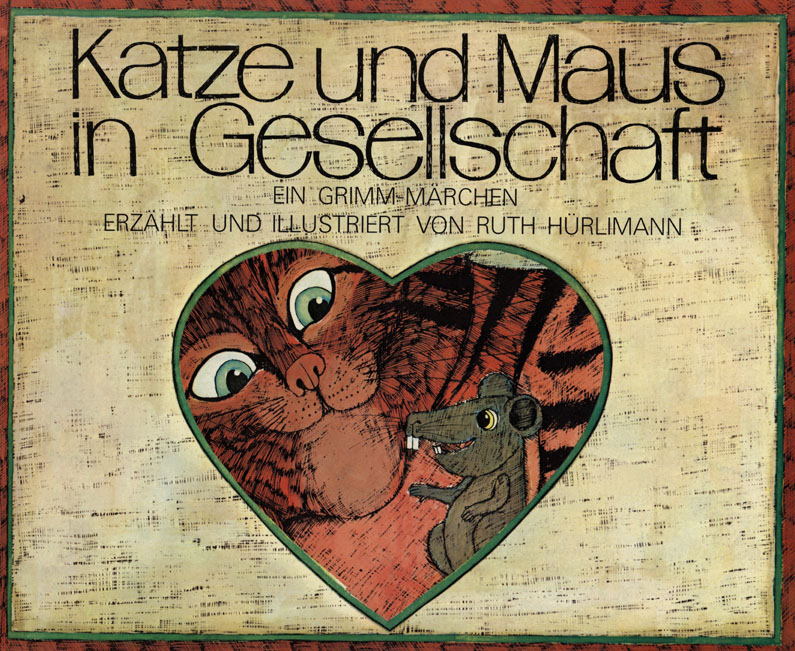
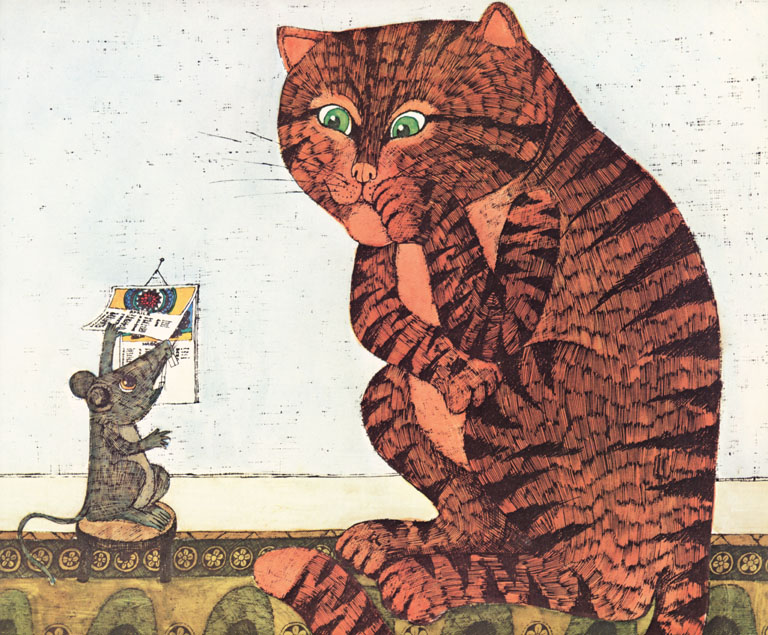
- “Tom and Jerry Become Friends” (Katze und Maus in Gesellschaft(1973) — Awarded Plaque Award, 1975 Bratislava International Biennial of Illustrations (BIB)Swiss Children’s Book Award: Adapted from the classic Grimm’s Fairy Tales. The cat and mouse buy a jar of lard and hide it under the church floor to prepare for winter. The cunning cat repeatedly lies about attending baptisms, secretly eating the lard—“scratching off a layer,” “eating half,” until it’s “completely devoured,” ultimately revealing its ferocious beastly nature. Schürrleman, with his calm, objective, and suspenseful visual rhythm, presents the realistic survival rules of folk tales.
| Birth | Ruth Hürlimann | Ruth Hürlimann (Sikart) |

• 2024: Malcolm Donaldson, husband of British children’s author Julia Donaldson, dies. Although not directly involved in the writing of Donaldson’s books, he supported her career as a pediatrician. His masterpieces, such as The Gruffalo, are beloved by children worldwide.The Donaldsons visited China together in March 2007 and told stories to children in libraries and bookstores in Beijing., Malcolm played guitar and Julia sang the story of the Gruffalo. This pediatrician who also had great achievements in the medical field and specialized in endocrinology,He is often called “Dr. Gruffalo” by his young patients.(Dr. Gruffalo).
