Last time, we talked about the artist who is known as the “master of wordless books”. His picture book “Hurricane” has a lot of text and is actually semi-autobiographical, presenting the standard of “perfect childhood”.Today, let’s read together David Wiesner’s masterpiece, “Tuesday,” which is almost a “wordless book.”
When we say this book is “almost wordless,” we mean there are only a few words left. How many? Let’s quickly flip through it. Let’s say the page with the picture is page 1, the copyright page is page 2, and the title page is page 3. Turning to page 4, there’s text: “Tuesday evening, almost 8 pm.” Moving through three folios, we reach page 12, which says “11:21 pm.” Then, skipping three more folios, we reach page 20, which says “4:38 am.” Then, after four more folios, we reach page 30, which says “Next Tuesday evening, 7:58 pm.” Turning to the next page, the story ends with a picture on page 32. Now let’s look at the text together:
Tuesday evening, around 8 pm
11:21 PM
4:38 AM
Next Tuesday at 7:58 PM
You see, it’s only 29 words in total, including numbers, without punctuation, just recording time, so it’s not storytelling at all. What kind of text is it then? Imagine this: if this were a movie, wouldn’t this text sound like narration? “Tuesday night, almost 8 pm,” tick-tock, tick-tock, tick-tock… time continues, the story unfolds… then a scene plays out, and the narration comes again, “11:21 pm,” tick-tock, tick-tock, tick-tock… the story gradually builds to its climax. You think, it’s almost midnight, a full moon night, in a remote town, shouldn’t something mysterious happen? —Yes, *Tuesday* tells such a mysterious story. The whole book is presented in a movie-like format; the text in the movie is like narration, in the book it’s like chapter titles. So this almost wordless book is roughly divided into four chapters, plus the prologue, making it five parts.
Okay, now I’ll try to describe these five parts. Please note that there are no standard answers in a wordless book; everyone may see different things. So here, I’m just providing a simplified version by A‑Jia, as a starting point for discussion.
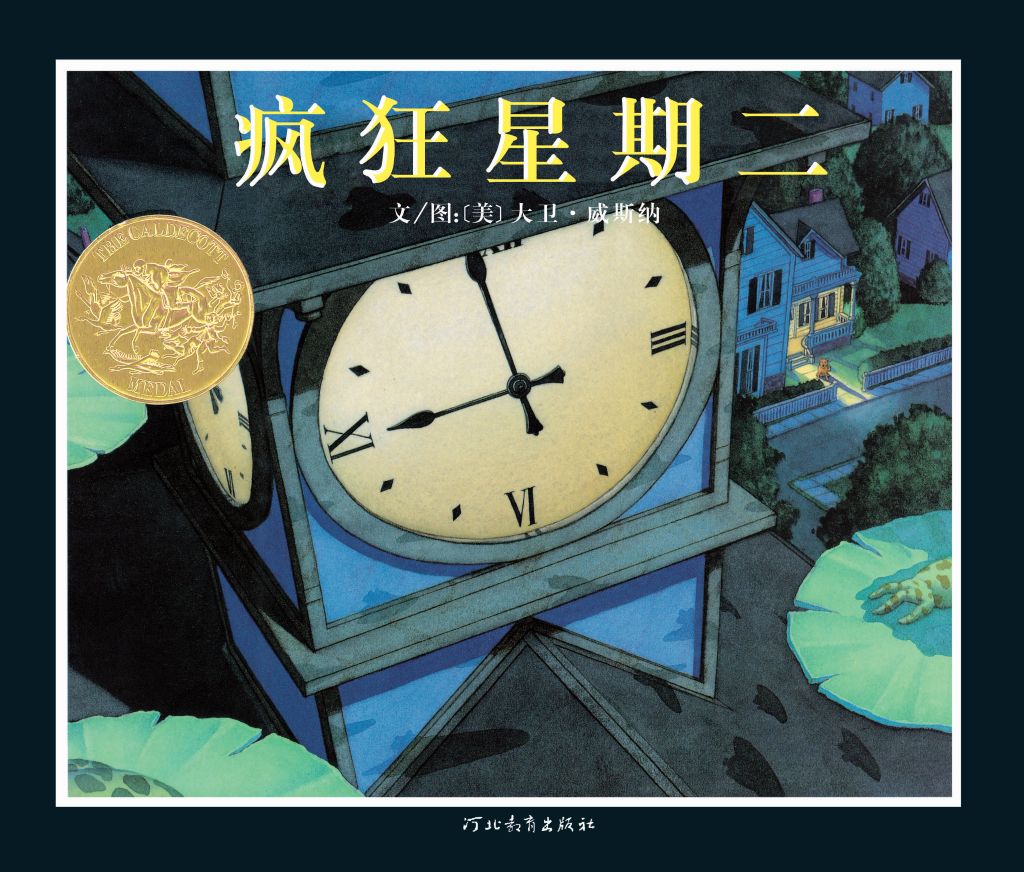
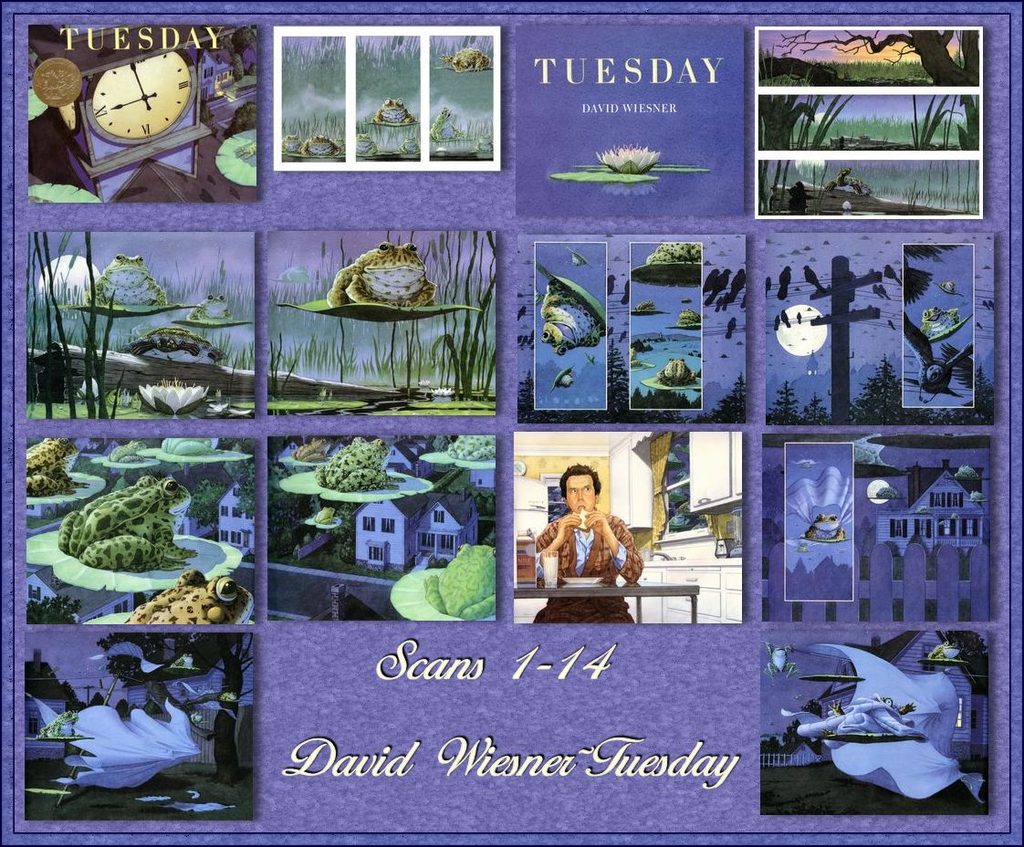
Let’s start with the first part. This part begins with the cover. The most striking element on the cover is the clock tower, its hands pointing towards almost 9 o’clock, indicating it’s 9 PM. In the foreground are large lotus leaves, through which you can see a small part of a frog. Strangely, the frog is on the lotus leaf, while the leaf itself seems to be suspended in mid-air. In the distance, a house is lit up, and a large brown dog lies at the doorway, looking up warily…
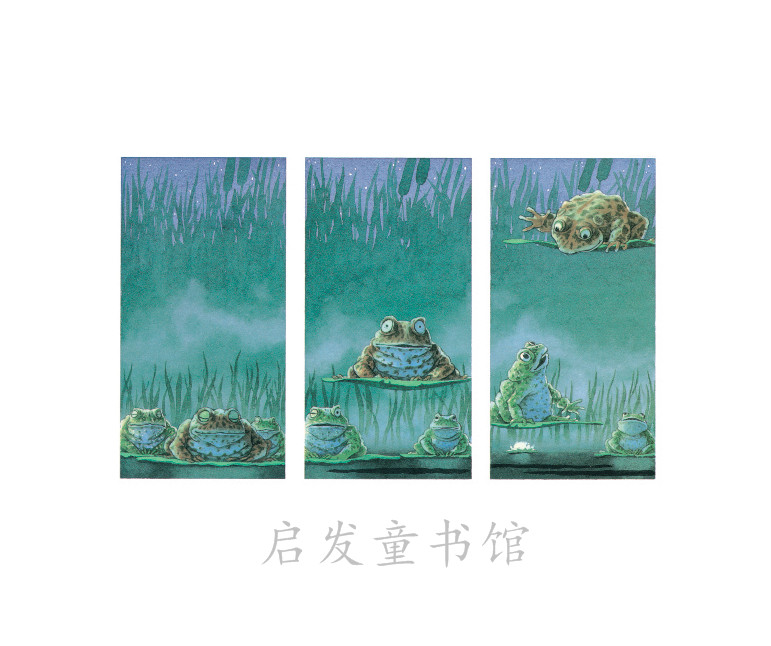
Turning to the next page reveals a prelude to the copyright page. The image is vertically divided into three long sections, which are actually three consecutive shots. First, three frogs are resting on lotus leaves with their eyes closed. These lotus leaves are close to the water’s surface, so they are not lotus leaves but water lily leaves. Then, in the second shot, the lotus leaf on which the dark-colored frog was resting suddenly rises into the air, and all three frogs open their eyes in surprise. In the third shot, the dark-colored frog rises higher and higher, and the green frog also begins to rise. The two frogs, one high and one low, seem to be communicating, perhaps saying, “How strange,” or “What’s going on?” In reality, there is a third frog that hasn’t risen yet, curiously observing from the sidelines.
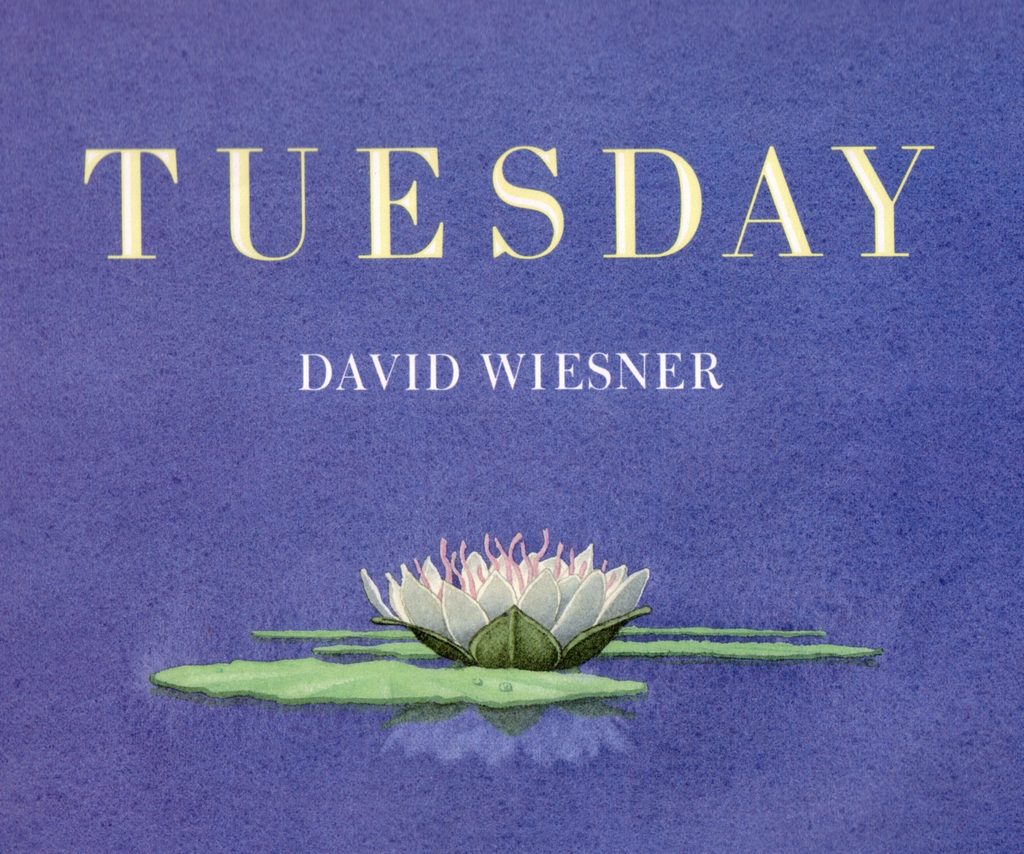
The greatest pleasure of reading such a wordless book lies in discovering the details within the illustrations and then conjuring up your own story in your mind. Turning to the title page, the scene suddenly becomes incredibly quiet: a still blue surface of water, a blooming water lily in the center, a few lotus leaves beside it, and the lotus’s reflection in the water. This tranquil scene, compared to the three long, dynamic images just moments before, creates a stark contrast; the quieter it is here, the more you feel something significant is about to happen!
The first part, from the cover to the prologue and then to the title page, contains only a few illustrations, but already boasts many noteworthy details. Here, I mainly introduce the perspective and methods for interpreting these illustrations; it’s impossible to cover all the details. The later parts are far too numerous to list; I can only provide a general outline. To truly enjoy this book, you must examine it carefully yourself.
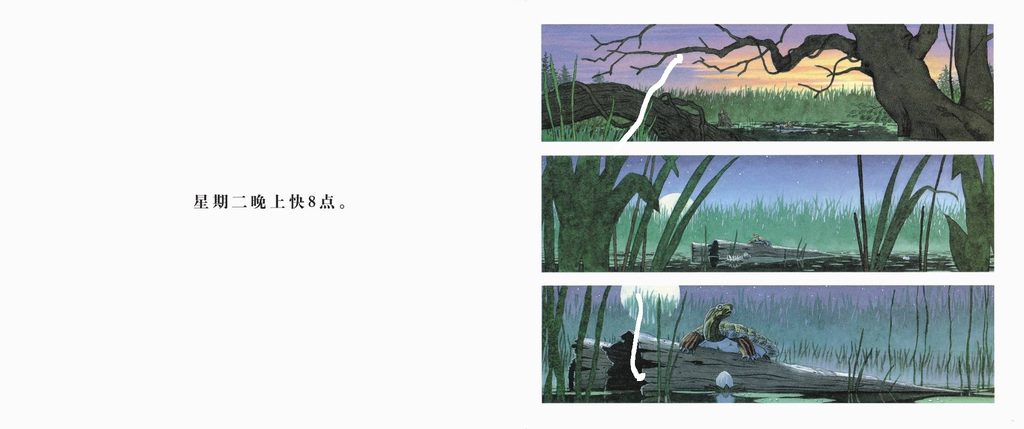
Okay, let’s move on to the second part, “Tuesday night, almost 8 o’clock.” This part uses four double pages. The first double page only has an image on the right page. It is three long horizontal blocks, which are also three consecutive images. The camera gradually zooms in from a distance, from sunset to moonrise. A turtle lying on a piece of driftwood suddenly raises its head, and you feel that something strange is about to happen.
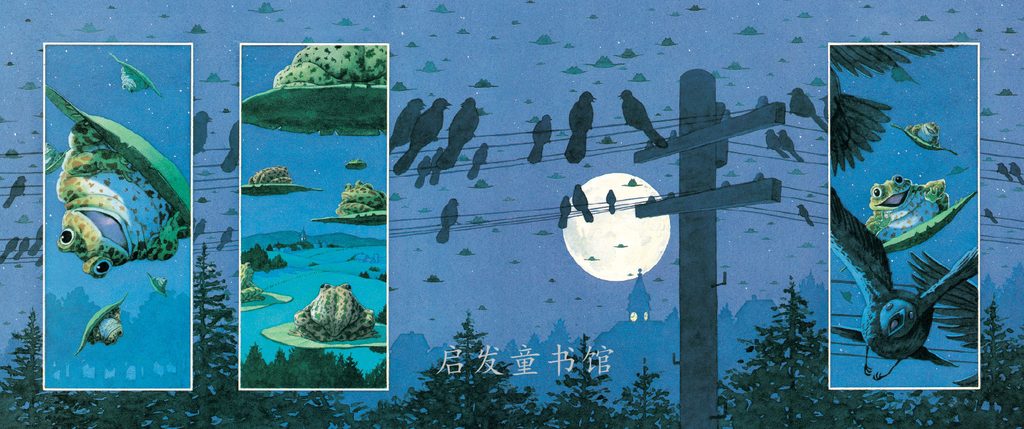
The next three double-page spreads depict the frogs flying from the pond all the way to the town. The turtle mentioned earlier, perched on the driftwood, suddenly retracts its head on the first double-page spread, watching the frogs fly overhead with terrified eyes. Most amusingly, the frogs on the lotus leaves sit proudly, eyes wide, looking very solemn, like generals going into battle. On the next double-page spread, the frogs have flown to a place with telephone poles, and in the distance, the clock tower on the cover can be seen. The night sky is full of frogs; normally, the sky is the birds’ domain, right? Look at the three close-up panels—the frogs are already flipping, swooping, and chasing after birds, scaring crows into a frantic flight.
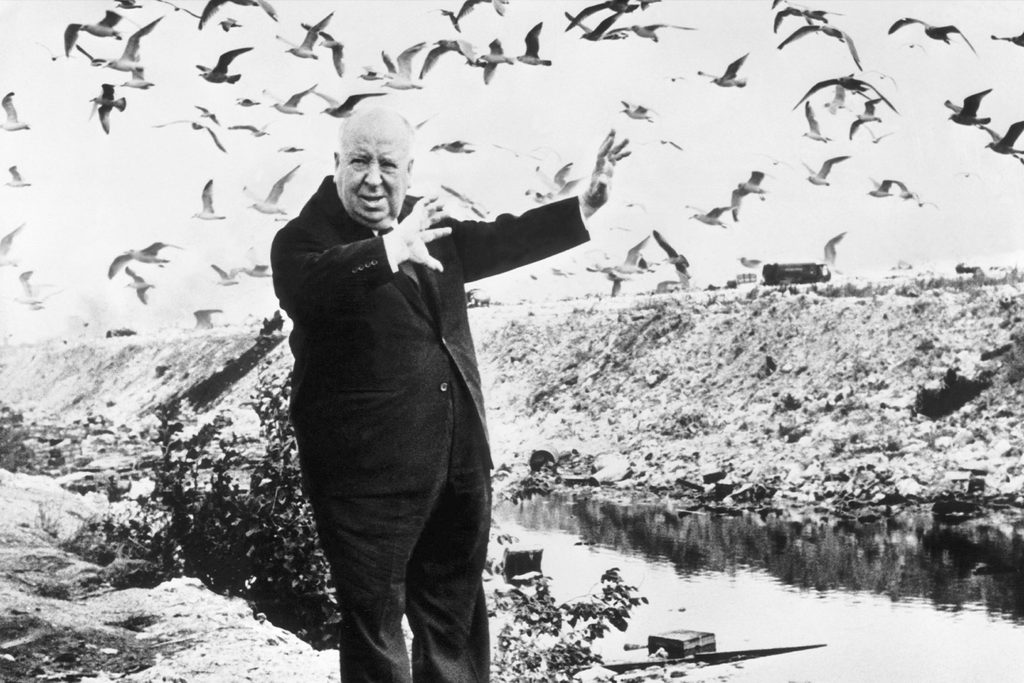
I highly recommend watching Alfred Hitchcock’s 1963 film *Birds*. It’s a horror film about birds suddenly attacking humans. David Wiesner likely saw this movie as a child (he mentioned in an interview that he’d seen all of Hitchcock’s films). The scene of frogs scaring birds is probably a tribute to Hitchcock, but in *Tuesday*, the effect isn’t scary; it looks like a funny prank, quite comical.
Turning to the next double-page spread, the frog army has arrived in the town. The image is taken from the frogs’ side and slightly behind, looking towards the town. By this time, most of the houses are dark, indicating that it’s quite late, perhaps close to 9 pm as shown on the cover. Why is it called an “army of frogs”? Mainly because of their imposing presence and the overall atmosphere of the scene. From this angle, the lotus leaves look like flying saucers, inevitably evoking thoughts of an alien invasion.

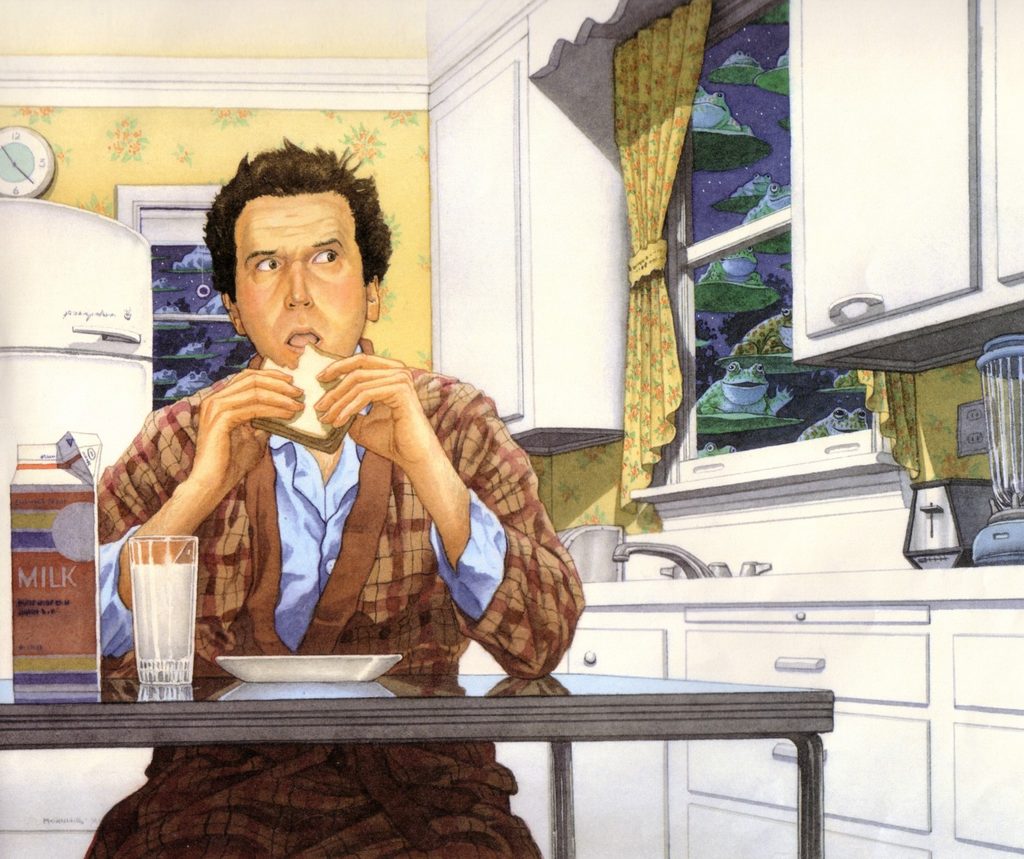
Okay, let’s move on to the third part of the story. “11:21 PM,” the camera shifts to an interior room. A man having a late-night snack discovers the frogs invading the town. Look closely at the man; he’s actually a self-portrait of the author, David Wiesner, looking terrified. But the frogs outside the window seem relatively friendly; one even smiles and waves a small paw in greeting, “Hi!”—well, the frogs seem to find it amusing. Next, the frogs flying close to the house encounter an accident. They crash into bedsheets and clothes drying in the sun, some falling off lotus leaves. Look closely at the bedsheets; the frogs that hit them still manage to fly forward, so you can still see the frog’s raised shape on the surface.
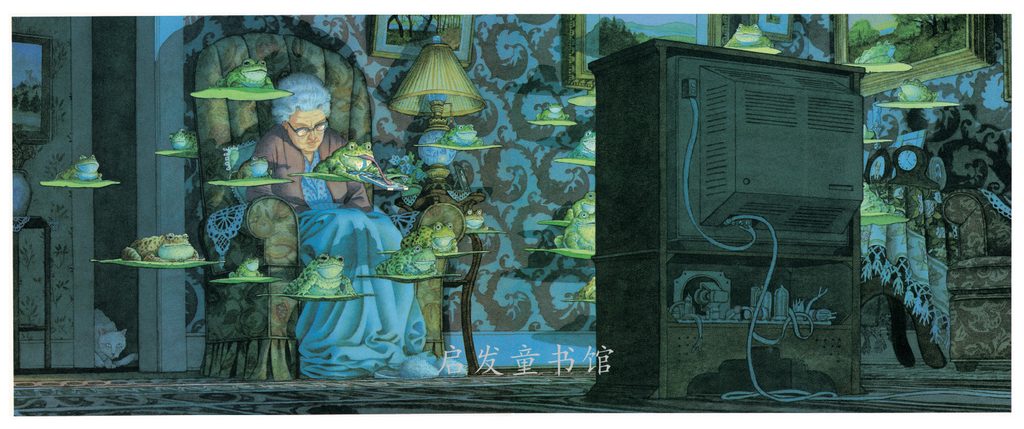
The next two double pages are particularly interesting. We see a group of frogs flying into a house, some through open windows, others through the chimney. There are people inside; an old woman is watching television alone, but she’s already asleep. The frogs immediately take control. One frog even picks up the remote and is changing channels with its tongue; another frog is admiring a landscape painting on the wall in the upper right corner—is it starting to miss the woods and pond? Perhaps the most interesting detail is the cat in the lower left corner, standing at the doorway on high alert, looking like it wants to attack but doesn’t dare.
In the fourth part, the big dog on the cover finally starts attacking the frogs. It’s “4:38 AM.” The dog first attacks a lone frog flying close to the ground, which attracts an army of frogs that chases after the fleeing dog. Just as the frogs seem to have conquered the entire town and are completely invincible, turn the page, and suddenly, the frogs start falling from the lotus leaves, some landing directly on the rooftops. What happened? As dawn breaks and the town welcomes its first rays of sunlight, the magic vanishes in an instant.
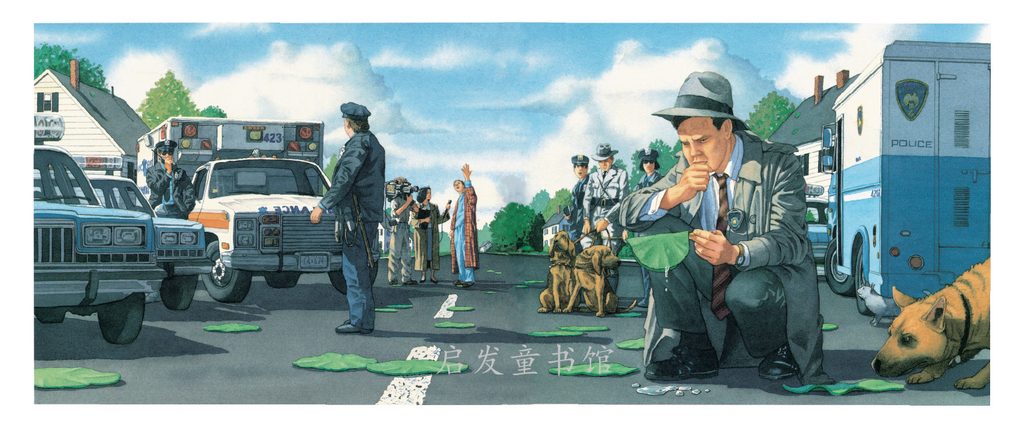
The next two double-page spreads depict an army of frogs that fell from the sky at dawn, hopping back to their pond. A close-up of a dark-colored frog is shown, perched on a lotus leaf, chin in hand, eyes wide with bewilderment, seemingly wondering, “What happened?” The next scene shifts to the human world: a town littered with lotus leaves, where a group of police officers are investigating. A close-up of a detective crouching on the ground stares at the lotus leaves, his hat askew, as if he’s racking his brains trying to understand. A large dog and a small cat are beside him, but neither can speak. Only a man eating a late-night snack, still in his pajamas, is being interviewed by a television reporter, but the police are clearly unimpressed by his fantastical tale, ignoring the frog-shaped clouds in the sky. Only the female reporter seems to be listening attentively. Who is she? Here’s a little secret: that lady is Kim, David Wiesner’s wife, a Korean-American surgeon, haha…
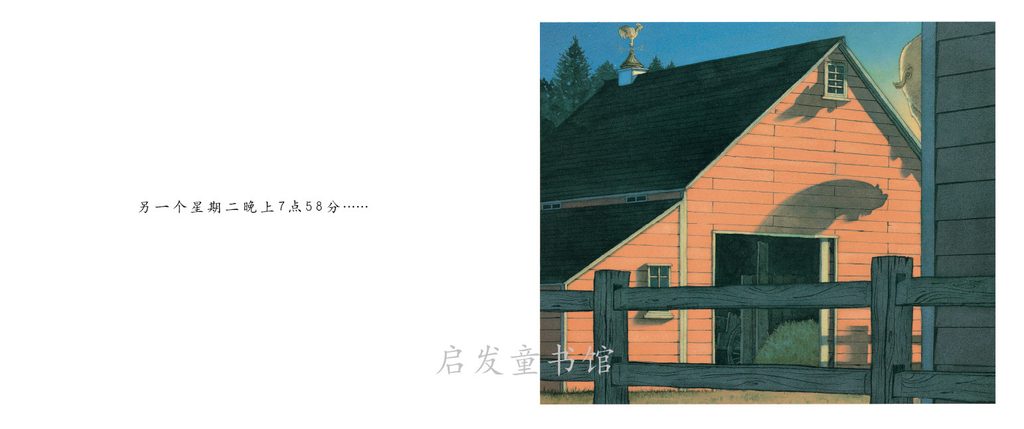
The fifth part of the story, actually the epilogue, leaves a cliffhanger: “Next Tuesday at 7:58 PM,” and something else flies out of the barn—the pigs have taken to the skies too! What will happen to the flying pigs? To find out, stay tuned… Well, almost 10 years later, David Wiesner did indeed draw a book called *The Three Little Pigs*, but that’s another story.

Here I’ll give a quick, general description of the illustrated story of *Tuesday*. It’s basically about a group of frogs suddenly possessed by magic who invade a small town at night. However, I can assure you that what I’ve described is probably less than a tenth of the original book. This is what makes wordless books particularly challenging; you really can’t tell the story, and readers need a lot of patience to read it themselves. However, reading this kind of book does require some methods and some understanding of the author’s background and thought process. Otherwise, you won’t know what they were trying so hard to achieve, or what benefits children actually gain from reading this kind of book.
Okay, that’s all for today. In the next episode, we’ll talk about why David Wiesner created these kinds of stories and why these kinds of books won the Caldecott Medal.