Cultivating a child’s reading habit from birth has become a consensus among many parents. Our goal is not to raise precocious geniuses, nor to fill their childhood with reading and literacy. Our aim is to fully develop their potential, making reading a vital means of cognition and communication, and an integral part of a joyful childhood. The secret to successful parent-child reading is to enjoy the pleasure of reading together, transmitting love to foster a love of books in children, and ensuring that the habit of joyful reading stays with them throughout their lives.
First tip: Choose books that adults like.
New parents are often confused about what books to choose for their children. Many experienced parents face the same dilemma, but as children grow older, adults can delegate more freedom of choice. However, infants and toddlers cannot choose for themselves; too many choices, or choices beyond their capabilities, will only confuse them. Therefore, parents of infants and toddlers must make the choices for their children. But how should they choose?
There is a very simple trick:Choose books that adults like.
Someone once asked, “I love ‘Dream of the Red Chamber,’ can I read it to a newborn baby?” My answer is, “Why not?” Our goal is to let children experience the joy of reading. If you genuinely love “Dream of the Red Chamber,” then show that joy and love to your child by reading it aloud. Besides, for a newborn baby, the rhythm and charm of the voice are far more important than the meaning of the language.
As children grow older, we naturally need to choose suitable reading materials for them: literature, cognitive learning, science, educational games, and so on. Adults can still follow the principle of “I like it, I choose it,” because reading together is something adults and children do together, and we can’t always “shortchange” the adults, otherwise the children will gradually find it boring.
The renowned British children’s author C.S. Lewis famously said, “Stories that merely please children are bad children’s literature.” Therefore, if a children’s book fails to evoke your affection and respect, you can simply discard it; it may not be a good book.
【Example】
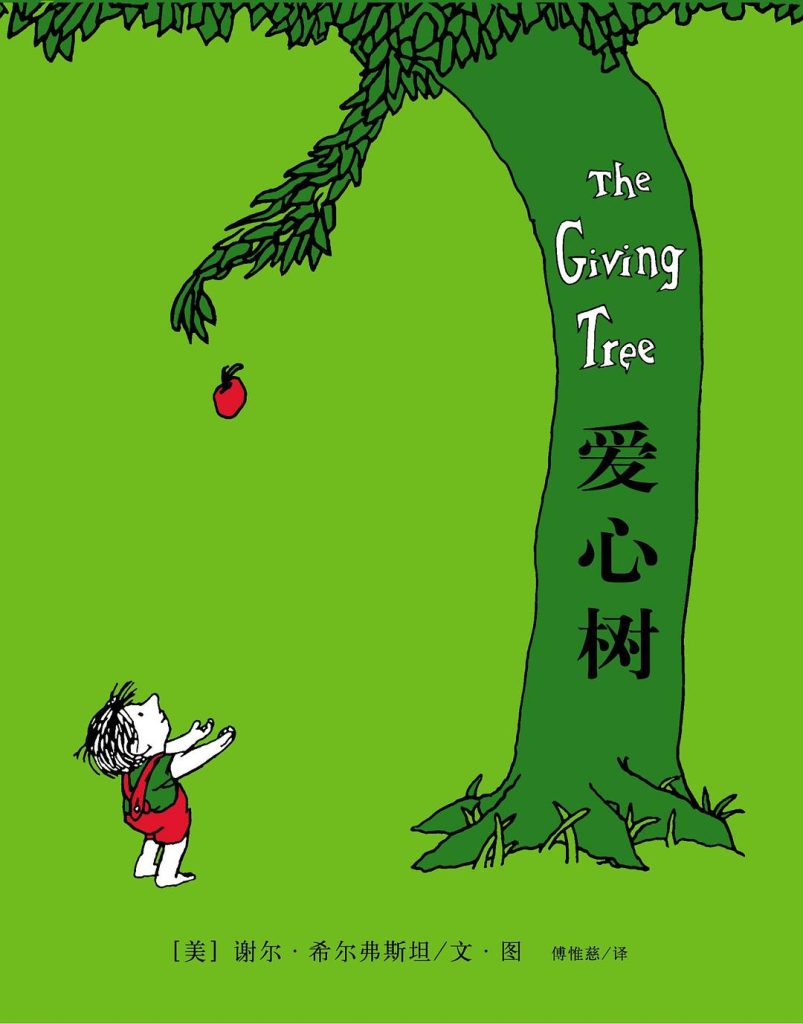
American author Shel Silverstein is a picture book author, children’s poet, and also a successful playwright, composer, and country singer. He has several very classic picture books, but it’s difficult to categorize them based on their readership. *The Giving Tree* tells the story of a boy and an apple tree. The illustrations and text are so simple that two- or three-year-olds love it, five- or six-year-olds can read it themselves, and many adults are moved to tears while reading it. Once, I read it to my mother, who is over seventy years old. She was deeply moved and said that the tree represented her parents.
Silverstein also wrote an even simpler picture book, *The Missing Piece*, incomparably simple, with only a line, a circle with a missing piece, and some other pieces. Each page contains only a few lines and a few words. The story is essentially about a circle with a missing piece searching for its lost piece, traveling to the ends of the earth. Some say it’s about the pursuit of love, some say it’s an allegory about the fulfillment and incompleteness of life, and others say it’s a philosophical allegory extracted from many stories. Some large American companies have even used it as psychological assessment material in their recruitment processes…
One morning, I found my four-year-old daughter engrossed in a book, muttering to herself. I leaned closer to look and realized it was *The Missing Piece*! What was particularly interesting was that she couldn’t read the words. I asked her, “Is this book good?” She confidently replied, “Yes!” I was quite surprised; at that moment, I wished I could be four years old again and see just how good this book was.
Perhaps this is what truly good children’s books should be like.
The second tip: Read aloud to your child.
Reading aloud to children is widely recognized as the simplest and most effective way to cultivate their reading habits. Here, “reading aloud” doesn’t mean making a very loud sound, but rather “reading aloud.”
Reading aloud to children is a long-standing tradition in the West, and we often see heartwarming scenes of this in films and television shows. In 1979, American painter and columnist John Trelease, who had just become a father, was deeply concerned about the declining reading levels among American children and wrote a book advocating for “reading aloud to children.” More and more people joined in advocating and researching this approach, turning its promotion into a social movement. The U.S. Department of Education even invested tens of millions of dollars in special investigations and research, and in 1985 officially recognized Read-Aloud and Sustained Reading (SSR) as the two most effective reading education methods.
To be fair, there are many effective ways to cultivate children’s reading habits. The traditional Chinese method of memorizing classics is often effective, and scholarly families often naturally produce generations of bookworms. However, in modern lifestyles, reading carries more burdens, and we don’t want our children to become bookworms who only know how to read. Furthermore, the fast pace of modern life means that working parents often cannot dedicate much time and energy to their children’s reading. Therefore, from an economical and practical perspective, consistently reading aloud to children every day may be the best approach.
Reading aloud to children isn’t difficult in itself; the challenge lies in consistency. Choose a suitable time each day and read for at least 20 minutes, enjoying the process together. Ideally, start from birth, and if possible, continue until they graduate from elementary school, or until they explicitly state they no longer wish to continue. Cultivating this habit is far from easy, but it’s a noble endeavor and well worth trying.
【Example】
Not all books are suitable for reading aloud to children. The vast majority of picture books are suitable for children. As Matsui Tadashi, the father of Japanese picture books, said, “Picture books are precious to children precisely because they are read to them.” Not all text-based books are suitable for children. In his book, *Read Aloud to Your Child—A Reading Handbook*, Mr. Trelease succinctly summarized the characteristics of works suitable for reading aloud as follows: First, a fast-paced plot; second, vivid and well-developed characters; third, clear and easy-to-read dialogue; and fourth, very few long descriptive passages, especially at the beginning.
Most folk tales and traditional fairy tales are told directly to children. Among classic fairy tales, *The Adventures of Pinocchio* is a model suitable for children, captivating them from the very beginning:
“Once upon a time…
“‘There is a king!’ my young readers will say right away.”
““No, children, you’re wrong. Once upon a time, there was a piece of wood.””
If you were to simultaneously open Zhang Tianyi’s “Dalin and Xiaolin,” a work by a master of modern literature, and Sun Youjun’s “The Adventures of Little Cloth Head” and “Little Pig Xili Hulu,” a work by a renowned contemporary children’s author, you would discover how perfectly this tradition has been inherited. If you were looking for the most suitable works to read to children in the contemporary world of children’s literature, I believe Sun Youjun’s works would be the first choice.
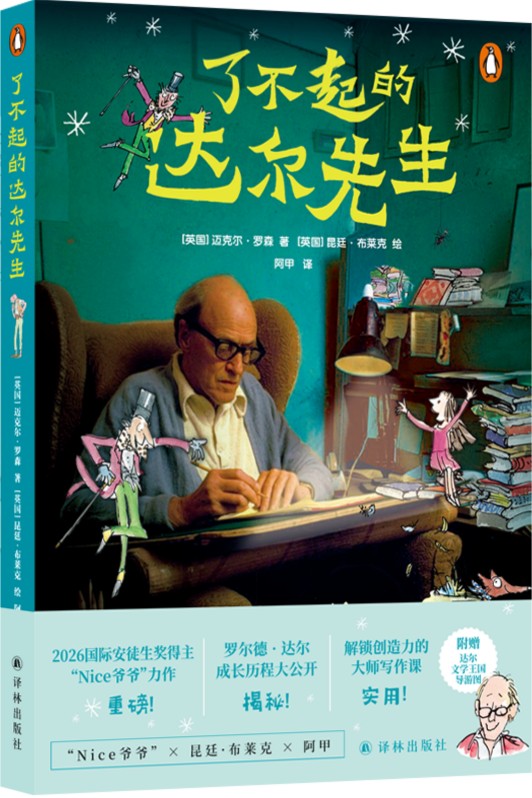
In the world of English children’s literature, the works of British author John Dahl are considered the most suitable for children to read aloud. His famous works, such as *The Witches*, *Matilda*, *The BFG*, *James and the Giant Peach*, and *Fantastic Mr. Fox*, have all been translated into Chinese, most of which were translated by translator and children’s literature writer Ren Rongrong.
The third trick: Read and play at the same time
There may be children who don’t love reading, but there are no children who don’t love playing. In terms of mindset, many adults view reading or other similar learning activities as quite serious matters. For example, we might say, “When playing, play properly; when reading, read properly.” We also often say “learning through play,” which isn’t inherently bad, but subconsciously we still see “teaching” and “playing” as two opposing things. Otherwise, why don’t we say, “Teaching is playing, and playing is teaching”?
In early childhood education, almost everything a child learns comes from play. There’s a saying: “Having a child takes three years of madness.” This is so true! Parents of newborns often grow up alongside their children in a playful and energetic way. What seems like just playful chaos is actually a natural method of teaching. Influenced and stimulated by adults, children actively absorb information from the outside world and mature at an astonishing speed. For children, reading is inherently a game. Words, pictures, and related sounds and touches evolve into interesting stories and a myriad of fascinating facts—it’s simply a miracle! If you’re willing, you can absolutely turn early childhood reading into “mad reading.”
Children can engage in many ways of reading. For example, some books are essentially toy books, where children can roll them around like cars, build houses with blocks, or create puzzles and patterns. Some books are adaptable to specific uses, like placing them in the bathtub or using them as play flooring. Some books even include games that children can participate in while reading. However, most books for toddlers are simply picture storybooks, and how children play with them requires adults to be creative. The most common ways to play include role-playing, drawing, and crafting. As long as adults are enthusiastic and creative, they can certainly come up with endless ideas.
Some toddlers will be busy playing with their toys while adults read to them. This doesn’t necessarily mean they’re uninterested in reading; they might protest if the adult stops. Adults need to be more patient and observant in such situations. If the child is indeed distracted, try a more suitable time, a more interesting book, or a more engaging approach.
【Example】
At the 2003 Beijing International Book Fair, I discovered a strangely shaped children’s book at a French publisher’s booth. It had a large, semi-circular notch, and holding it in my hand, it looked more like a large building block than a book. Curious, I opened the book. When it opened, the large notch became a perfect circle. That is, when closed, it was a “C” shape, and when opened, it became an “O”. It turned out to be a story about animals. Each illustration showed an animal’s body and head, but the face was a large, round notch. The notch was for the face of the storyteller or listener! Imagine telling a story to a child, and your face is placed on what should be a lion’s face, exaggeratingly saying, “I am a starving lion!” How would the child react?
In book design, children’s books offer the greatest creative space, where you can often find wonderful ideas brimming with childlike innocence. For example, bath books are already quite creative; babies can flip through water-resistant, floating books while taking a bath – reading can be so enjoyable! The China Children’s Publishing House’s “Baby Bath Book” adds another layer of creativity, including a small physical model, such as a submarine, that can dive underwater. This way, adults can read to their babies while they bathe, and the baby can hold a small toy – a unique and fun experience.
There’s another type of book called “Baby’s Cognitive Encyclopedia,” which originally consisted of cards with pictures of real objects and nursery rhymes—books like these are everywhere. However, ingenious designers punched small holes in the cards, giving this book a new function. By binding different cards together with ribbons, the cards become a book that can be flipped through; even more interestingly, the cards can be strung together with hooks and hung on a frame, transforming into a fun wall chart. If children can participate in making it themselves, they’ll be overjoyed. This design seems simple, but it truly requires a genuine childlike heart and playfulness.
Fourth tip: Invite children to participate while reading aloud.
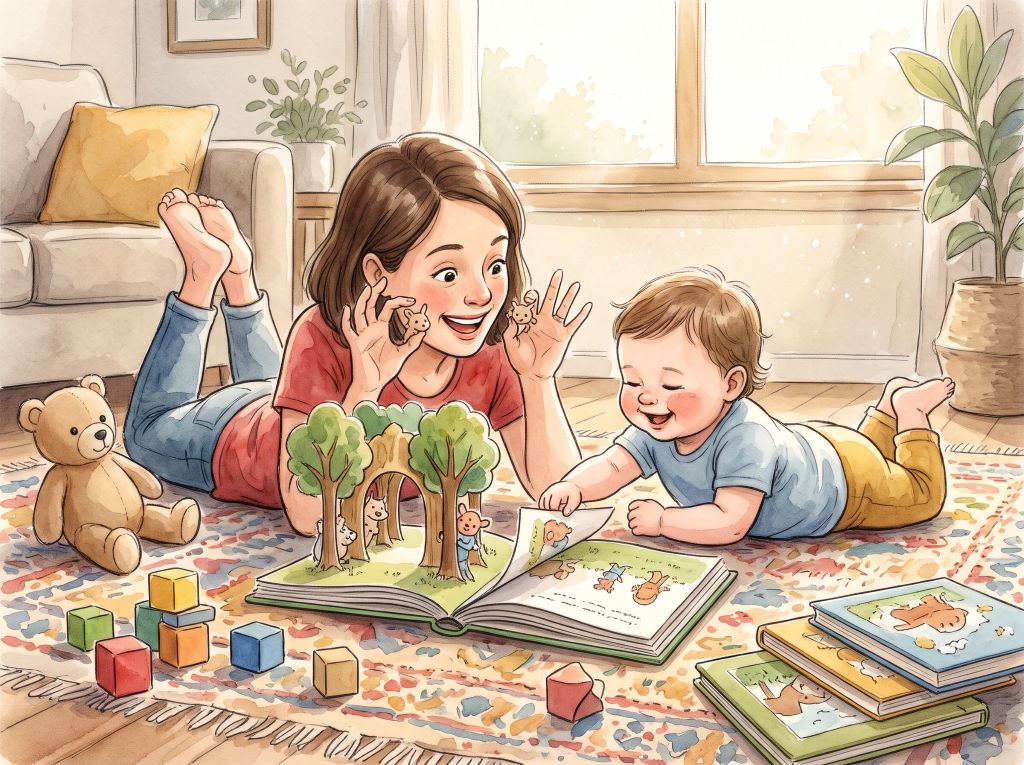
In parent-child reading aloud, involving the child can make it both fun and effective. Children are generally very curious about adults reading aloud from a book and turning the pages. One- or two-year-olds sometimes imitate adults, holding a small book and babbling earnestly.
There are many ways to get children involved, the simplest and most direct being turning pages and making sounds.
Children around one year old can already turn pages. After reading a page, adults can invite the child to help turn the page. Older children have developed a connection between the pages and the story content. For books they read repeatedly, they can often accurately identify the pages based on the pictures. At this point, you can ask the child to lead the page-turning. By letting the child control the reading speed, you can indirectly understand their comprehension and enjoyment of the story.
If you start reading rhyming texts like nursery rhymes and Tang poems to your child from birth, you’ll find that they quickly develop a strong sensitivity to rhythmic pronunciation. When my daughter was six months old, I noticed she enjoyed humming along with adults reciting Tang poems, especially at the end of each line, and her intonation was remarkably accurate. In fact, regardless of what’s being read, children around one year old can already hum along with adults, intentionally. This is imitation, and adults should encourage it. You can make it easier for children to participate by adjusting the rhythm of the reading.
Many books contain onomatopoeic words that imitate animal sounds, the noises of events, or human exclamations, such as “woof woof,” “smack,” and “ee–,” which one- or two-year-olds particularly enjoy making. Older children are fascinated by repetitive short phrases or particularly interesting expressions. When adults read aloud, they can intentionally slow down, lower their volume, or even remain silent in these parts, allowing the child to experience the fun as well.
Involving older children usually requires making the activities a bit more complex. For example, reading in roles, acting out scenes, drawing props, or making props by hand are all good methods. If the child is willing, you can even invite them to join in a story relay.
【Example】
In the animated children’s song collection “Glorious Childhood,” there’s a song called “Little Bear Breaks Corn,” which my daughter especially loved listening to when she was ten months old. The lyrics go something like this: “Little bear breaks corn, twisting and turning, breaking one and dropping one, twisting and turning. Breaking and breaking, breaking and breaking, breaking and breaking, oh dear, only this one left in my hand, this one. Little friend, little friend, please tell me, why is this? Huh—why is this?” My daughter probably heard this song countless times, remaining very quiet whether listening or watching the animation, especially when the song reached the “huh—” part, she would always sing along, her rhythm perfectly accurate. This was probably the first word she pronounced correctly before saying “mama” or “papa.” Gradually, she started singing along with “oh dear,” and even more challenging exclamations like “twisting and turning.”
If we think back carefully, many children go through a similar process when they first learn to speak. This wonderful and interesting process can also be very effective if it can be applied to cultivating children’s reading skills.
“The “Little Pocket Literature” series includes a fairy tale called “The Kind-Hearted Man-Eating Troll,” which tells the story of two children who encounter a kind troll in a castle on the edge of a forest and eventually become good friends. When the story begins with the children’s first encounter with the troll, the two children scream, “Wow, a child-eating troll!” The troll shouts back, “Wow! Child-eating trolls!” The two children are so frightened they freeze in place, while the troll, equally startled, leaps up the stairs. This is the most humorous and lively scene in the story, and children who have heard it several times always get particularly excited at this point. In similar scenes, if we can get children involved—for example, imitating the children’s screams and the adults imitating the troll’s screams—it makes the reading process much more fun. This isn’t just about letting children experience the language of the story; it’s also about teaching them to engage in reading and derive maximum enjoyment from it.
Fifth tip: Explore through images
A crucial and enjoyable step in reading aloud to children is picture walking. Picture walking involves gently and naturally guiding and accompanying children as they look through the pictures and illustrations in a book. This reading style should be very relaxing, like strolling leisurely through a painting.
Picture walks can be incorporated into the reading aloud process or done independently. This activity is suitable for picture books or illustrated books. Excellent picture books often have a strong ability to tell a story through illustrations; children can even “read” a complete story from the pictures.
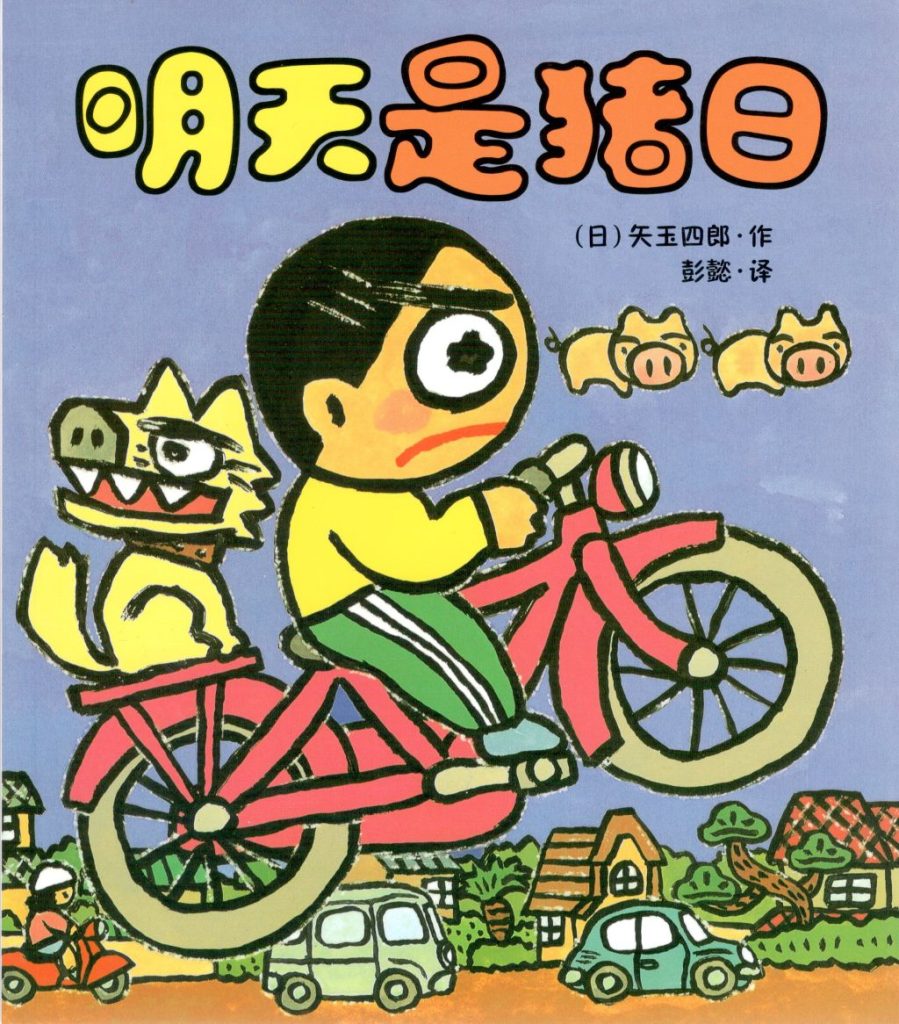
Before formally reading aloud to your child, it’s best to do a picture walk first. This walk is like a rehearsal. For example, point to the cover and ask your child, “Guess why this little pig is called Xi Li Hu Lu?” Then casually flip through the illustrations in the book, “Look, why are Xi Li Hu Lu’s pants falling down?” “Oh no, the big bad wolf is coming!” and so on. After this warm-up, the child’s attention will be drawn in, and they will be full of curiosity about the story in the book.
While reading aloud, it’s best to let the child see the pictures at the same time. Adults often read and tell stories based on the text, but children read their own stories from the pictures. Experienced adults know that children have an amazing “eagle eye” for details in pictures, and they often read stories differently from the words.
After reading it aloud, you can either walk through the picture again with your child or let them do it on their own, to savor the experience once more. A child’s unbridled imagination can fill the gaps that words and pictures cannot describe.
If a child is in a good mood, they will tell the story themselves while holding the pictures. Never expect a child’s story to be “faithful to the original”; adults should listen attentively to the child’s own story.
【Example】
In his book “My Theory of Picture Books,” Japanese publisher Matsui Tadashi recounts the following story. He had three children, then in fourth, third, and first grade respectively, and he often talked about books with them. One day, the three children told him that they recently became particularly fond of a picture book called “Thumb-sized Calf,” and they took turns telling him the gist of the story and describing how interesting it was. The renowned picture book publisher Matsui was quite surprised; he couldn’t recall ever having such a book at home. How could he not know about a picture book? Then, the children pulled a book from the shelf, and Matsui suddenly realized: it was a picture book sent by a Hungarian publisher, which he had overlooked because he didn’t particularly appreciate its illustration style.
He reread the book carefully. It was called *The Magic Cow*, a traditional Russian fairy tale written in French. To his great surprise, the story the children told was almost identical to the one he had read in the book, even though the three children knew nothing of the foreign language; they understood the story entirely through the pictures. Children who have seen many picture books are very adept at reading stories through illustrations. They look at one illustration, grasp the story from it, then look at the next illustration, grasp the story from that illustration, and then combine the two parts. Where there are gaps, they use their imagination to connect the parts of the two pictures. In this way, they look at the pictures one by one, piecing them together to piece together the plot development.
When reading picture books together, children see the story through the illustrations while listening to the adult’s voice, including descriptions of background, actions, and dialogue. Imagine how similar this is to watching a play! The difference is that children can turn the pages themselves, using their own hands to draw back the curtains of each scene. How fascinating is that!
Sixth trick: Performative reading aloud
Adding more performance elements to activities where children read aloud can make the whole process more enjoyable and achieve better results.
Most adults haven’t received training in performance or professional reading aloud, and coupled with the fatigue of work, they often choose to read to children in a very straightforward manner. This isn’t bad, but it’s not “excited” enough to truly engage a child and make them fall in love with reading. Children are naturally active, prone to exaggeration, and like to take everything seriously. Performative reading aims to utilize these endearing traits to guide them into the realm of knowledge.
Adults should never worry about their acting abilities. Children are the most forgiving audiences in the world; they will not only forgive your “clumsy” performance but also offer their sincerest applause for your efforts. Performing for your child is a tremendous pleasure.
The simplest performance is a reading aloud with emotion and appropriate rhythm. To do better, you should generally preview the material beforehand, at least being able to distinguish who speaks which line in the dialogue sections. Books with too much dialogue or too many characters are generally not suitable for reading aloud, so try to avoid choosing such books. Stories with particularly endearing protagonists, distinct personalities, and clear language features are especially suitable for reading aloud.
The most fun performances are the role-playing segments that attract children’s participation, where stories can be chosen to suit their abilities. For younger children, more actions and simple pronunciation can be assigned. In one televised storytelling event, an adult performed the story “The Turtle Flies to the Sky” with a two-year-old. The child spent most of the time imitating a turtle crawling, with only two lines: “Who are you?” and “Will you take me to the sky to play?” The whole performance was hilarious. Children are very willing to be part of the story, and they will enjoy it immensely if given the opportunity to participate.
【Example】
A mother once told me how she used role-playing to read *The Story of Miss Baby* to her daughter. It’s a classic picture book by Beatrix Potter, the author famous for *Peter Rabbit*, about a little mouse who tricks a kitten named Miss Baby, the kitten’s revenge, and the mouse’s clever escape. The cat and mouse in this story are just like a pair of playful children who are always bickering. The text is simple, and it can be read in two or three minutes. The mother vividly described how she played the cat and her daughter the mouse, and the two of them imitated the actions and dialogue from the story for over an hour. Her description touched me deeply; it will be a sweet memory shared by mother and daughter. With a mother like that, how could a child not love books?
When I read the illustrated version of the children’s story “Dalin and Xiaolin” to my daughter, I put on a show to keep her captivated. Each character in this fairy tale is vividly portrayed: Xiaolin is brave but also a bit naive, speaking like a child; Dalin later becomes Mr. Baha’s son, Jiji, who, along with Baha, is an enormous, fat fellow who speaks slowly, one word at a time; the long-bearded king is an old child who cries after saying just a few words; Sisige has overly large nostrils, speaking in a muffled, echoing voice, always repeating himself at the end of sentences; the fox, Pingping, has a pedantic, pretentious air; Miss Crocodile is self-absorbed, using her gruff voice to act coquettish; Princess Rose is incredibly delicate, walking like a duck, speaking in an affected, affected manner, and prone to fainting after just a few words; the most amusing character is Judge Bao Bao, with his dark face and powdered face, singing his “Angel’s Song” in a high-pitched voice: “Eat a piece of chicken cake, beautiful Bao Bao. Eat a piece of chicken cake, beautiful Bao Bao.”… Although, by most people’s standards, my so-called “performance” was quite clumsy, my only audience gave me the most enthusiastic encouragement. After two weeks, we happily concluded this reading journey.
Seventh tip: Pay attention to every question your child asks.
Children are full of curiosity about the world; they seem to have a million “whys.” During shared reading activities, children often ask many questions, which are crucial opportunities for communication that adults shouldn’t overlook. The purpose of reading with children is to share—to share joy and to share confusion. Children’s thinking differs from adults’, so their questions often seem quirky or even absurd to adults. If adults simply laugh off such questions or forcefully stop them, they may miss a wonderful opportunity.
When children ask questions while reading, they generally fall into the following categories: they don’t understand the language in the book; they don’t understand the cause-and-effect relationships between events in the story; they don’t understand the relationships between characters in the story; they don’t understand or agree with the handling of the plot; they strongly like the story or the characters in the story; they strongly dislike the story or the characters in the story; they make associations with the story; they discuss the relationship between the story and reality; they ask seemingly meaningless questions; they ask questions with a certain intention to distract; and so on.
Adults sometimes find themselves at a loss when faced with children’s questions, mainly because they don’t quite understand how children ask them. Sometimes, what appears to be a question is actually just a request for adult validation. However, in many situations, they use non-questioning methods to make judgments, such as “Sun Wukong is real, Tang Sanzang isn’t.” This shows they disagree with the character relationships and plot developments, but they can’t articulate the problem. Therefore, adults need to be extra patient with children’s questions, trying to understand their thought process and guiding them to their true concerns. In fact, once those underlying questions are elicited, you don’t even need to answer; the problem is already largely solved.
Young children often struggle to distinguish between fictional and real events, frequently drawing connections between fictional stories and real-life situations. For example, a child might ask, “Snow White’s stepmother is so mean, where did her father go?” Adults usually see stories as just stories, but children don’t. With proper guidance from adults, children can gain a rich and enriching experience.
【Example】
There’s a book called *Nobel Laureates Talk to Children*, where the questions are all asked by children, such as “Why is the sky blue?”, “Why are leaves green?”, “Why do Mom and Dad have to go to work?”, and “Why do I get sick?”. The people answering these questions are Nobel laureates—scientists, writers, politicians, economists—considered among the most intelligent people on Earth. Reading their earnest answers to children, you’ll discover that behind children’s seemingly innocent questions often lie profound truths.
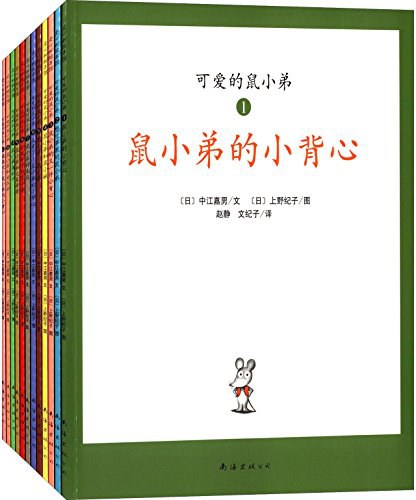
When children ask questions anytime, anywhere, adults often dodge, counter with questions, or simply play a game to brush them off. Adults are often reluctant to admit they also have questions. There’s a Japanese picture book series called “Little Mouse,” where each illustration is very simple, featuring only a little mouse, or perhaps one of his friends. Many adults who have read it to their children admit that “Little Mouse” is a particularly humorous picture story, but one thing particularly puzzles them: “The pages of this book are so wide, why is Little Mouse drawn so small?” Indeed, Little Mouse is drawn so small that you can only see him clearly if you look closely, and the large space on the page is mostly blank. Why is that? It seems adults don’t know the answer to everything. Perhaps you should think about this question first, and we’ll discuss it in the next section.
Eighth tip: Talk about interesting things in the book.
After reading a book together with their children, many adults like to ask them questions or ask them to retell the story. This is mainly to check if the child understands and remembers the story. While this is one method, it’s not necessarily the best. Many children become impatient with such tests, and their reactions often disappoint adults. Some children even gradually become bored with shared reading activities.
Mr. Chambers, the famous British author who won the Hans Christian Andersen Award in 2002, is also a reading education expert. After more than 30 years of research, a teaching and research group with him as the core believes that the best way to help children understand reading materials is to “talk about the book”. He also wrote a book on this topic, “Tell Me About It”.
Talking about books with children usually starts with a series of questions, but these questions aren’t meant to test their understanding; rather, they’re meant to guide them to express their own thoughts. Therefore, these conversations should be stress-free, open-ended, and allow for open conclusions. Chambers particularly emphasizes that it’s best to begin book conversations with children using relaxed phrases like “Tell me about it,” rather than starting with a somewhat aggressive tone like “What does that mean?”
We’ve all had this experience: after sharing something with others, the participants have many topics to discuss and are more likely to reach a consensus through these exchanges. The relationship between adults and children in shared reading is similar. Our true goal is to help children understand and derive enjoyment from the experience. Therefore, the important thing isn’t for the child to “answer correctly,” but rather for both parties to reach a consensus through communication. The adults’ understanding of fictional stories and real life is naturally conveyed to the children.
When discussing books with children, the relationship between adults and children should be equal. Adults have rich social experience and reading experience, naturally leading to a depth of understanding that children cannot match. However, children are innocent and straightforward, without as many preconceived notions, and are particularly good at noticing details. Adults are not always superior to children in understanding stories. Therefore, when discussing books, adults need to get down to children’s level, not act superior.
【Example】
In the previous section, we mentioned the issue of the seemingly disproportionate appearance of “Little Mouse” in picture books. Children seem to accept it effortlessly, but adults often find it somewhat perplexing. If you also have this question, take some time to talk to your children and ask for their opinions. In fact, many people have raised this question with the illustrator Noriko Ueno, even hoping that she would “draw Little Mouse bigger” in her next book. But did you know? This illustrator drew this adorable Little Mouse with a magnifying glass!
Let’s try to see things from a child’s perspective, through their eyes. Isn’t that seemingly weak, naive, yet spirited little mouse a reflection of ourselves? Isn’t that vast, seemingly insurmountable blank world a reflection of the world in a child’s eyes or imagination? The artist’s painstaking efforts are precisely to encourage us to bend down, move closer, and see and think with them. In our hurried adult world, how much have we overlooked? Perhaps the most terrifying thing is pure imagination. Talking with children isn’t just beneficial for them; it’s also for ourselves.
The fifth book in the series, *Little Mouse, Little Mouse*, tells the story of Little Mouse jumping onto a scale, but the pointer doesn’t move an inch. A monkey jumps on, and the pointer moves a few notches, saying proudly, “See, I’m much heavier than you!” A pig laughs at the monkey, “You’re only a little bit heavy!” The pig then makes the pointer move a few more notches. Next comes the lion, the horse, the rhinoceros, and the elephant. The elephant is the most proud because the scale pointer is almost a full rotation. Little Mouse has a clever idea; he jumps onto the scale again, and this time even the elephant is convinced: “Oh dear—you’re heavier than me!” How did this happen? Talk to your child about it.
Ninth tip: Encourage your child’s positive responses
We need to pay attention to children’s reactions after reading together, because reading is not something that ends once the book is finished. Reading responses are a crucial part of the entire reading process; they are an important element in helping children understand and guiding them to expand their reading.
When young children fall in love with a book, the most common reaction is “I want to read it again!” They enjoy adults reading it repeatedly. Some children treat a book like a living friend, taking it with them while eating and sleeping, and saying “Bye-bye, Winnie the Pooh” when they go out to play. Some children imagine themselves as the main characters in the book, making up their own funny stories. Still others line up their toy animals and “tell them stories” while holding the book. These are all positive reactions that deserve encouragement.
Older children have even more creative ideas. They’re sometimes happy to retell the story to others, though often with multiple changes, sometimes even drastically altering it beyond recognition. They’re also eager to draw something for the book or do crafts, like making a mask or prop. If other children are around, they’re happy to act out the characters or eagerly share their opinions. When they’re really into it, they might even make up their own nursery rhymes related to the story. In short, adults need to know that these are all positive responses that are helpful for reading and require encouragement and timely guidance.
If possible, adults can also help children write a letter or send an email to the book’s author, or create a fun homemade book together, inspired by the child’s favorite book. Also, and perhaps most importantly, it’s best to take the time to talk to the child about it.
【Example】
I met a friend online, a woman much older than me, who is now in junior high school. Once, she asked me to recommend some good books of essays. I particularly loved Mr. Sun Youjun’s collection, *The Eccentric Old Man’s Random Thoughts*, so I sent her the book. She was incredibly excited after reading it, saying she was “surprised” to discover that the *Adventures of Little Cloth Head*, which she had worn out as a child, was written by this very same eccentric old man! I told her that the eccentric old man was still writing fairy tales, and that he was also one of my online friends. I forwarded her email to Mr. Sun, and from then on, they began communicating online. This young woman and the old man became inseparable friends, and the girl even created a website for him called *The Eccentric Old Man’s Random Thoughts* in her spare time—it’s the most exquisite and unique children’s literature website I’ve ever seen in China…
Here’s something else interesting. Did you know that some classic picture books in the world of children’s literature originated from picture books created by adults for children around them? Among the most famous are Beatrix Potter’s *The Tale of Peter Rabbit*, Dr. Hoffmann’s *Striped Peter*, Jean de Brunov’s *Barbar the Elephant*, Hans Finça’s *The Bremen Town Musicians*, Egon Matisse’s *The Blue-Eyed Kitten*, Leo Leoni’s *Little Blue Dot and Little Yellow Dot*, Takeshi Mota’s *Children of Paris*, and so on. If you discover that you and your child also have a talent for this, don’t let it go to waste! Even just giving it a try would be great. Just think how exciting that would be!

The tenth tip: Encourage children to read independently.
Reading is a skill, and mastering any skill requires practice. In shared reading with children, besides adults reading aloud, we should also encourage children to read independently. If we compare it to learning to drive, reading aloud is like watching adults drive, while independent reading is like driving yourself.
When should we begin cultivating a child’s independent reading habits? It can begin as soon as the child can grasp flashcards. There might be a conceptual issue here; many people believe that independent reading requires a large vocabulary, and they don’t consider reading while looking at pictures to be reading. However, if you carefully observe an infant pondering flashcards, or a toddler turning the pages of a picture book and murmuring to themselves, you’ll see that their level of concentration is no less than that of an adult reading a book with text.
For infants and toddlers, cultivating independent reading primarily involves developing attention span and habits. The interactive process of deriving meaning from reading material deepens with age. In fact, toddlers who cannot read at all can still accurately “read aloud” while turning the pages of a picture book they have read many times. They fully understand the book, but they cannot yet distinguish the relationships between words.
However, cultivating a child’s independent reading habit should not be rushed. Parents who are good at teaching their children to recognize characters are often more anxious, but in reality, there is no direct correlation between the number of characters a child knows and the habit of independent reading. Children develop this habit mainly through imitation of adults. Adults should strive to create a suitable environment and set a good example for their children in daily life. When children show a desire to read independently, adults should enthusiastically encourage them and provide timely guidance.
【Example】
A mother asked me this question: “My child is five years old. He started recognizing characters when he was two and now knows many words, and can read most children’s books without any problems. However, I’ve noticed that although he often flips through books with great interest, he’s only reading the pictures. If I ask him to read aloud, he’s very slow, often omitting or adding words. When I ask him to point to the words, his fingers and mouth don’t coordinate; his finger goes too far before he can read the intended part. I often correct him, but he gets impatient, and what usually starts happily ends in a fuss. How can I help my child learn to read independently?” This is roughly the question. There are quite a few similar questions.
Adults often anxiously hope that children will quickly move beyond the picture-assisted reading stage and begin reading text-based books independently. Adults with this mindset often fail to recognize that children reading pictures is reading in itself, neglecting the joy children experience in reading. This anxiety often damages children’s interest in reading itself; many children even begin to dislike reading before starting school. If reading is just like that, who would enjoy it?
I suggest that adults with this idea read “The Little Mouse’s Wordless Book,” illustrated by Swedish master illustrator Monica Monique. It’s a book with absolutely no words except for the title. Adults should read it themselves, then quietly observe how their children read it, and find an opportunity to talk to them about it. You’ll discover that the imagination, reflection, and love for life conveyed by this purely pictorial story are in no way inferior to those of a written story.
Children today are fortunate. In our past, when reading was almost entirely devoid of pictures except for comic books, we had to rely on memorizing words to fully enjoy reading. That was such a difficult start, and how many were kept away from the world of reading by difficulties and pressure. Today, children can enjoy the perfect pleasure of reading from a very young age, thanks to pictures and the voices of adults. Let our children experience this joy more often. I firmly believe that as long as they fall in love with reading, they will surely learn to read.
Eleventh tip: Read growth records
Many parents enjoy keeping a record of their children’s growth, which is an excellent habit. Important milestones in a child’s development, daily activities, and innocent remarks can all be recorded. Adults can often look back and savor these records, finding them endlessly enjoyable. If we could also record our children’s reading journey, it would not only be very interesting but also highly helpful in guiding their reading.
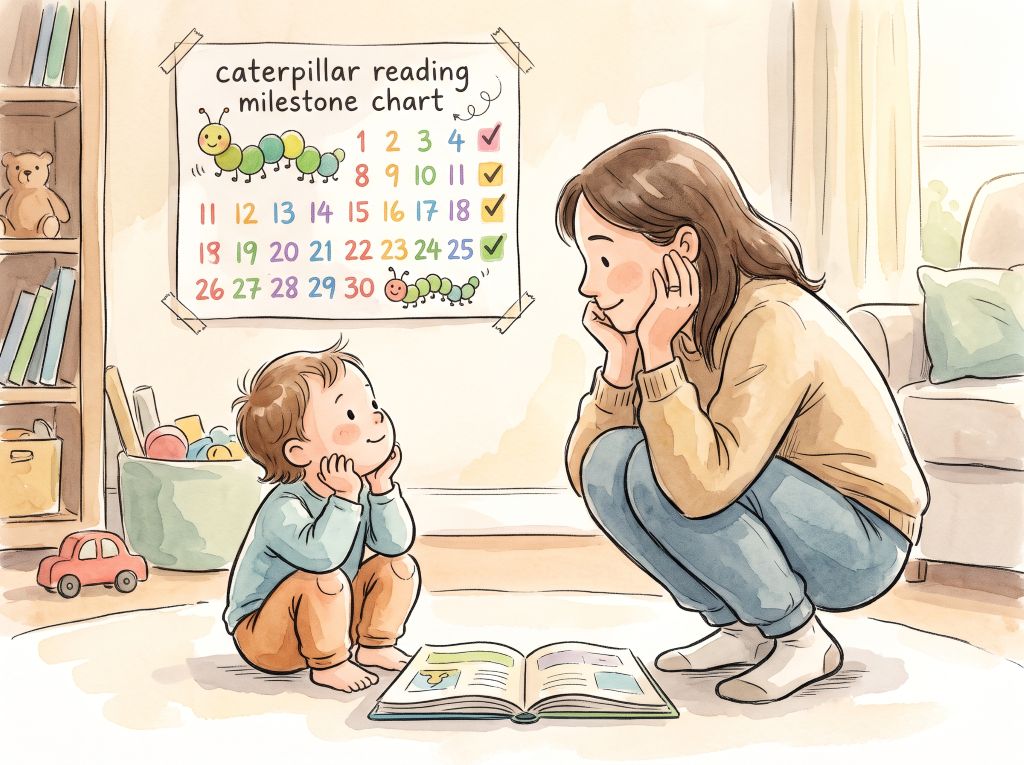
The simplest record is to write down the books your child has read at each stage. Simply listing the time periods and book titles is already valuable. However, it’s best to involve the child in this record and present it visually in a fun way. For example, draw a large chart for each stage, like a train timetable, and fill in the books the child read during each time period; or hang a map-like chart and write the book titles on small flags, sticking them onto the map one by one; or make some cards, the first card being the head of a worm or dragon, the last card the tail, and the book titles written on the cards in the middle for the body. The more books the child reads, the longer the worm or dragon’s body will become, and then hang it in the room. This kind of visual record is a great stimulus for children; they will be fascinated by filling in the chart or lengthening the dragon’s body, which means continuing to read.
More detailed records can include reading methods and the child’s reading responses, such as likes and dislikes of certain books, interesting questions raised while reading certain books, comments made about certain books, and thoughts after finishing reading, etc. Adults can often refer to such records to analyze the child’s reading development, and children can also use them to relive the joyful moments of reading, thereby further repeating reading or extending reading.
【Example】
Let me first quote a book review:
““The key to this book is that the kid’s diary is hilarious! What does he write? A diary full of lies, which actually happen the next day. Oh, I find that really funny. Especially the part about frying pencils. They actually fry pencils! I just don’t believe it! Can you fry pencils? Can I ask my mom to try it sometime? Oh, and there’s another really funny part, especially when he writes, ‘Sometimes it rains pigs on sunny days.’ That’s just too funny. Hehehe, I can’t stop laughing when I hear that line.””
This is a review of the picture book *Sometimes It Rains Pigs* by five-year-and-eight-month-old Xiaoshuiwan, dictated by her and recorded by her mother before being posted on the Hongniba Reading website. There, she also writes reviews of books like *The Spring of Ice Duckling* (by Sun Youjun), *Adventures in the Land of Lies* (by Rodari), and *The Adventures of Cipollino*, which are incredibly fun to read. Her mother reads the stories to her, then chats with her about them when she’s in a good mood, records the conversations, and then transcribes them into a written record. Think about it, it’s quite a lot of work! Do you think it’s worth it? I think it’s a remarkable thing. With such a wonderful mother, how could Xiaoshuiwan not become a little bookworm?
Twelfth tip: Further reading
Those with extensive reading experience understand that reading is not a simple linear process like “choosing a book—reading—reading response,” but rather a multi-dimensional cycle like “choosing a book—reading—reading response—choosing another book—reading again…” The more you read, the more you want to read, and the more you want to read, the more you will read.
To cultivate a child’s lasting interest in reading, it’s crucial to focus on extended reading during guidance sessions. The most common types of extended reading include those based on the author, the theme, or related events.
For example, if a child particularly likes a book, they will naturally like the author. If you recommend another similar book by the same author, they will often readily accept it. Even young children, who don’t yet have a concept of authorship, will naturally enjoy similar works by the same author. Therefore, in shared reading, we can cultivate the habit of paying attention to the author and illustrator. Each time we read, don’t forget to read the author’s and illustrator’s names aloud. If possible, you can also talk to your child about the author’s or illustrator’s own story.
For example, if a child enjoys a fairy tale about forest animals, they might develop a strong interest in those animals; after watching an animated film about dinosaurs, they might become curious about these ancient creatures. Similarly, when reading idioms or historical stories, children might ask questions about events from a particular historical period; or after reading biblical fairy tales, they might become fascinated by myths and legends such as God creating man or Pangu separating heaven and earth. If adults can provide relevant books at appropriate times, they will certainly achieve excellent results. This is an extension based on a theme or event.
The world is full of connections. If we can extend children’s reading perspectives along various interesting connections, we can certainly help them gain a broad range of interests in the field of knowledge.
【Example】
Once, I read a popular science book called *Fun Animal Paradise*. Although it didn’t look particularly appealing on the outside, it was quite humorous and explained the characteristics and habits of animals very well. So I decided to recommend it to my four-year-old daughter. She flipped through it casually, seemingly uninterested, and wasn’t very enthusiastic. So I said to her, “Let’s play an animal game. Tell me, what’s your favorite animal?” She said, “Rabbit! I like little white rabbits the most.” — Haha, of course I knew that, because she is a little rabbit! So I turned to the section on herbivores in *Mammals*.
““How does that nursery rhyme go: Little white rabbit, white and white…” My daughter immediately chimed in: “Two ears standing up.””
I immediately transformed into a presenter: “Here’s a question. What do a rabbit’s ears look like when it runs at full speed?” The question sounded rather strange at first, and she paused for a moment. I continued: “Look at the picture. There are four answers: bent backward, spread to the sides, swinging back and forth, and upright. Guess which one it is?” The book had four fun cartoons, and my daughter hesitated, thinking this one looked like one, and that one looked like another. “Now start the timer. Beep, beep, beep…” Urged on by my “timer,” her finger pointed to the fourth picture, “upright.” “Congratulations, you got it right!” Apparently, rabbits don’t have well-developed sweat glands, and their ears are their main organs for heat dissipation. When running at full speed, they generate a lot of heat, and standing their ears up is the best way to dissipate it, similar to a dog sticking out its tongue on a hot day.
After finishing the rabbit section, she wasn’t satisfied, so we moved on to the lion, tiger, panda, giraffe, and so on. We looked at all the animals she liked first, and then she said she wanted to see the parts I liked. This “Happy Dictionary” game lasted for several days. It’s human nature to like what others like, especially children. If we can capture a child’s interest and gradually expand upon it, there’s no place reading can’t reach.
The thirteenth tip: Reading exchanges among children of the same age
Reading is a form of communication. It’s an exchange between the reader and the author through words or pictures, and parent-child reading goes beyond this, adding another layer of communication between adults and children. This communication enriches the meaning of reading and extends beyond the work itself. Encouraging children to engage in reading discussions with their peers is another fun and effective way to guide them.
The most direct way to exchange books is through borrowing and lending. The value of books lies not in collection but in circulation; even the best book is meaningless if only one person can read it. Encouraging children to share books not only allows them to appreciate the true value of books but also helps them make like-minded book lovers.
The best way for children to connect is to read and talk about books together. The influence children have on each other sometimes far surpasses the influence of adults. A child may not yet have developed a reading habit, but placing them among a group of children who are reading will encourage them to imitate and gradually integrate. A child might find reading a book fun, and telling an adult might only elicit a knowing smile, but telling other children will make them genuinely happy. If everyone has read the book and likes the same protagonist, they will be overjoyed. Through such interactions, children not only strengthen their friendships but also benefit from each other.
Consider encouraging children of similar age to enjoy this kind of interaction among friends and family. Take your child to bookstores and public libraries to read with other children. Encourage your child to bring a few books to kindergarten to share with their classmates. Strive to help your child understand that books are not wealth to be hoarded.
【Example】
Many parents are troubled by their children’s obsession with books like “Ultraman”. Leaving aside whether it’s good or bad for children to like these books, let’s first consider how this obsession occurs.
Most children are introduced to Ultraman through cartoons and their kindergarten classmates. But children watch many cartoons, so why Ultraman specifically? The decisive factor is the influence among children. Peers have a very strong desire to communicate, and their influence sometimes even surpasses that of adults. Through imitation and imaginative games, they constantly exchange and stimulate each other with information they’ve gained from Ultraman. Those who like it experience pleasure, those who dislike it are unwilling to admit it, and those who don’t understand it become curious, until everyone is surrounded by this information. This “contagion” effect is exploited by savvy media operators who cleverly control the dissemination process to allow such cartoons, characters, and related books to dominate the market. Disney is one such successful operator; even in the highly competitive United States, Disney’s blockbusters and related animated series consistently rank among the top sellers every year.
In fact, this “contagious” effect can be fully utilized by clever parents and teachers. For example, parent-child reading clubs and class reading clubs can be established in different areas, allowing children to spread the word about Ultraman, as well as Winnie the Pooh, Piglet, Shuke and Beta, Tim and Sharan, Little Mouse, the BFG, the Magic School Bus, and so on.
Fourteenth tip: Read anytime, anywhere
Reading is a way of life; it’s an indispensable part of the daily lives of book lovers. For young book enthusiasts, anywhere can be a great place to read.
At home, little book lovers can read in bed, at their desk, on the floor, among their toys, snuggled in their mother’s arms, or even sitting on their father’s belly…
When taking your child out for a meal or gathering, don’t forget to bring books. If your little bookworm has a full stomach but can’t find anything new to play with, they’ll probably start asking to read.
When you go hiking or on a picnic with your children on the weekend, don’t forget to bring a book. What could be more enjoyable than flipping through a favorite book when you’re resting on a mountaintop or a large lawn?
When traveling with your children during the holidays, don’t forget to bring books. There are bound to be boring moments on the road, especially when you encounter delays or traffic jams. At these times, enjoying interesting books with your children is a great joy.
Reading anytime, anywhere doesn’t mean filling your entire life with reading, but rather making happy moments even happier and making time that would otherwise be spent more fulfilling. For book lovers who are spiritually fulfilled, there is no time that needs to be wasted.
【Example】
Since a little bookworm was born into our family, we’ve had to put some thought into what books to bring on every trip. For example, when friends and family gather for a meal, the adults chat and eat, but the child finishes eating early, and we can’t let him run around everywhere. Giving him a book is a wise solution. Ideally, the book should be small-format, with lots of pictures and few words, or even wordless, such as “wordless books” or the “Little Circles Series.”
When traveling by car or public transport in big cities, traffic jams are inevitable, sometimes unbearable even for adults, let alone children. At such times, having a picture book that your child particularly enjoys, such as “The Little Elf Who Eats Nightmares” or “The Moon Dog,” can be a lifesaver. Alternatively, you can open a large-print nursery rhyme or Tang poem reader and read a few lines in an elegant tone; or you can open “Fun Animal Paradise” and play a few guessing games with your child. The frustrating time will pass in laughter and joy.
When traveling long distances with children, it’s advisable to bring a few books. Reading familiar and beloved books to children in unfamiliar places can provide them with immense comfort. In such cases, if adults have plenty of energy, they can also choose longer books, such as “Dalin and Xiaolin” or “Little Pig Xili Hulu,” keeping the reading suspenseful and engaging, which will help children forget about the fatigue of the journey.
During breaks from hiking, outings, and picnics, it’s especially good to read books that will make you laugh out loud, such as “Tim and Sharon Go on a Picnic” and “Sometimes It Rains Pigs.” Laughter will boost your spirits and enhance your enjoyment of the trip.
However, it’s best to consult with the child first when choosing which books to bring, as the books the child wants to bring are often the best.
The fifteenth tip: Make full use of public resources
Book lovers need to learn to make full use of public resources. No matter how wealthy a person is, it is impossible to buy all the books in the world, and such possession is meaningless. The most commonly used public resources for books are bookstores, libraries, and the internet, and we need to teach children how to use them.
Larger bookstores usually have children’s book sections, where children can be seen browsing books after school or on holidays. Regularly taking your children to bookstores allows them to experience the atmosphere of books, read a few books on the spot, or buy some to take home. This teaches children how to find and use books, and also how to cherish them.
Libraries are the best public resource, and the level of library development is a marker of a country’s or region’s level of civilization. Many large cities in China have dedicated children’s libraries or children’s sections in public libraries. However, children’s libraries in China generally have minimum age restrictions; for example, children must be at least three years old to borrow books from the Guangzhou Children’s Library. Obtaining a library card for eligible children and taking them to the library during holidays, gradually teaching them how to independently find and use the library’s resources, will greatly broaden their reading horizons and increase their interest in reading.
The greatest benefit of getting children used to using libraries is that it allows for maximum respect for their own book choices. Adults can offer some guidance, but should encourage children to select the books they want to read. Don’t always do it for them out of concern that they won’t choose; a person can only learn how to choose when they have the freedom to do so. True book lovers learn to choose their own books.
The availability of Chinese books online is also increasing, with a large number of free e‑books and paid online libraries. However, prolonged computer use may be detrimental to children’s health. If possible, adults can select some books to print out for their children to read.
【Example】
The Guangzhou Children’s Library is located on the beautiful banks of the Pearl River. I remember clearly the first time I took my daughter there. She was just three and a half years old then. When we entered the open-shelf lending area on the second floor, my daughter suddenly shouted, “Daddy, there are so many books here!” I quickly squatted down and said to her, “Shh—don’t disturb the older children reading.” My daughter looked at the bookshelves, then at the older children reading at the tables or on the floor, her eyes filled with curiosity and excitement.
She walked along, looking around, until she reached a small bookshelf by the window. She picked up a book and exclaimed, “Daddy, come quick! The Magic School Bus!” I went closer to look, and sure enough, it was it. We flipped through a few pages together, and she realized it was the same book as the ones at home, so she put it back. A little boy wearing glasses nearby immediately ran over and grabbed the book. My daughter looked at the boy with curiosity but also friendliness. She seemed to want to say something but didn’t, then turned and grabbed other books.
That day we borrowed 10 books. I picked two for myself, and she chose the rest. Most of the books she chose were picture storybooks related to cartoons she had watched. On the way home, I asked her, “What did you think of the library?” She said, “It was fun!”“
Sixteenth tip: Fill your home with the fragrance of books
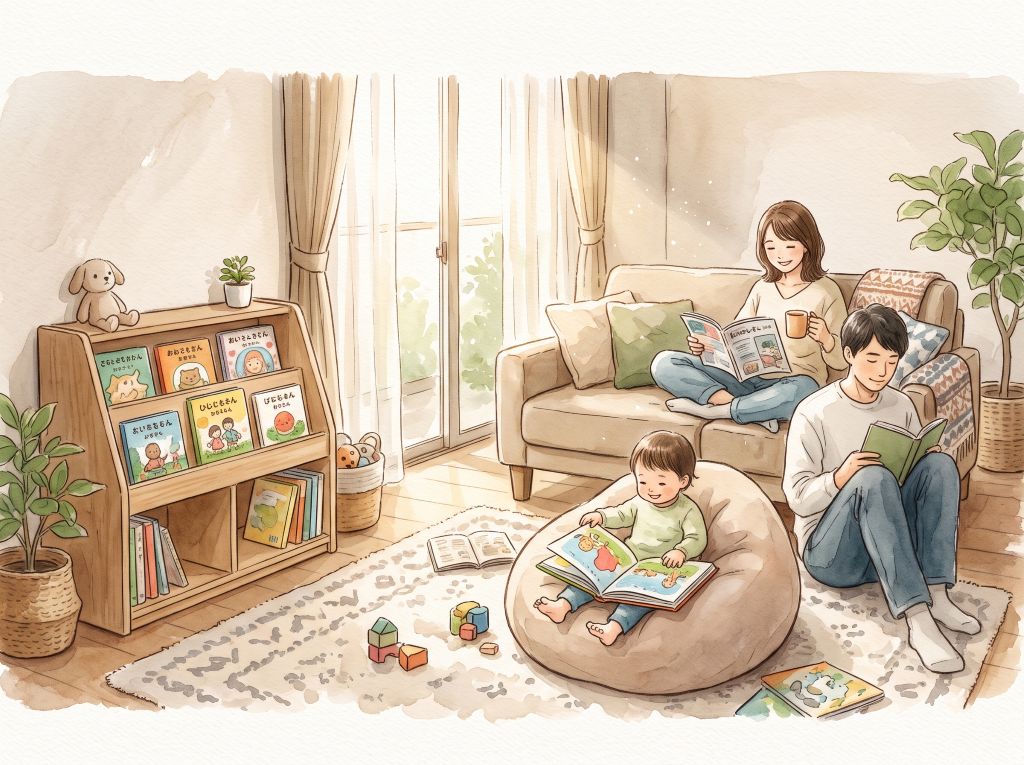
Decorating your home with books and creating a reading atmosphere at home is the most effective way to get children to love books.
Parents often complain that they’ve bought their children countless books since birth and read to them regularly, yet their children simply “aren’t interested in books.” Upon closer examination, we often find that such families lack a strong literary atmosphere. Reading isn’t just a child’s responsibility; simply buying books for children and focusing solely on their reading habits is far from sufficient.
The saying goes, “Example is worse than precept.” To get children to love books, the key lies in adults’ attitudes towards books. If adults only watch television, rarely buy books for themselves, and even less often read themselves, then even if children own many books, it will be very difficult for them to develop a love for reading rather than watching television.
Decorating your home with books encompasses not only decorating your child’s living space but also the entire family’s living environment. Children’s reading expert Trelease once described it this way: “If possible, build your roof with books.” This is certainly an exaggeration, but if we make books an integral part of our home, placing everyday books, newspapers, and magazines within easy reach, adults can naturally and frequently enter a reading state. The impact of such an environment on children is self-evident.
Family reading activities can take place not only between parents and children, but also as a family activity. Everyone can chat about books, read books and newspapers together, and when they come across an interesting passage, Dad reads it to Mom, and Mom reads it to Dad. The joy derived from reading will naturally be passed on to the children. Why would children not love reading?
【Example】
My daughter’s daily routine is quite rich. Besides eating, sleeping, and going to kindergarten, she plays with her friends, draws, dances, watches cartoons, plays computer games, and plays with toys. She also goes for walks, visits to the children’s playground, and swims in the summer, and so on. If you observe carefully, you’ll find that almost every child’s day is similarly busy. In short, children spend very limited time reading. How can we help children become book lovers as they grow up? It’s not simply about reading a few stories each day; another crucial element is the daily environment.
To give my daughter her own quiet bedroom, I gave her my study a long time ago. Half of her room is filled with my books, and the other half with her books and toys. It’s no exaggeration to say that she lives in a world of books. Finding and flipping through books in her room has become a daily routine. Whenever bundles or boxes of books I buy arrive, I ask her to help me organize them. We move them around, count them, and we’re as happy as a pair of rich kids.
Besides reading to our daughter, the adults in the family often read to each other, such as interesting stories from the newspaper or passages from books. Books like “The Giving Tree” are especially suitable for family members to read aloud to each other. There are also some fun quiz cards, such as a set of Tang Dynasty poetry quiz cards, which are perfect for the whole family to play together, except that the child gets the first chance to answer. Our daughter is particularly enthusiastic about these reading games.
If adults genuinely love books, it’s not difficult to get children to love them too. This doesn’t require excessive attention; simply making reading an integral part of family life is sufficient.
Seventeenth trick: The principle of shop windows
When we shop in malls, we often pay special attention to well-arranged shop windows, and many people linger in front of them. Multiple surveys show that items displayed in shop windows tend to have the highest sales conversion rate. If we consider recommending good books to children as a special kind of “sales pitch,” then we can certainly learn from the allure of shop windows.
Decorating a child’s living environment with books is like setting up a bookcase in the home. Placing lovely books in a child’s bedroom, on their bedside table, on their dedicated bookshelf, or on their toy shelf will definitely attract their special attention.
Sometimes we encounter situations where we really want to recommend a book or two to our child, but they don’t seem very interested. What can we do? Perhaps we should take a look at the window displays in shopping malls. Merchants will arrange their featured items in a very enticing way, coupled with harmonious backgrounds and lighting design, which will always make you want to take a second look.
Books can actually be displayed in a very appealing way. For example, a children’s book often has a beautiful cover and illustrations. If placed sideways on a bookshelf, only the spine with the printed text is visible. However, if it is laid flat or open, it will look unique. Several sets of books or books with related themes laid out together look even more lively and interesting. If you have a book you particularly want to recommend to children, you might want to try the principle of a shop window display.
Older children can sometimes be quite opinionated, seemingly uninterested in anything adults enthusiastically recommend. That’s perfectly fine. You can try putting the book in a locked glass cabinet, letting the child see it but intentionally not giving it to them, until one day you “carelessly” forget to lock it, and you might find the child secretly and eagerly opening it.
【Example】
American children’s reading expert Mr. Trelease once told a little story about his family. When his son Jamie was a little over nine years old, one morning he suddenly asked his father what kind of book was “John the Gunman’s Son” on the bookshelf. Trelease gave his son a brief introduction, and then asked curiously, “Why did you ask that?” Jamie explained, “Oh, I was just thinking about it. Sometimes when I wake up, I happen to see those book titles, and if I haven’t read a book yet, I’ll guess what it’s about based on the title.” You see, this is a classic example of how a shop window can be effective.
There’s another interesting story. Zheng Yuanjie, the “King of Children’s Literature” famous in China for creating stories like Pipilu, Luxixi, Shuke, and Beta, tells the following story in the preface to his adapted version of *Dream of the Red Chamber (Children’s Edition)*:
As a child, Zheng Yuanjie read *Journey to the West*, *Water Margin*, and *Romance of the Three Kingdoms* on his father’s recommendation, and became fascinated by these classic works. In elementary school, his Chinese teacher introduced the “Four Great Classical Novels” of China, including *Dream of the Red Chamber*. He was puzzled as to why his father hadn’t told him. He immediately asked his father when he got home, who told him that the book wasn’t suitable for children and should be read when they were older. This only fueled his curiosity. One day, he searched his father’s bookshelf and found *Dream of the Red Chamber*, then devoured it. He only read a few pages before his father discovered him, scolded him severely, and the book disappeared from the house. Years later, still yearning for it, he found *Dream of the Red Chamber* in the army library, finally fulfilling his reading dream. During his five years of service, he read it nine times. This classic novel had a profound influence on his later writing.
This is another story told through a shop window.
Tip 18: Reading is not just “a woman’s thing”.“
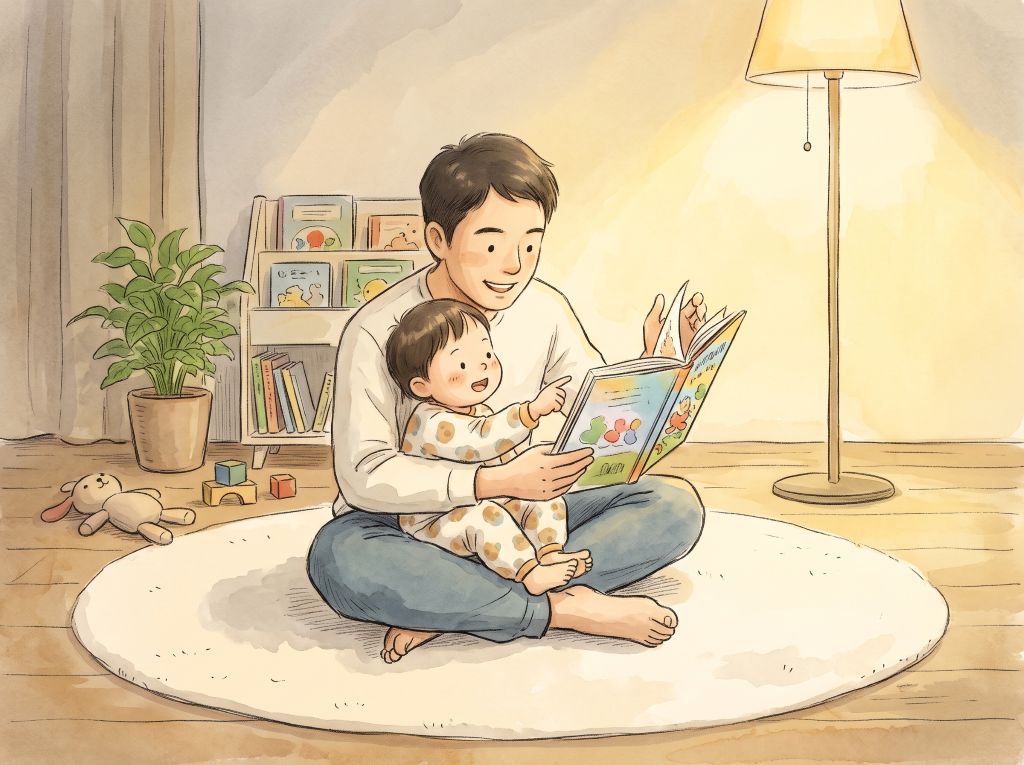
Early reading for children shouldn’t be just “a woman’s job”; fathers should participate in parent-child reading activities as much as possible.
Multiple surveys show that in nearly 90% of families in China, mothers are responsible for selecting books for their children, and in nearly 90% of families engaging in parent-child reading activities, mothers are also primarily responsible for reading to their children. If we expand on early childhood reading activities, almost all kindergarten teachers are women, and in the lower grades of primary school, roughly 95% of language arts teachers are also women. This means that for at least eight or nine years after a child’s birth, women almost entirely dominate their reading world. Therefore, it’s not surprising that they perceive “reading as a woman’s activity.”
What consequences might this situation have? A similar situation exists in the United States. One significant consequence is that the vast majority of students exhibiting significant reading difficulties in the fifth and sixth grades are boys! In modern society, reading difficulties are almost synonymous with learning disabilities.
Therefore, families with boys should pay special attention, as fathers need to take more responsibility for their children’s reading. This isn’t difficult to achieve; simply take your child to the library when you’re not playing sports, make time to read to them, set a good example by reading in front of them, and buy a few books along with roller skates as a gift.
From another perspective, fathers’ storytelling and reading styles differ from mothers’. Fathers are usually more assertive, humorous, exaggerated, and absurd, and they have unique approaches to handling these styles of stories that mothers lack. A child’s childhood is significantly diminished by the absence of stories told by their father.
【Example】
In families where both parents read to their children, the children who listen are often quite picky. For example, they might insist that Mom read this book, while Dad must read that one. But upon closer inspection, the children’s choices often make a lot of sense.
Since mothers usually read more books, I would like to recommend a few books that are suitable for fathers to read.
For example, Dr. Seuss’s “The Cat in the Hat” is humorous and whimsical, full of mischievousness, and requires exaggerated expression. Fathers should definitely read this kind of book.
For example, “Sunny Days, Sometimes Pigs Rain” is a really crazy book. You can’t really appreciate its charm without that crazy energy. That’s probably one of Dad’s strengths.
For example, in “I Say You Are a Bear,” a story about a father and son playing a game where the mother becomes a “pirate,” the philosophy of life and the warmth between father and son are something that only a father can truly understand.
For example, “The Ghost Under Willy’s Bed” seems like a story about a mother and son’s life, originally intended to help the child overcome his timidity, but it turns into a satirical commentary on the mother. Haha, how could a father miss such an opportunity?
For example, “The World’s Cutting-Edge Arsenal” contains the most advanced military gadgets. Dad’s expertise in this area is far superior to Mom’s. “War keeps women away”—Dad, charge!
The N+1st move: The best move is no move at all.
Parents’ Must-Read: I know you are a father who reads aloud to your child, but I don’t know how you interact with your child in other aspects of your life as a father.
A‑Jia: That’s a bit hard to say. My daughter especially likes to call me “Stinky Dad” or “Silly Dad,” which gives you an idea of what I mean. But she’s generally quite respectful in front of others. For example, when I pick her up from kindergarten, she sometimes shouts “Teacher A‑Jia!” from afar. Also, when I’m not home, if she argues with her mother, she’ll say something like, “Daddy said we should speak to children gently.”“
*Parents’ Must-Read*: In the past, when reading was mentioned, many people always said that it was something mothers should do. However, you often tell everyone that reading is by no means a woman’s exclusive job. So, how do you and your wife divide your roles in the family?
A‑Jia: This is probably a family tradition. My father does pay more attention to our reading and learning than my mother, and it seems to be more about enjoyment than responsibility. So, I find it hard to understand families where only the mother is particularly concerned about the child’s reading. In my small family, there’s no deliberate division of labor in this regard. I generally put in more effort when choosing and buying books, telling the child new stories, or when the child needs to progress through a certain reading stage; while for daily reading, especially rereading the same stories, my mother takes on more responsibility. Especially short bedtime reading sessions are basically my mother’s privilege.
Parents’ Must-Read: Many parents have called or written to us saying they don’t know how to choose books for their children. Could you tell us what makes a good children’s book? And how should we choose books for our children?
A‑Jia: This is a long story, enough to write a whole book about the philosophy and selection methods of children’s books. However, I can simply introduce a few principles:
First, adults should choose books that they also like; they must genuinely like them.
Secondly, we must keep trying. No one is born an expert. Adults grow up alongside children, and adults should be forgiving of themselves and not be afraid of making mistakes.
Third, we should communicate more, including with other people and with our own children, and be good at learning from other people’s experiences.
Fourth, respect children’s own choices. There is no best, only the most suitable. It is best to encourage children to make more independent choices from the beginning and trust their own choices.
Parents’ Must-Read: Besides choosing children’s books, how to read with children is also a problem that many mothers are confused about. I know that you have given 18 tips for parents in the upcoming issue 6 of the second half of Parents’ Must-Read. Can you share one or two tips here?
A‑Jia: Those 18 moves are an elaboration and refinement of some basic principles, which can be simplified back into two moves:
☆ Read to your child with an enjoyable attitude;
☆Strive to create a suitable reading environment.
There’s another move I didn’t introduce in the 18 moves because it’s “no moves,” meaning a move that doesn’t use any specific techniques. This move is called “becoming a children’s book enthusiast yourself.” If adults can truly do this…
If you become as fascinated with children’s books as a child, then any method will do.
I’m afraid I’ll end up fighting with the kids over the books, and then I’ll really be at my wits’ end!
(Compiled by A‑Jia; originally published in Parents’ Must-Read magazine in 2004)
Leave a Reply