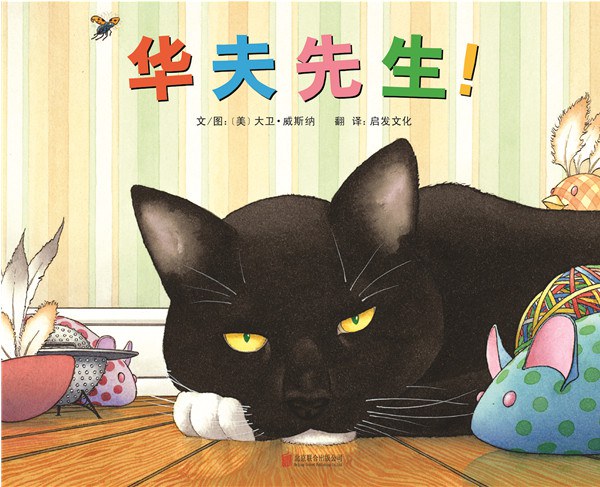
Last time we talked about David Wiesner’s “The Secret of the Sea,” which won him his third Caldecott Medal.Today we’ll talk about another masterpiece by this master of wordless books, “Mr. Wuffles!”, which won the Caldecott Honor.
Broadly speaking, this is David Wiesner’s fifth wordless book, following *The Great Flight*, *Tuesday*, *The Seventh Dream Factory*, and *The Secret of the Sea*. While *Tuesday* contains a few words—timekeeping notes—*Mr. Waffle* also has a few sentences—dialogue within speech bubbles within illustrations—not narrating the story. Therefore, both should be considered wordless books. After its publication, *Mr. Waffle* received praise from professional book critics, who called it David Wiesner’s best work to date! However, likely because he had already won the Caldecott Medal three times, he only received a Silver Medal in 2014.
However, in terms of creative techniques and the ability to tell stories through illustrations, David Wiesner has indeed reached a level of consummate skill. In this book, “Mr. Waffle,” he didn’t use many pages, only the usual 32 pages for a picture book, but very clearly presented a science fiction blockbuster with fairy-tale elements. The book brings together many elements that children are familiar with and love, making a thrilling alien story take place in what seems like an ordinary home.
Let me try to tell you the story in the book. As I always say, for excellent wordless books, the stories within the illustrations are rich, multi-layered, and complex, making them difficult to simply retell. The best way to read them is through shared reading with your child. Adults and children work together to discover the details in the illustrations and find the clues to the story’s development. Children are often better at noticing details, while adults usually have more background knowledge and a better understanding of the story’s internal logic. Therefore, collaborative storytelling or discussing while reading is probably the best reading method.
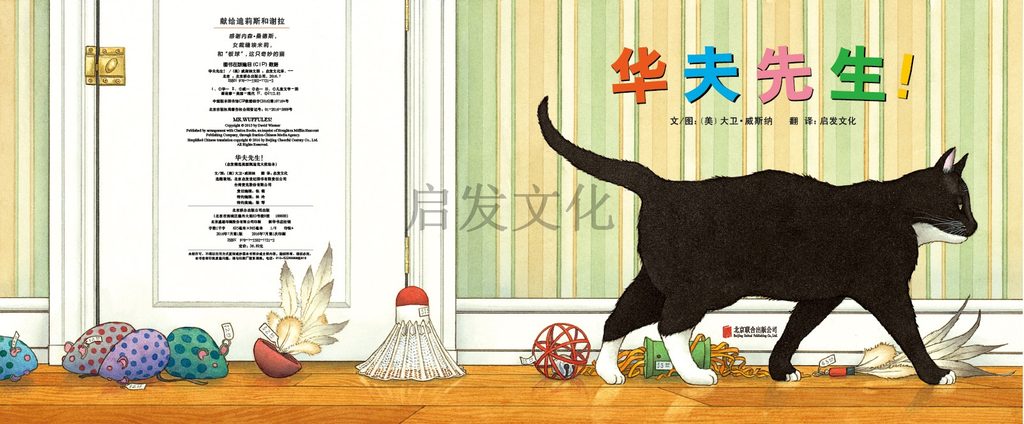
Mr. Waffle is actually the name of a cat, a black cat with white spots. If you’re familiar with David Wiesner’s work, you might recognize him; this cat appears in his semi-autobiographical picture book *The Hurricane*, where he’s called Hannibal, and also on the last page of *Dream Factory No. 7*. Mr. Waffle seems to be a very special cat. His owner dotes on him, constantly buying him new toys, and even before the price tags are removed, new ones are bought. However, Mr. Waffle is quite aloof, showing disdain for these toys. From the prologue page to the title page to the first illustration inside, you can see the cat arrogantly walking past a row of toys…
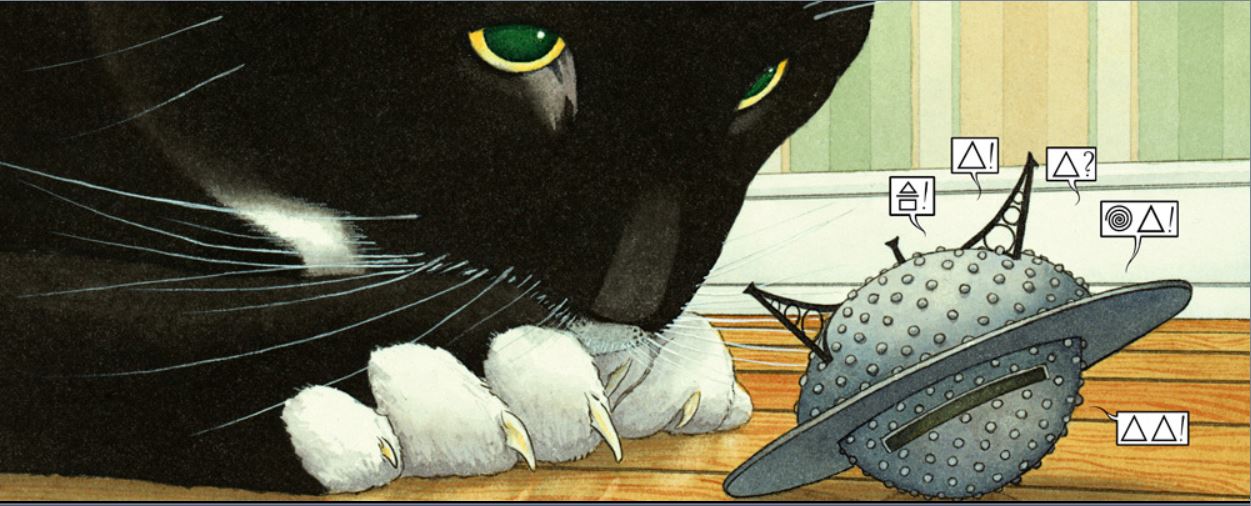
But wait, what’s that little thing near the cat’s hind leg? Zooming in, zooming in, it turns out to be a tiny spaceship, with aliens inside wearing robes and looking like bean sprouts.
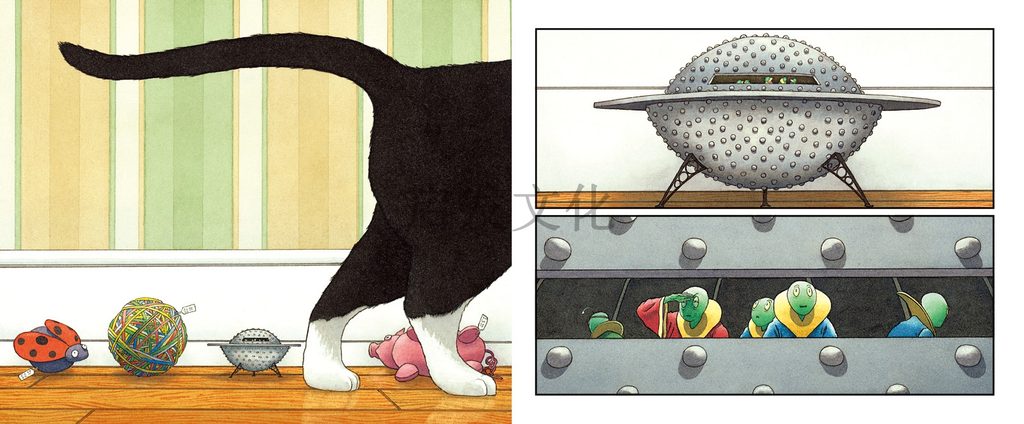
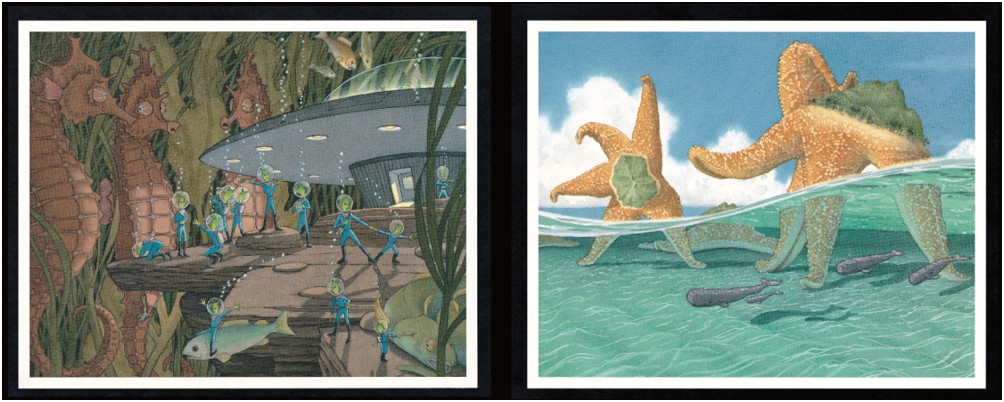
It turns out it’s about miniature aliens flying into your home. Isn’t that a thrilling concept? David Wiesner has always been a science fiction enthusiast. In the 1980s, he had the opportunity to collaborate with renowned director Steven Spielberg, illustrating the novel adaptation of *E.T. the Extra-Terrestrial*. The idea of aliens coming directly into Earth’s lives—this concept may have borrowed some logic from the movie *E.T. the Extra-Terrestrial*, but David Wiesner’s use of miniature aliens is arguably his own original creation. In fact, in that book, *Secrets of the Sea*, these miniature aliens live alongside seahorses on the ocean floor.
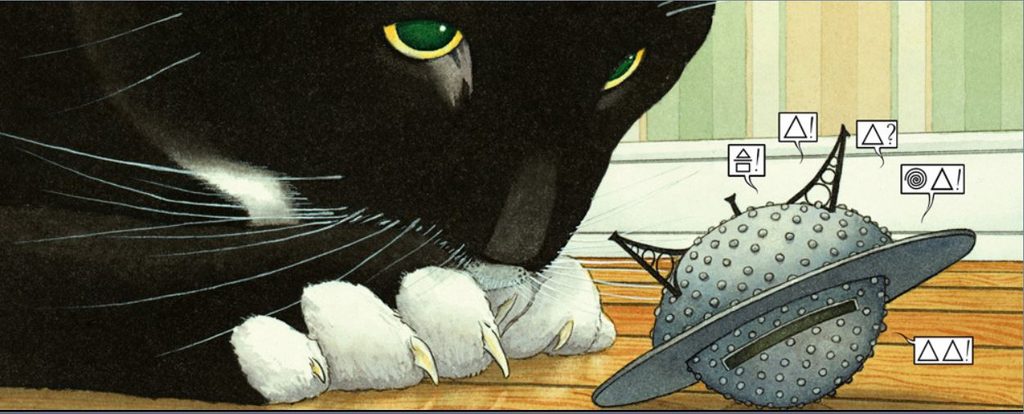
Back to the green bean sprout aliens in “Mr. Waffle,” they seemed to be cheering, perhaps because they had discovered a new planet and were celebrating a safe landing. But on the next page, they saw Mr. Cat’s big eyes through the spaceship window! To the enormous cat, the alien spaceship was like a tiny ball of yarn, which the cat naturally wanted to play with. The aliens inside were tossing and turning, getting completely disoriented, but worst of all, the spaceship started smoking—what happened? It turned out that the crucial flight instrument had malfunctioned. What to do? —The aliens trapped inside the spaceship decided to take a desperate gamble, and together they grabbed the damaged flight instrument and escaped, hiding in the radiator compartment by the wall.
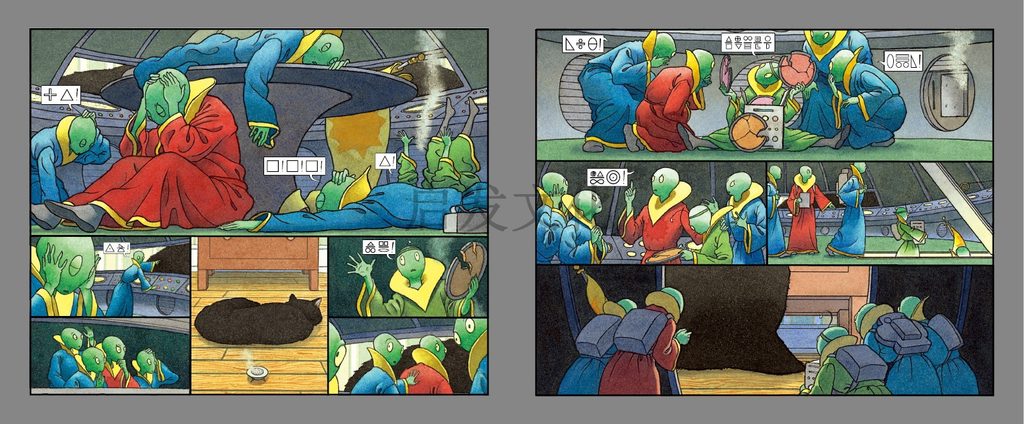
Thus began the first exciting chase and escape scene in the story. Pay special attention to the five aliens wearing robes of different colors. The one in the green robe with a small lightbulb on his head must be a tech expert; he was the one carrying the flight instrument, and it was he who eventually fixed it. Because the instrument was too heavy, the one in the green robe was left behind. But when Mr. Cat spotted them and prepared to swat them down, he lay down to protect the instrument, while the other two crouched behind him, shielding him. This shows how united and selfless these aliens were.
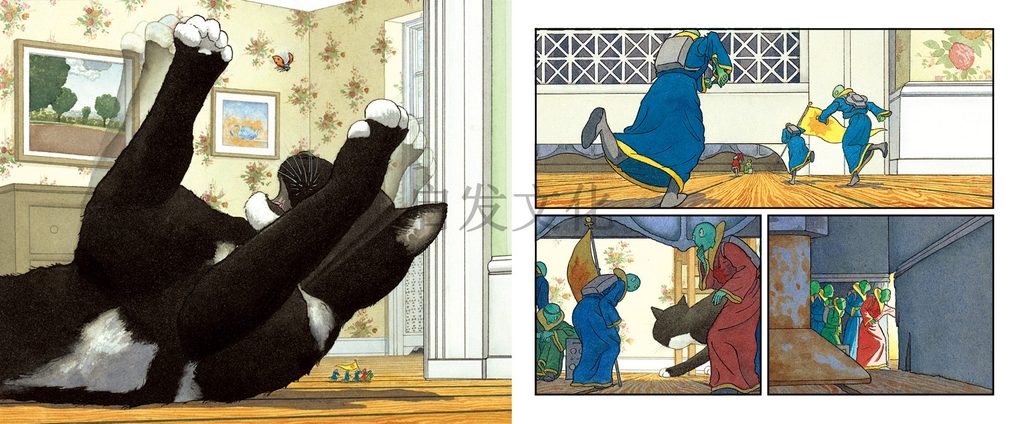
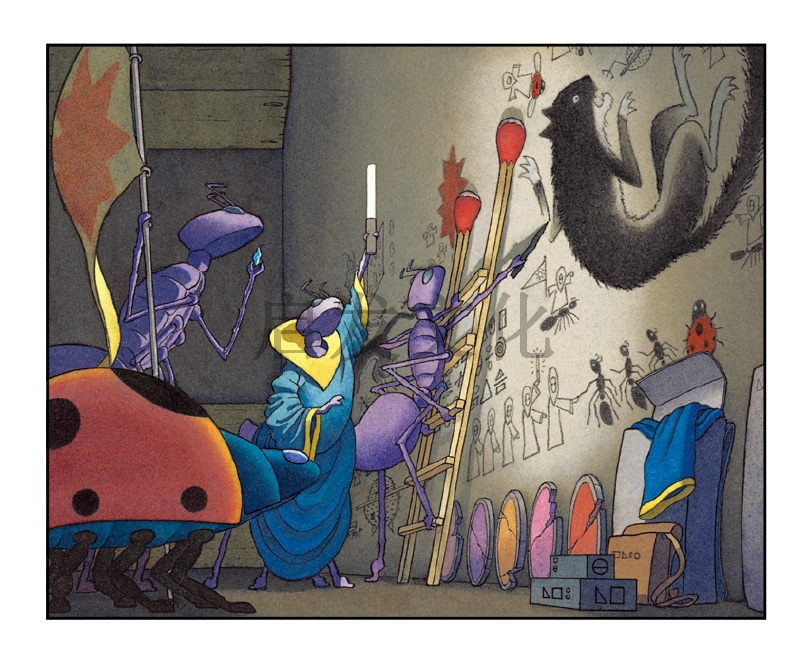
At the last second, a flying beetle distracted Mr. Waffle, and the alien finally managed to escape into the compartment behind the heat sink. There, they were surprised to find a mural on the wall depicting beetles and ants teaming up to fight a cat. When the beetle and ants arrived, the bean sprout alien immediately took to them, and they chatted and laughed. They then took photos together, shared food, and talked about everything under the sun…
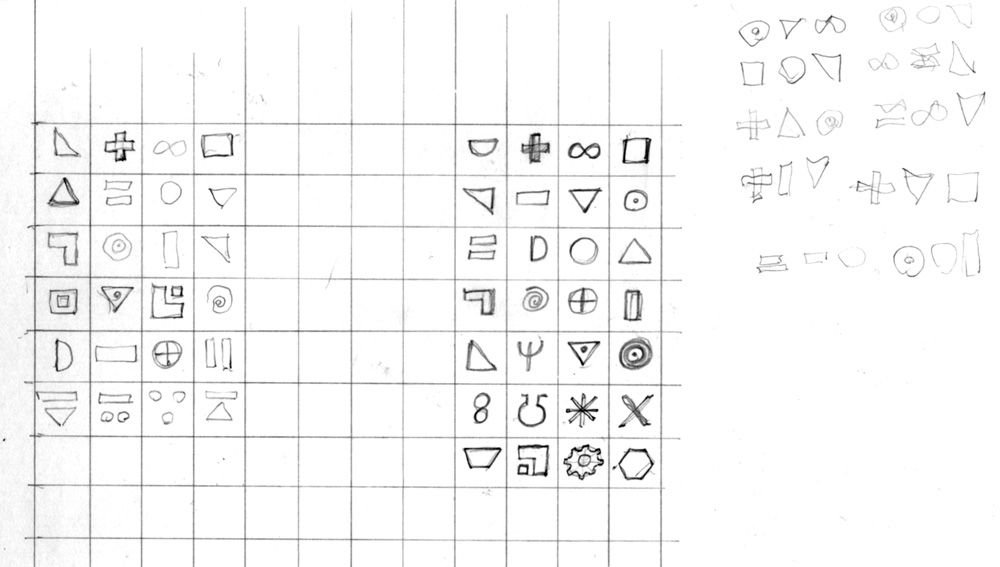
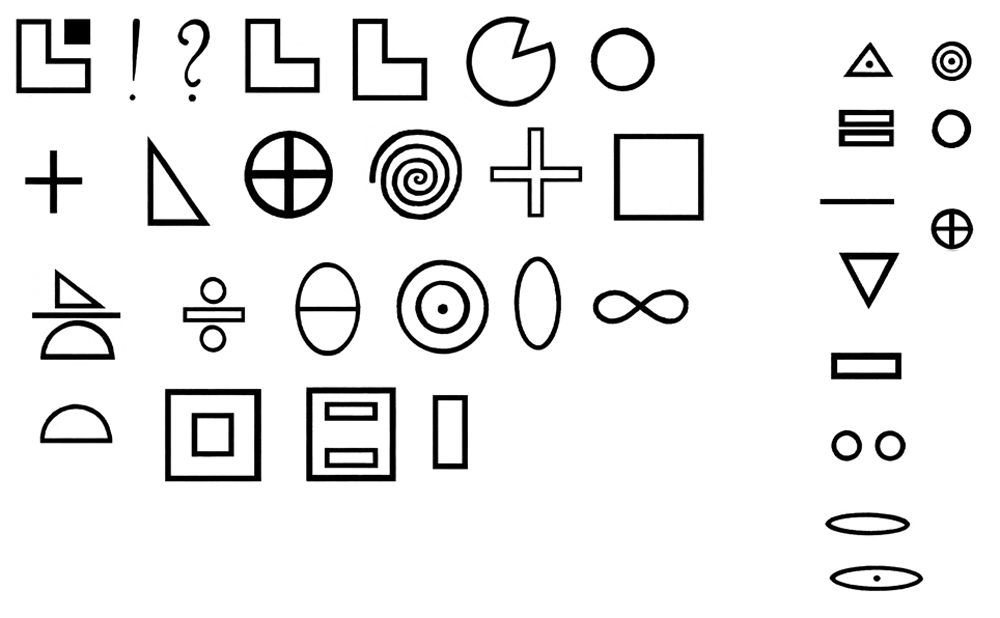
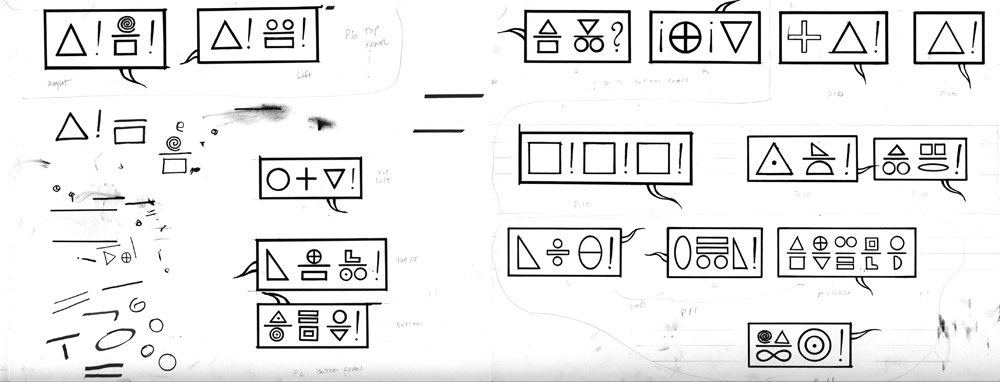
By the way, isn’t this a wordless book? How do the characters communicate? That’s precisely the most interesting part of the book. David Wiesner designed four languages for this story: the first is human language, which is the few words the cat owner says to Mr. Waffle; the second is the language of the green bean sprout alien, represented by various geometric shapes; the third is the language of beetles and ants, which is almost like a lot of small scratches spreading like smoke; and the fourth is the cat’s language, with only one angry “meow.” The story is set up so that the cat can understand human language, but the aloof Mr. Waffle almost completely ignores it, while the alien can communicate with the beetles and ants, and can even be said to have a pleasant conversation.
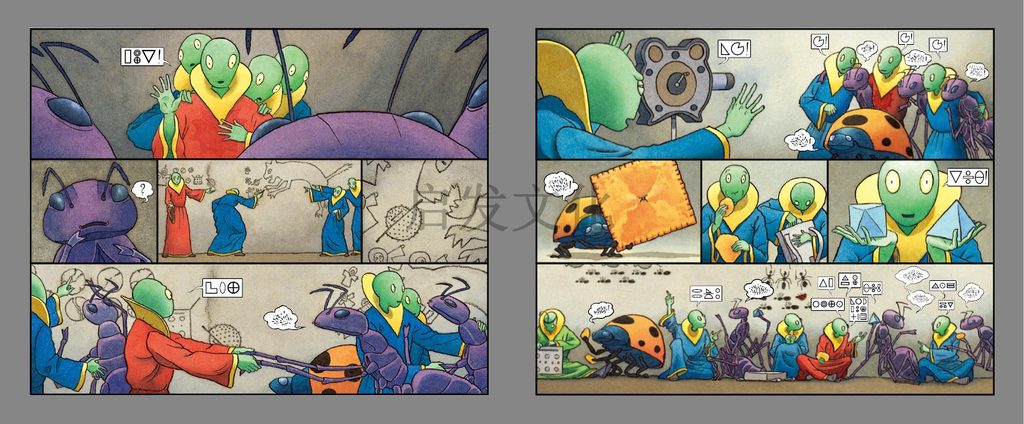
In the following story, the beetle and the ant provided crucial help, helping the alien repair the spacecraft. They also joined forces to evade Mr. Waffle’s pursuit and successfully sent the alien back to the spaceship and started it up. The alien piloted the spaceship and flew out of the window at the last moment before Mr. Cat was about to pounce on him.
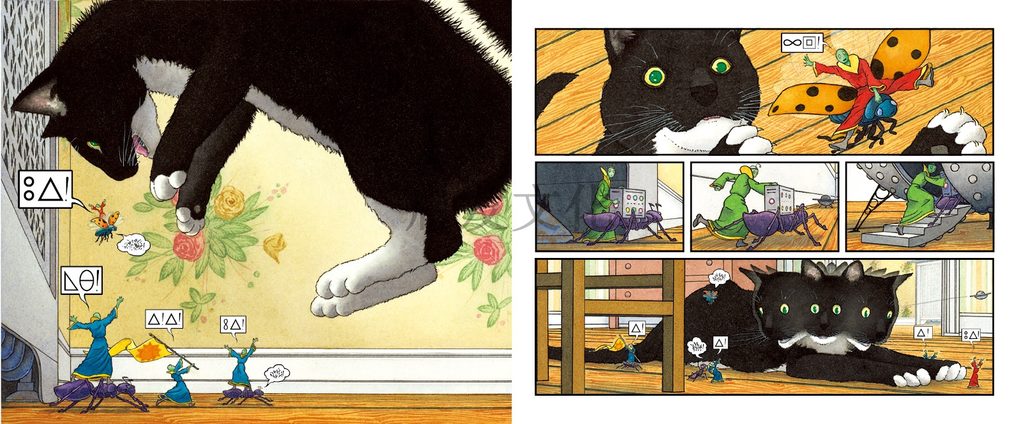
David Wiesner, who has been creating wordless books for over twenty years, has successfully presented the thrilling experience of a miniature alien’s triumphant escape. Using a series of illustrations to depict this process was not difficult for him. The most fascinating challenge for him was creating a unique alien language. To this end, he consulted a professor specializing in language, who suggested using graphic symbols as basic letters, combining them into sentences like mathematical formulas, and using fractional expressions like numerators and denominators to enrich the language. David Wiesner readily accepted this advice, and after some exploration, he created an alien language. The graphic symbols are sometimes upright, sometimes sideways, and sometimes upside down; different combinations of symbols produce rich variations. The alien in the green robe in the book is likely a spaceship engineer; note that his speech is quite neat, with complete numerators and denominators, indicating that he speaks logically, with a high information content, and has the demeanor of a scientist. Of course, what exactly the aliens in the book are saying is left for the reader to figure out.
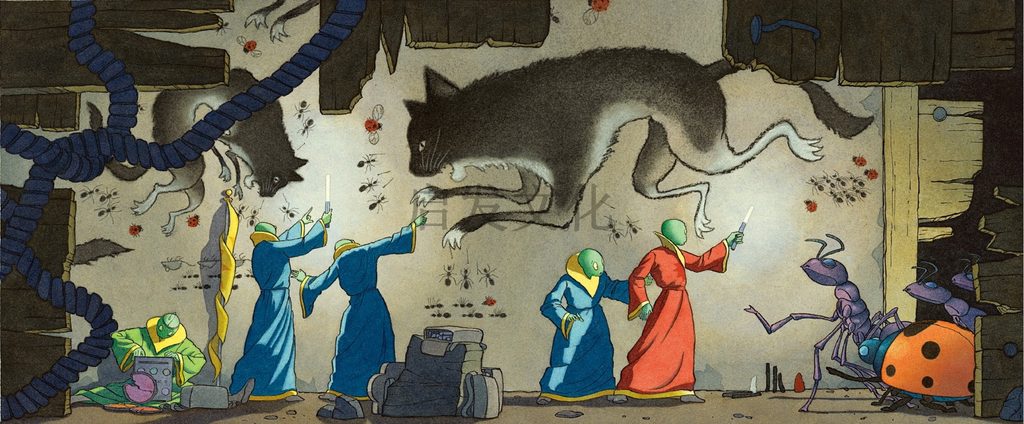
This miniature Star Wars sci-fi story demonstrates the various possibilities of communication through visual language. For example, the ant and beetle murals are clearly a tribute to cave paintings by primitive people. Primitive people used murals to record events, and so did the ants and beetles. The aliens understood this at a glance and quickly realized that the ants and beetles shared a common enemy—a cat named Mr. Waffle!
After the aliens leave, in the final illustration, the ants and beetles continue to enrich their mural while using the aliens’ equipment, recording their thrilling story of fighting alongside the aliens. Where do the ants’ and beetles’ language—those tiny scratches in the dialogue bubbles—come from? They actually represent the way Snoopy, the goofy little bird from the Peanuts comic strip, speaks. David Wiesner is unwittingly paying homage to Charles Schulz, the creator of Peanuts. Whether through comics, picture books, or wordless books, the goal is to show children the possibility of communicating through visual language, a concept that dates back to pre-written times and might even become a primary means of communication with extraterrestrials in the future.
Here, I want to emphasize the value of science fiction for children’s development. We all know that children love to fantasize, to start with everyday things and let their imaginations run wild. But as children get a little older, some adults become less enthusiastic about their children’s flights of fancy, even when they’re exposed to science, they prioritize the acquisition of scientific knowledge and worry that children will waste time on science fiction and neglect their studies. If you carefully consider a science fiction story like “Mr. Waffle,” you’ll find that it actually connects to a lot of knowledge; its fantasy is built on a solid foundation of scientific knowledge. You could say it’s using science as a game, experiencing things through science-based fantasy. This is because of a certain dissatisfaction, a desire to constantly push boundaries.
In the history of technological development, human imagination has always preceded invention. Humans dreamed of flying, and only then did airplanes come into being. The famous American fairy tale *The Wizard of Oz* features a tin man who roams freely; the story was written around 1900, and it wasn’t until almost half a century later that the first robots appeared. Furthermore, the three laws of robotics originated from the idea in Isaac Asimov’s science fiction novel *I, Robot*. The first human landing on the moon was in 1969, while Jules Verne’s science fiction novel *From the Earth to the Moon* was written a century earlier. Even the comic strip *The Adventures of Tintin* contains detailed descriptions of the moon landing, and the book *Exploring the Moon* was published 15 years before the Apollo moon landing…
There are many examples like this. What I want to say is that excellent science fiction stories not only don’t waste children’s time, but they can also help them apply their knowledge to the fullest extent, gaining exciting and enjoyable experiences through science. More importantly, in that immersive participation, their imagination and creativity are constantly stimulated, allowing children to dare to go further and further without restraint. David Wiesner’s science fiction picture books constantly challenge children’s imaginations in this way, and children become engrossed in them, responding with even wilder imaginations. This is precisely the most anticipated state of reading.
—That’s all for now. We’ll continue our discussion in the next episode.