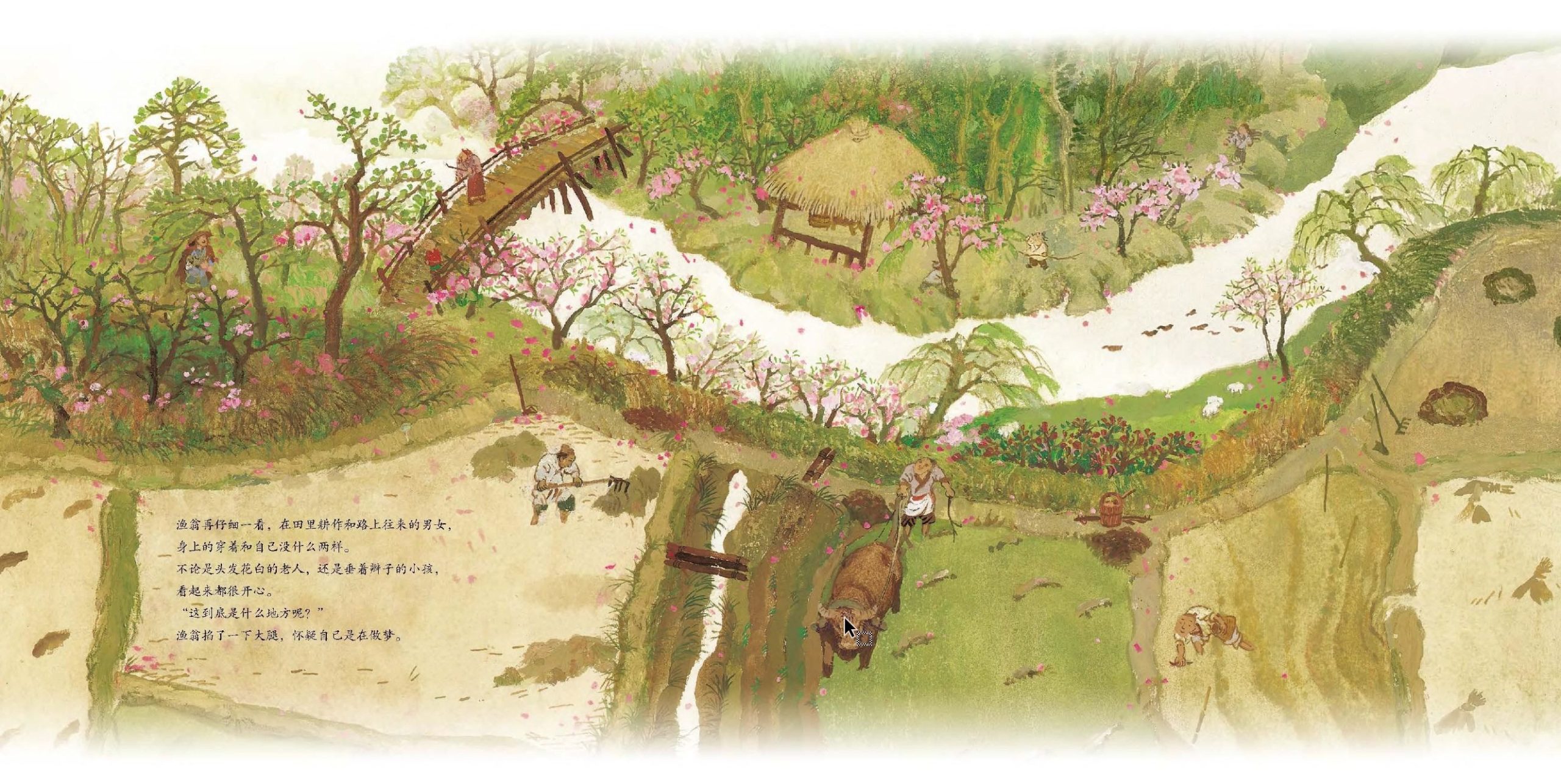
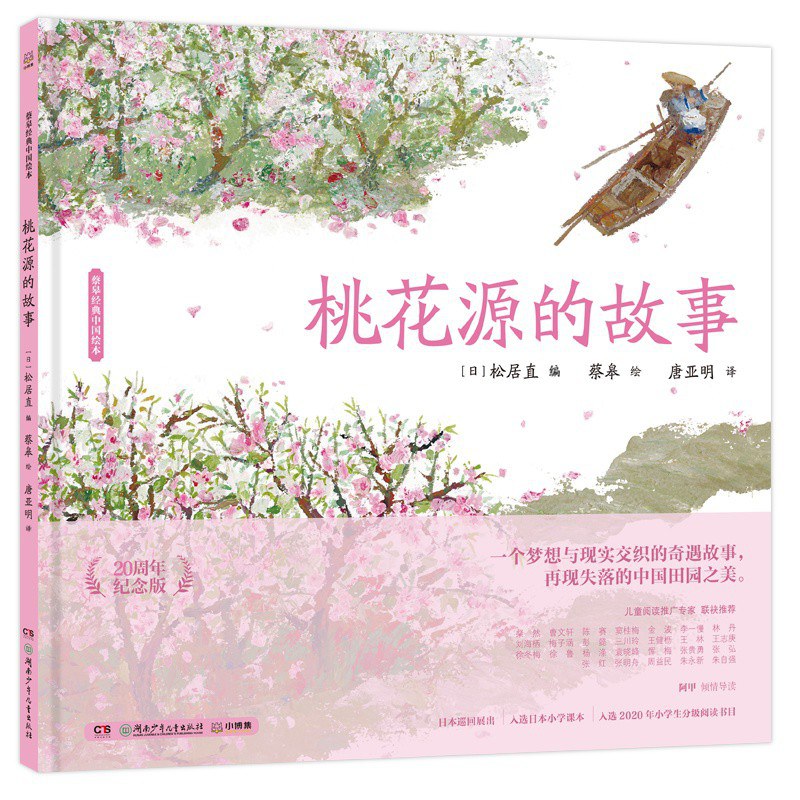
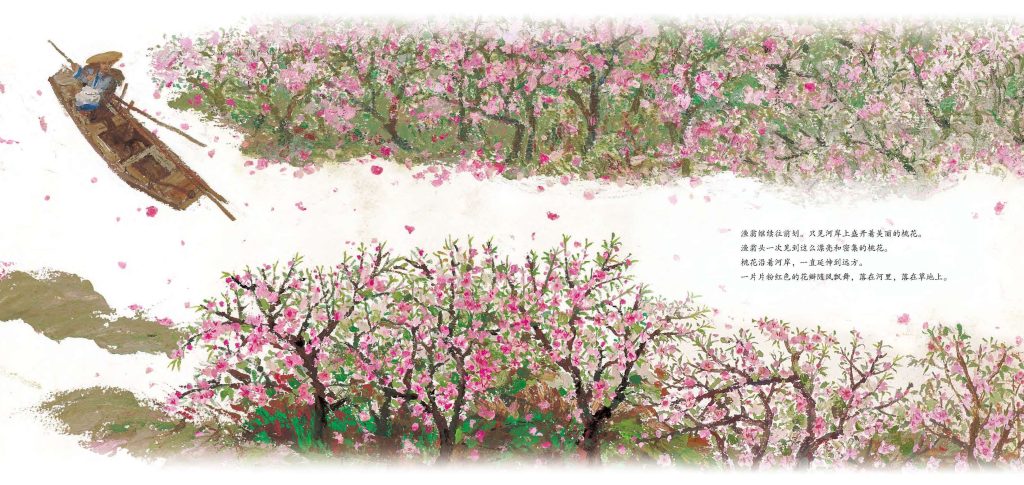
I first read “The Story of Peach Blossom Spring” in 2009, and was immediately struck by its overwhelming beauty. Although the text was a modern retelling by Mr. Matsui Nao, seeing Mr. Cai Gao’s paintings brought back Tao Yuanming’s timeless masterpiece. “During the Taiyuan period of the Jin Dynasty, a man from Wuling made a living by fishing.” (The first folio of the text) — turning to the next page, “Walking along the stream, I forgot how far I had gone.” — turning another page, “Suddenly I came upon a forest of peach blossoms, stretching for hundreds of feet along the banks, with no other trees in sight. The grass was fresh and fragrant, and the fallen petals were scattered profusely…” As I chanted the beautiful “falling petals profusely” and gazed upon the vibrant blossoms, I felt a little reluctant to turn the page.
Because I’ve loved this ancient Chinese text since childhood, I’ve always been able to recite it. I know it’s actually the preface to the Peach Blossom Spring, but I can’t memorize the five-character poem itself. This preface, however, remains deeply etched in my mind. I’ve seriously considered why “Peach Blossom Spring” appeals to children. First, it’s a beautiful and magical story. The sense of wonder it evokes in a lost wonderland captures a child’s curiosity and leaves a lasting impression. Second, it’s the sound and rhythm. Although the 321 characters are written in prose, the sentences are typically composed of three, four, or five characters, creating a rhythmic flow, like free verse unconstrained by meter. If you understand the story and recite it repeatedly in a rhythmic manner, you’ll likely find yourself dancing and enchanted.
As a picture book for contemporary young readers, it was crucial for Japanese publisher Naoki Matsui to adapt the story into a modern language. Thanks to his child-friendly retelling, complemented by Cai Gao’s stunning illustrations, the story was included in Japanese elementary school textbooks. This fulfilled a dream of Naoki Matsui’s. Influenced by his father from a young age, he deeply loved the story of Peach Blossom Spring. After a long journey, he finally had the opportunity, through international collaboration, to bring Peach Blossom Spring to the hearts of even more Japanese children. I believe that having an adult read the text aloud to children while they look at the accompanying illustrations is the best way to begin enjoying the Peach Blossom Spring story.
However, I have even greater expectations for young Chinese readers. I believe that after becoming fully familiar with the story, reciting the original classical text directly while observing the illustrations will be even more enjoyable. The story told in the illustrations alone perfectly aligns with the meaning and rhythm of the original text, demonstrating the artist’s profound literary mastery. In the original story, upon returning home, the fisherman “went to the prefecture and reported the incident,” implying that the fisherman had proactively reported the incident. The adapted version is more tolerant of human nature, with the prefect questioning the fisherman after hearing the rumor. The added details of the spread of information in the illustrations make this process more natural. The adapted original story omitted the following tidbit: “Nanyang Liu Ziji, a noble man, upon hearing the news, happily set out to visit…” However, the artist’s final folio could also be interpreted as conveying this message. The figure furiously writing on the boat could be either Tao Yuanming or Liu Ziji. Therefore, turning to the last page and seeing the lonely boat perfectly embodies the sentiment of “no one has since come to visit.”
I’ve read this book directly from Tao Yuanming’s original text in many reading activities with children. The most memorable one was at the Beijing Concert Hall. Accompanied by a performer’s impromptu music, we immersed ourselves in a beautiful imaginative world created by the efforts of ancient and modern people, Chinese and Japanese. We knew it was a story, but it was more than just a story; it was a beautiful wish, worth passing down from generation to generation in the best possible way.
Cai Gao’s experience of having to teach in remote villages for many years during a special period has nourished her brush with a strong rural flavor. The folk customs in the book are real and tangible. Even the four words “all come out of wine and food” in ancient texts are reflected in the picture as fragrant farm meals in western Hunan. Readers of all ages will have a better understanding and love of life through such reading.
However, thanks to a collaboration with Naoki Matsui, known as the “Father of Japanese Picture Books,” this book also fully incorporates the narrative language of modern picture books. The edges of the images are blurred throughout the story, giving this beautiful tale a constant air of mystery. Water is present almost everywhere in the story, yet the artist rarely depicts it directly. The blank space left in traditional paintings often becomes the reader’s imaginary water, and sometimes serves as a blank space for text. There’s also the direction: the fisherman enters the Peach Blossom Spring from left to right, but leaves from right to left…
There’s an interesting detail. Since childhood, I’ve wondered how the fisherman, upon leaving, marked the path to Peach Blossom Spring, hoping to return. Why then, despite searching for the path he had marked, did he still get lost? Where did his earlier markings go? This book surprisingly provides the answer! Of course, this is a subtle play on details the artist left in the painting. I believe young readers will enjoy discovering it for themselves.
Written in Beijing on January 1, 2021