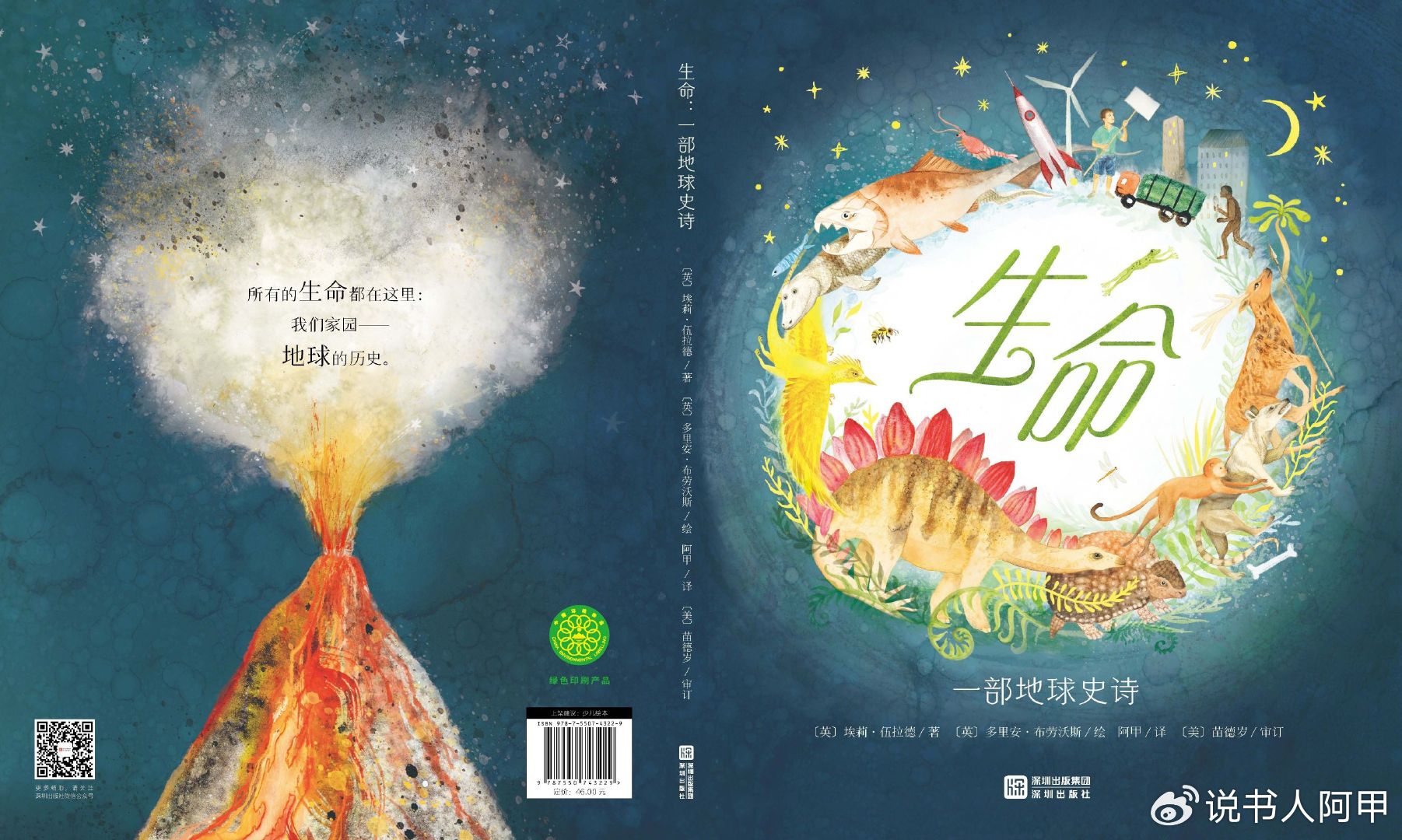
The Chinese version of “Life: An Epic of Earth” has been introduced and published by Shenzhen Publishing House, translated by A‑Jia, and with thanks to paleontologist Miao Desui for his popular science review.
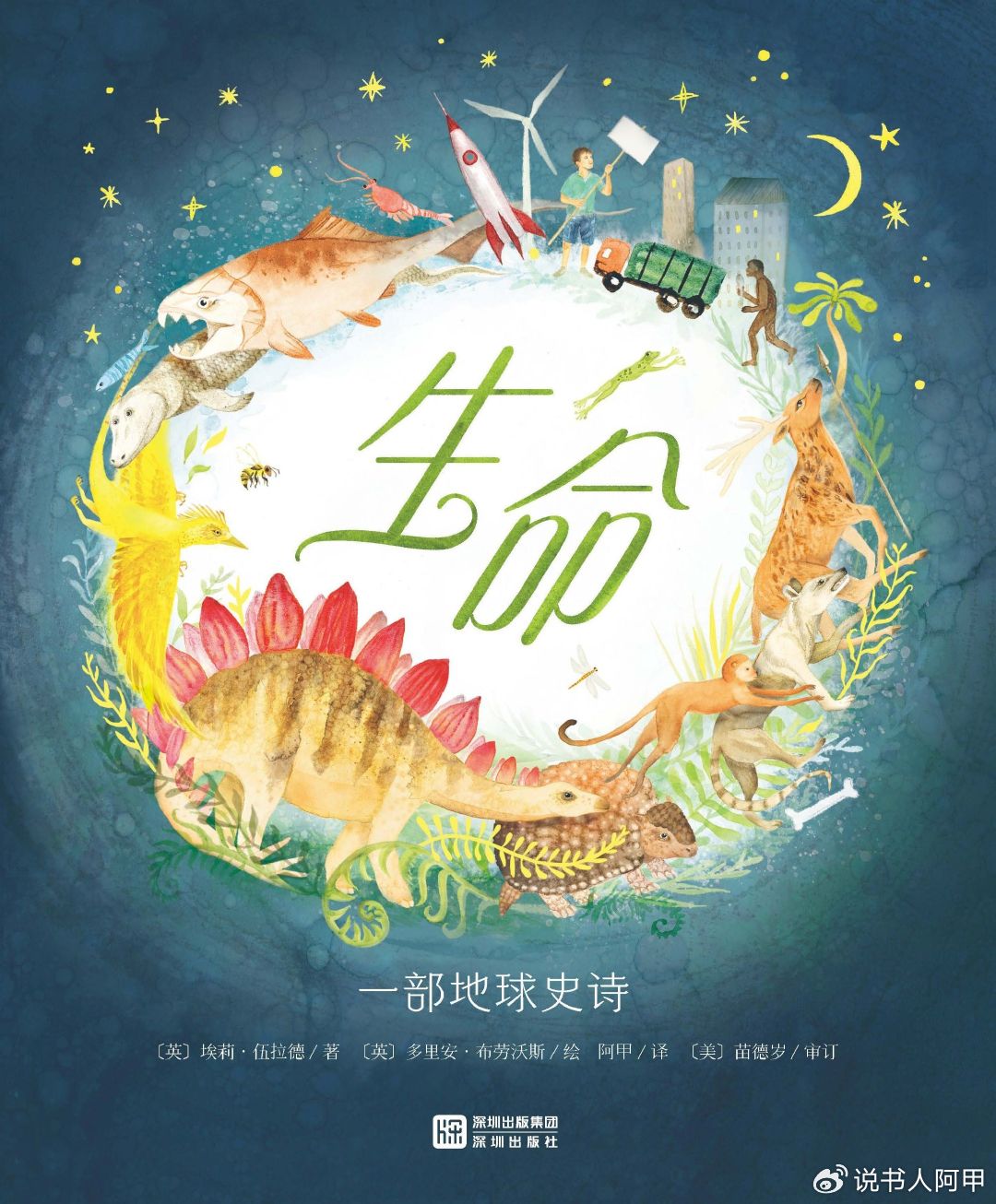
Imagine how to present the Earth’s 4.6 billion-year evolution in a long poem (while maintaining a rigorous scientific approach).
Before time begins,
The world has just been born.
All over the earth
There are no living beings yet.
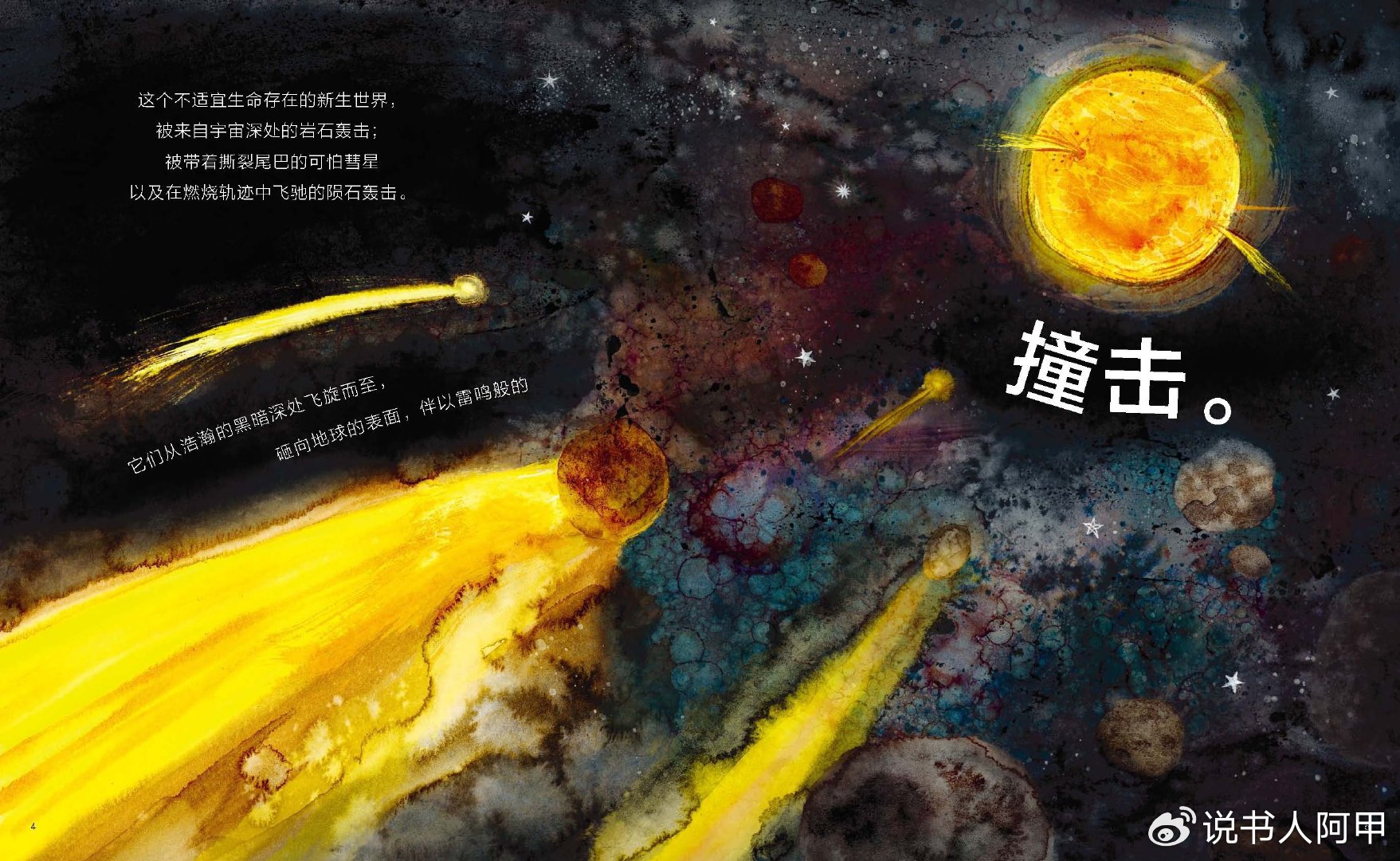
This new world is unsuitable for life.
Bombarded by rocks from deep space;
A terrifying comet with a torn tail
And the bombardment of meteorites speeding along their burning trajectories.
Life: A Celebration of Earth’s History creates a unique “double immersion” experience by transforming rigorous scientific knowledge into catchy, rhyming long poems, accompanied by magnificent watercolor illustrations. It’s more than just a popular science book; it’s an audiovisual feast spanning 4.6 billion years.
Author Elli Woollard breaks away from the dry prose or dialogue style of traditional popular science books, boldly adopting an extended long poem format. Through rhyme and rhythmic variations, the text simulates the pulse of Earth’s history. For example, in describing the early days of the Earth, the verses depict the “bombardment” of cosmic rocks and the “flights” of comets, creating an atmosphere of violent upheaval; while in describing the emergence of tiny bacteria, the tone softens, describing their “quiet spread.” This rhythmic cadence makes the otherwise profound geological eras easy to read and remember, described as “a perfect blend of narrative, science, and wonder.” Elli uses imaginative vocabulary to explain complex scientific concepts. For instance, she describes cyanobacterial photosynthesis as “breathing oxygen out of the ocean,” and the extinction of dinosaurs as “finally, only bones and dust remained.” This poetic language not only lowers the barrier for children to understand evolution but also imbues cold fossils with warmth, allowing readers to empathize with the passing of life.
The book is structured like an epic, beginning with the dark void “before time began,” traversing the explosion of marine life, the age of dinosaurs, and finally the rise of human civilization. Particularly noteworthy is the ending, where the poem shifts from praise to warning, bluntly stating that humanity is a species “capable of both building and destroying.” This emotional turn is highly impactful, inspiring readers to feel a sense of responsibility for the future.
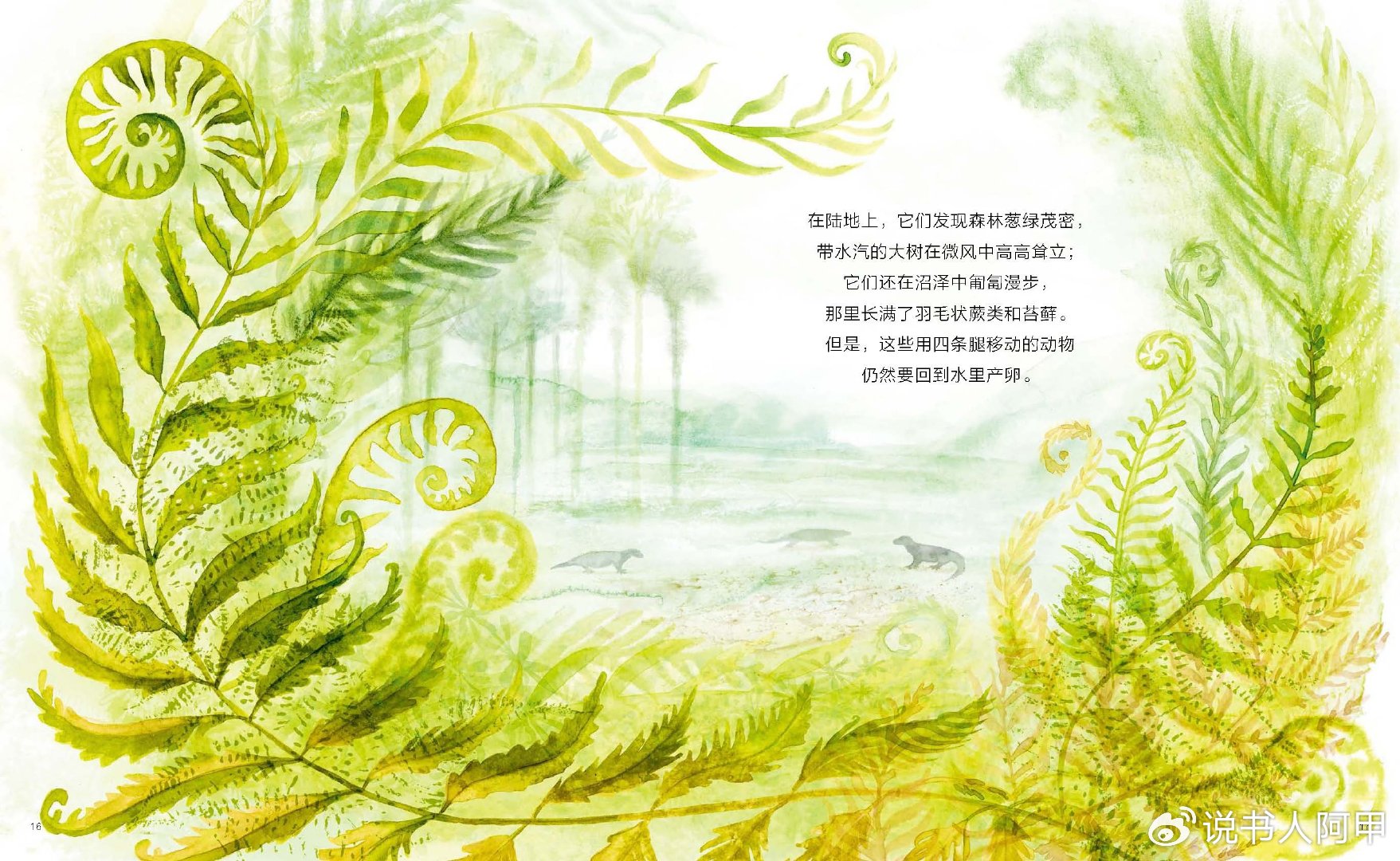
Illustrator Dorien Brouwers utilizes the transparency and fluidity of watercolor to create immersive panoramic images that are both scientifically detailed and aesthetically pleasing. Instead of a cartoonish style, Brouwers employs a delicate, beautiful, and magnificent approach. For example, she uses deep blacks and bursts of orange-red to depict the magma and impacts of Earth’s early days, showcasing a “hostile” yet spectacular primal beauty; she uses fresh greens and soft light and shadow to depict the lush greenery of the first forests. This style transports the viewer to that distant time and place.
While maintaining its artistic merit, the illustrations are rich in detail in their depiction of prehistoric creatures. From “shelled tubes” in the ocean to “flipped worms” on land, and various dinosaurs (horned, spiky, swift), the images vividly “revive” extinct creatures. Critics have noted that these illustrations are “extremely detailed, bringing historical scenes to life.” On the page depicting the asteroid impact that led to the extinction of the dinosaurs, the image suddenly turns gray, revealing only skeletal remains; this strong visual contrast intensifies the devastation of the disaster. Later in the book, when human cities appear, the illustrations are filled with skyscrapers and machines, creating a stark contrast to the previous natural landscape and vividly illustrating the enormous changes humans have made to the Earth’s appearance.
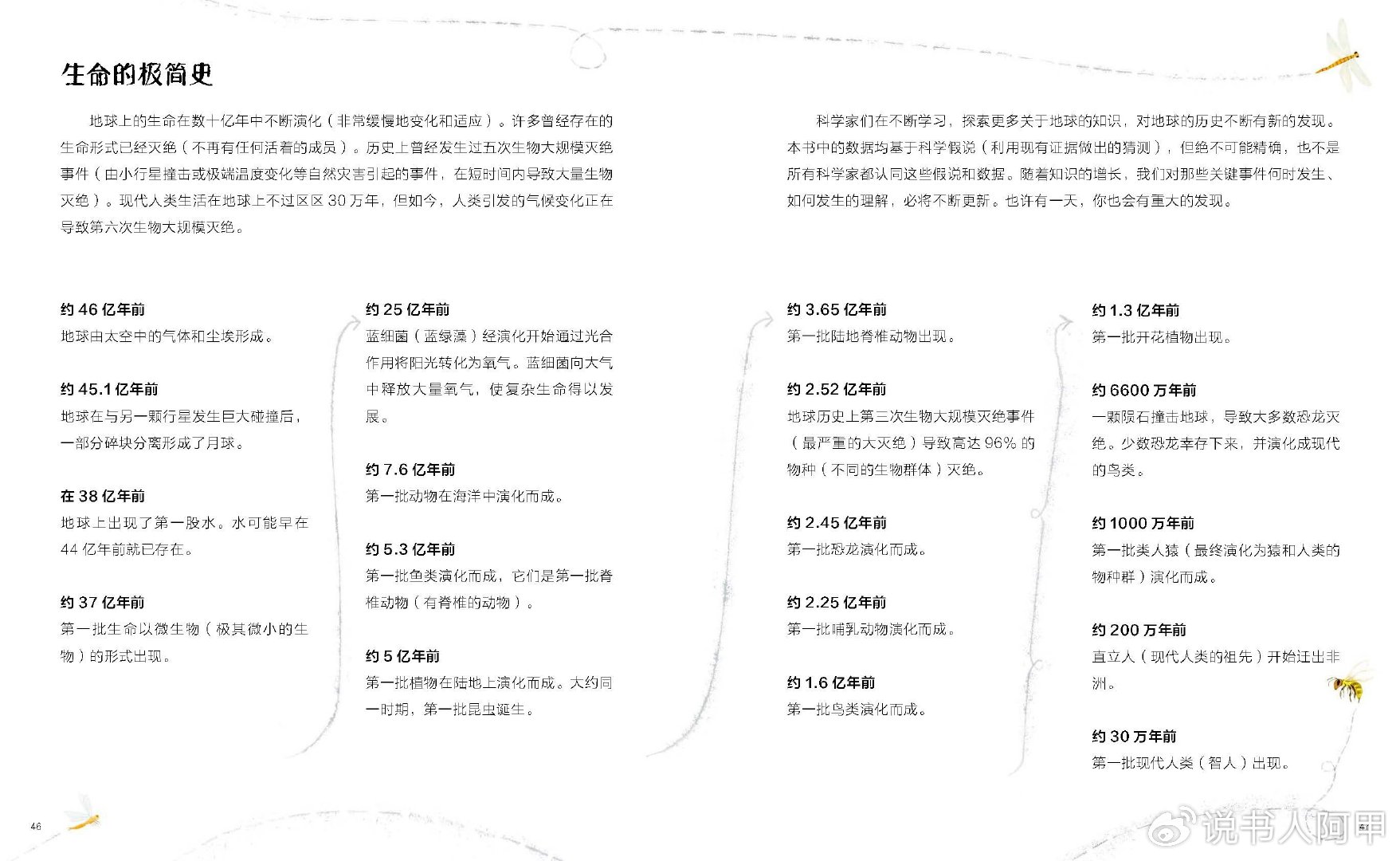
This non-fiction picture book skillfully balances “poetic experience” and “scientific rigor” in its depiction of evolution: the main text is responsible for “wonder”—focusing on storytelling and conveying emotions, allowing children to experience the miracle of life’s evolution and the fragility of the Earth through reading; the appendix is responsible for “truth-seeking”—a special “minimalist history of life” timeline at the end of the book lists key milestones (such as the appearance of water 3.8 billion years ago, the extinction of dinosaurs 66 million years ago) and their scientific explanations. This design ensures the accuracy of the picture book as a science book while avoiding excessive data that could disrupt the poetic flow of the main text.
Unlike textbooks that mechanically list geological ages, this work reshapes Earth’s history through the chemical reaction of poetry and painting. If we compare Earth’s 4.6 billion-year evolutionary history to a grand symphony, then Ellie Woolard’s poetic words are the undulating melody, guiding the direction of emotions; while Dorian Brouwers’ immersive illustrations are the magnificent stage setting, completely drawing the audience (readers) into this performance that transcends time and space.
[Author and Illustrator]
Elli Woollard is a British children’s book author, best known for her picture books and children’s poetry. With a degree in social anthropology, she has worked as a teacher, editor, and translator, a diverse background that imbues her work with both a humanistic perspective and childlike charm. Woollard’s works are renowned for their catchy rhyming verses and humorous stories, characterized by their brisk pace and wit, making them popular with children and parents alike. For example, her representative works, such as *The Giant of Jum* and *The Dragon and the Nibblesome Knight*, are rhyming fairy tales that blend humor and warmth, showcasing her talent for nursery rhyme-style narrative. In her new book, *Life: An Epic of Earth*, Woollard continues her signature poetic narrative style, using lyrical long poems to tell scientific stories, hailed as a model of “perfectly blending narrative, science, and wonder.” It’s worth noting that Woolard’s own concern for society and history, as well as her identity as a mother of four, prompted her to convey her care for the evolution of life and our planet Earth to children through poetic language. This book is her first attempt at large-scale popular science, a bold exploration that integrates professional knowledge into the nursery rhyme genre.
Illustrator Dorien Brouwers is a Dutch illustrator who graduated from a British art school with a degree in graphic design. Her artwork has been selected for the Bologna Children’s Book Fair Illustration Exhibition and has won awards at world illustration competitions, demonstrating her high artistic level. Brouwers’ style is delicate and beautiful, and she excels at creating immersive images using traditional media such as watercolor. She has previously provided illustrations for renowned museums such as the Prado Museum and Tate Modern. In *Life: An Epic of Earth*, Brouwers recreates the various stages of life’s evolution with magnificent and grand visuals. The illustrations are exquisite, vivid, and full of epic grandeur, with many scenes so realistic that they feel like you are actually there. Her illustrations enhance the impact of the text, turning the history of scientific evolution into a series of beautiful scrolls of life. From her creative motivation, Brouwers has a genuine passion for nature and environmental protection—in the book’s title page, she pays special tribute to a young reader, May, who once asked, “Could humans have been born from dinosaurs?”, and to William, a child who calls her a “little ecological fighter.” This reveals her desire to answer children’s curiosity about life through picture books and inspire environmental awareness among the younger generation. This creative intention coincides with Woolard’s poetic approach to science popularization, laying a foundation for the book’s poetic yet responsible tone.
[Comparison with similar science picture books]
Children’s picture books on the theme of natural evolution are not uncommon, with classics such as *Life Story: The Story of Life on Our Earth from Its Beginning Up to Now* (by Virginia Lee Burton) and more recent originals like *The Great Evolution: The Miracle of Life on Earth Over 3.8 Billion Years* (by Milly Children’s Books) each possessing their own unique characteristics. However, *Life: An Epic of Earth* stands out for its unique innovation in both content depth and form:
Firstly, in terms of narrative form, most life science picture books use prose or dialogue to convey knowledge, while *Life* is entirely a long narrative in poetic form. One review noted, “Of all the books on this subject to date, none has been written with such elegance and composure in the extended poetic form as *Life*.” Woolard skillfully employs rhythm and repetition, making the entire book melodious and easy to read aloud, perfect for parent-child reading. This poetic narrative not only enhances the literary beauty but also lowers the reading threshold for profound scientific concepts. In contrast, Burton’s *The Story of Life* uses a five-act play structure to metaphorically represent the history of life on Earth; while the language is equally poetic, it leans towards a prose style. *Life*, on the other hand, completely connects billions of years of history with rhyming poetry, a bolder form.
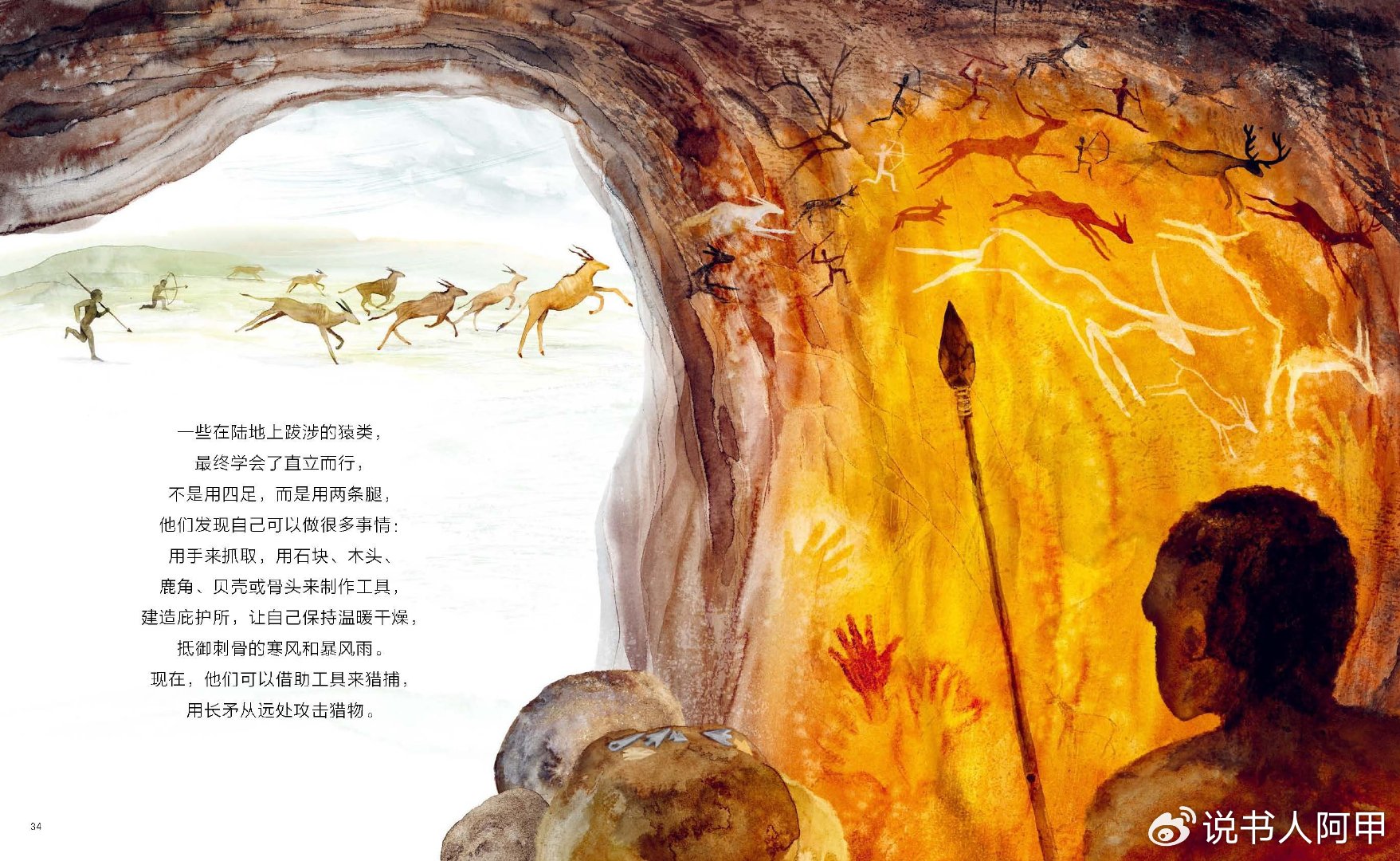
Secondly, in terms of illustration style and visual presentation, *Life* employs immersive panoramic images, with a delicate and realistic style that doesn’t lack artistic imagination. Each illustration is “deeply impactful and beautiful, rich in detail, bringing historical scenes to life.” Many picture books on similar themes either use exaggerated cartoon styles to appeal to children or take a realistic, scientific illustration route. Brouwers, however, chose a blend of impressionistic and realistic techniques: it provides accurate scientific depictions of ancient creatures and their environments while creating a breathtaking epic atmosphere through color and composition. For example, scenes of the birth of the ocean, the roaming of dinosaurs, and glacial storms are handled with a realistic yet dreamlike grandeur, elevating the overall aesthetic of the book. Burton’s *The Story of Life* features illustrations with a mid-20th-century retro feel; while the compositions are grand, the colors and brushstrokes are simpler. *Life* successfully strikes a balance between scientific rigor and artistic aesthetics, providing children with visual enjoyment while inspiring wonder and reflection on the evolution of life in every illustration.
In terms of breadth of content, *Life*, like many evolutionary picture books, covers the entire process from the birth of Earth to modern humans. However, it weaves complex knowledge into simple and easy-to-understand poetry, integrating scientific information into the storyline, achieving both scientific accuracy and entertainment. The text “skillfully utilizes poetic features, is rich in information, supports curious children in understanding the evolution of the world, and is honest about contemporary world problems while still holding hope for the future.” For example, the book uses imaginative vocabulary and rhymes to describe ancient life (such as using onomatopoeia to depict comet impacts and the “thump-thump” footsteps of dinosaurs), conveying knowledge through entertainment. The ending, discussing the impact of human environmental impact, becomes more serious and direct, prompting readers to reflect. In contrast, *The Story of Life* is more detailed and praised for “presenting a time and space landscape that is both distant and close with extremely simple yet grand language and magnificent illustrations,” but it has more text and a relatively higher reading threshold. *Life: An Epic of Earth*, on the other hand, while ensuring accuracy, cleverly reduces the difficulty of understanding through the conciseness and rhythm of poetry. The “A Brief History of Life” timeline appended at the end of the book lists key evolutionary events on a timeline with brief annotations, supplementing the popular science information. This design balances readability and scientific accuracy, further highlighting its innovative form.
[Core Concept: Earth’s Epic and Human Responsibility]
“Life: An Epic History of Earth” is published by Puffin Publishing in the UK. Puffin is a renowned children’s book publisher under Penguin Random House, known for its high-quality children’s literature and picture books. Puffin’s release of this picture book, which compiles a “complete history of Earth,” demonstrates their endorsement of the book’s concept. The editors emphasize in the promotional materials that the book “perfectly blends storytelling, scientific knowledge, and a sense of awe,” hoping to satisfy children’s curiosity and inspire wonder at nature.
From the perspectives of the authors and illustrators, the core message of this book is very clear: to respect the evolutionary process of life and to face the responsibilities that humanity bears. A major motivation for the two authors in creating this book was to answer children’s curiosity about the origins of life, cultivate their scientific spirit, and at the same time raise their awareness of environmental protection.
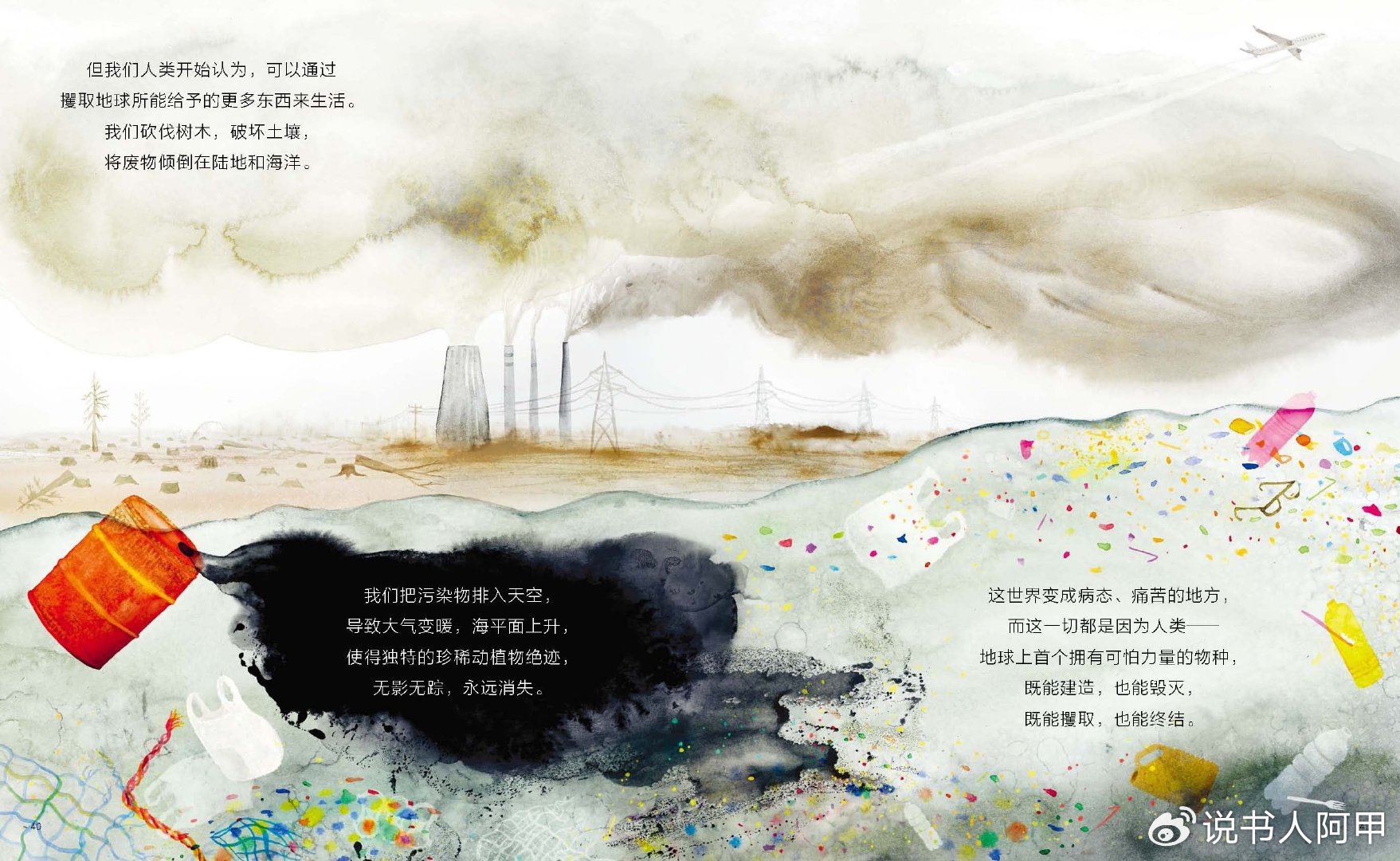
The book’s approach to Earth’s history and environmental issues is both gradual and impactful. The first half, filled with wonder and praise, depicts the magnificent process from the primitive Earth to the emergence of dinosaurs and humans, its soaring and poetic tone inspiring awe in the reader regarding the evolution of life. However, after the introduction of humans, the story shifts dramatically, using stark and somber language to describe humanity’s exploitation and destruction of the Earth: “We cut down trees, destroy soil, and dump waste on land and in the ocean. We release pollutants into the sky, causing global warming, rising sea levels, and the extinction of unique and rare plants and animals…” These words are quite rare in picture books, yet they accurately pinpoint the cause of the contemporary ecological crisis—humans are the first species on Earth capable of both creation and destruction. This message reflects the author’s strong sense of urgency: to help children understand the pain and “pathology” that humanity has inflicted on the Earth. But the author doesn’t stop at warning; instead, at the end, the author appeals for “cherishing this precious place—our home, Earth.” This narrative technique of first praising and then criticizing, and then turning to hope, allows children to feel both the severity of the crisis and the significance of taking positive action.
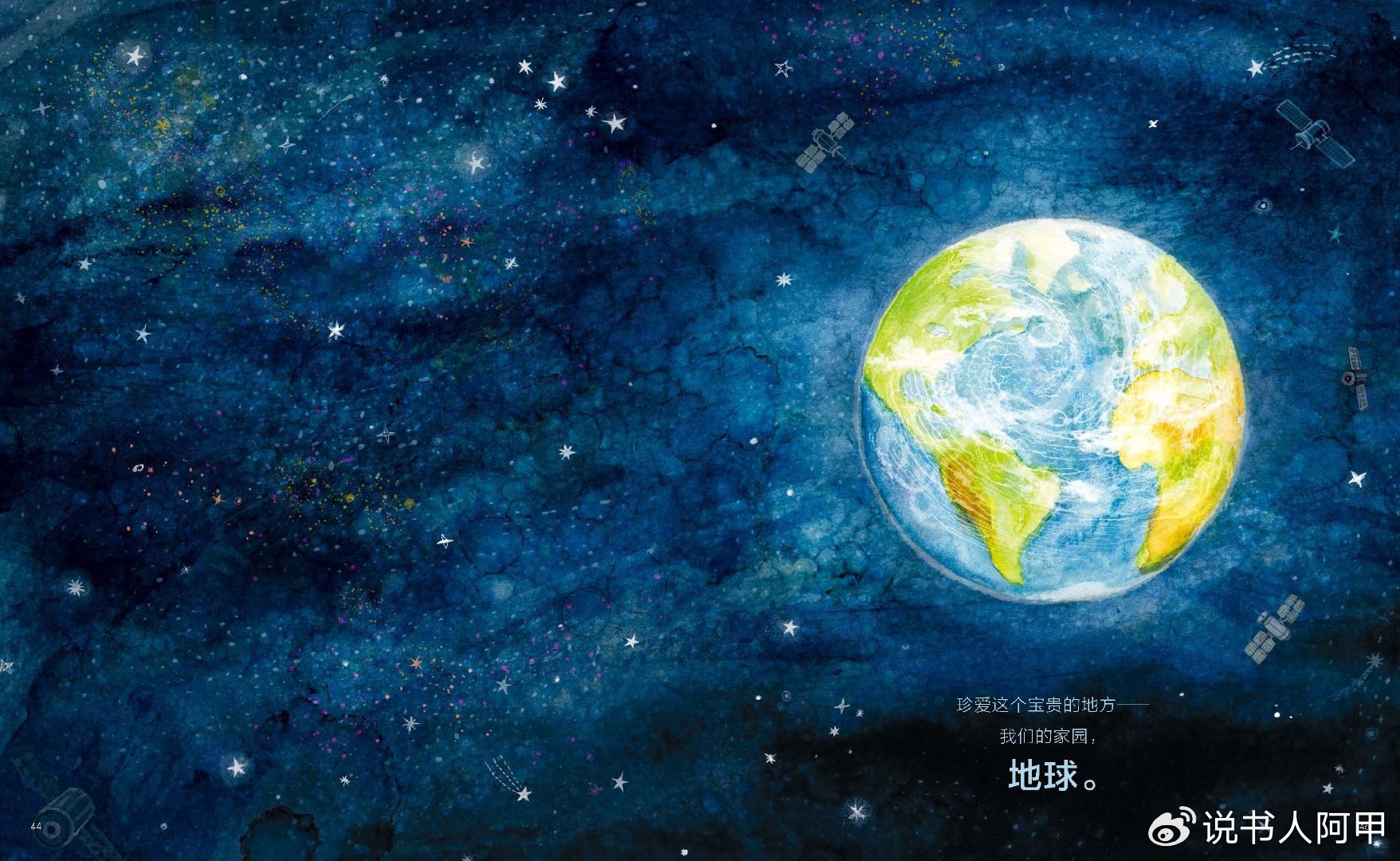
Overall, the creative concept behind *Life* is to tell children an epic story of life on Earth, allowing them to experience the grandeur and miracle of life’s evolution; at the same time, it guides them in a simple yet powerful way to recognize their environmental responsibility as the most intelligent beings on Earth. The publisher clearly values this kind of work that combines scientific perspective with values education, believing it can both stimulate children’s interest in science and history and cultivate global citizenship. For young readers, this book plants the seeds of “respect for life and cherishing the Earth”—perhaps this is the core message that the creators and publishers wanted to convey.