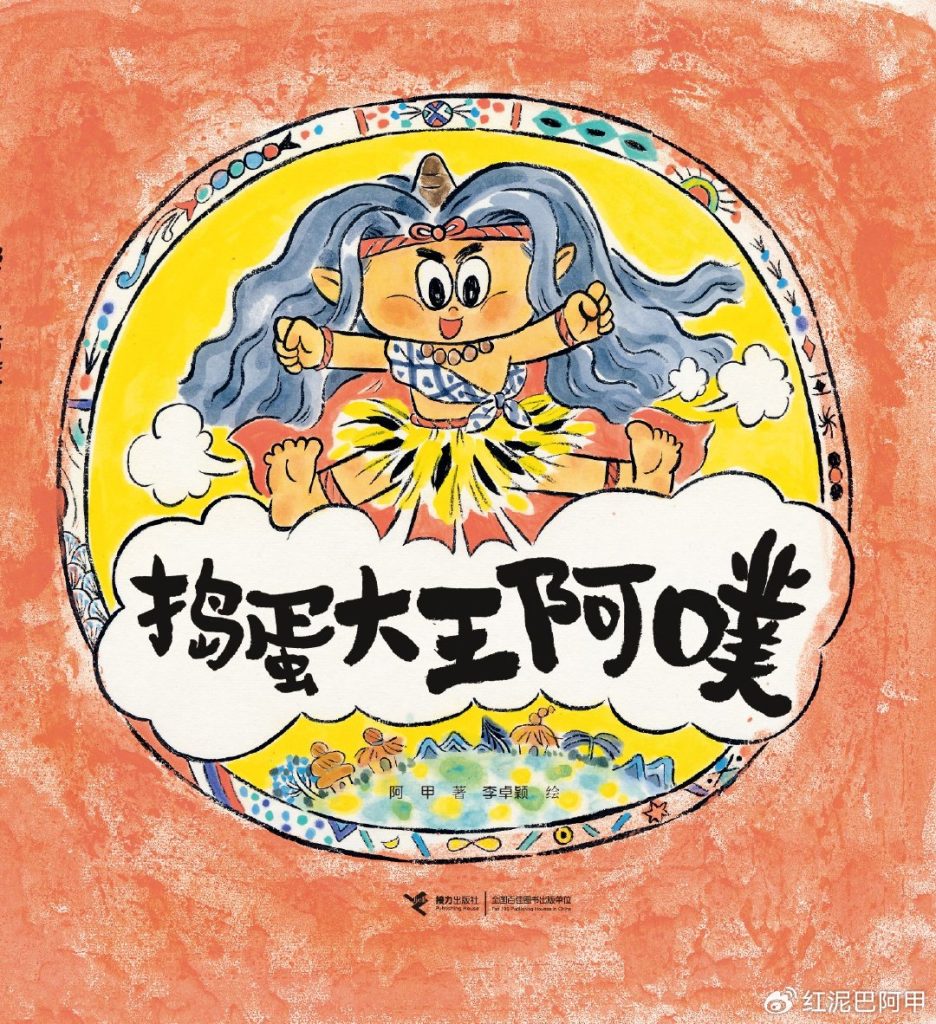
A story and question eight years in the making – to trick or not to trick, that is the question! An absurd comedy veiled in the guise of a folk tale…
The initial idea for this story came from a conversation my daughter and I had while walking the dog in 2016. It likely stemmed from the tumultuous national election that everyone was watching at the time (side note: this election, in a strange way, continued into 2024, with the same protagonist!). My daughter, then in high school, posed a rather perplexing question: How do you judge whether someone is “good” or “bad”? For example, when someone spouts nice words and grandiose rhetoric, but consistently acts in ways that seem terrible, is that person really “good” or “bad”?
At the time, I found it difficult to simply answer this question using the Confucian ethical principle of “listen to what they say and observe what they do,” because that principle implicitly assumes that there are very specific standards of good and bad, and that judgments are primarily based on a person’s behavior. Modern society has become too complex for such simplification. Then, I suddenly remembered a strange question my criminal law professor posed to us in a criminology class in college:
In a classroom, why do teachers often need to identify “bad students”?
The answer may be quite depressing:To maintain classroom orderWith “bad” examples, there will be standards for punishment, and conversely, there will be “good” examples. Most students will have behavioral norms that meet the teacher’s expectations, and everyone will know how to abide by discipline.
This statement is obviously just a metaphor, and can be seen as a popular expression of the “labeling theory” in criminology. Its core idea is that society’s definition and labeling of certain behaviors is likely based on the need for control and management, but “labeled” individuals may become victims of stigmatization on the one hand, and on the other hand, they may gradually internalize their labels and eventually become “bad guys.” Thinking about it the other way around, whether certain behaviors are “good” or “bad” actually depends on how people view and accept them. Behaviors that are “treasonous” in some social environments may be normal in another social environment, and there may even be legislation to emphasize their legitimacy. In this way, confusion is even more inevitable -
What is “good” and what is “bad”?
I’d like to use a funny story to get the children to ponder this difficult question together. This is closely related to their growth, because who knows when they themselves might be “labeled” as troublemakers?
To trick or not to trick, that is the question.
The story you’ve finally read, “The Mischief-King Ah-Pooh,” is an absurd comedy veiled in the guise of a folk tale, but at its core, it’s based on a real criminal case. Criminal law was one of my favorite subjects in college. Later, I worked in the criminal division of a court and taught criminal law and criminal procedure for five years at university, so I’m brimming with criminal cases. The case serves as the basis for this bizarre spy case. The suspect had been lurking since the founding of the People’s Republic of China, constantly waiting for opportunities to sabotage. To gain more opportunities, he diligently acted like a good person his entire life, earning praise from everyone who knew him. In his old age, feeling uneasy, he surrendered himself to the police. Whether and how this “bad guy,” who had never committed a single wrongdoing, should be convicted is a question worth discussing in criminal law classes. From a simple common-sense perspective, what would your judgment be?
The original version of this story was “Pooh, the Worst Pooh in the World.” The protagonist is an egg-born creature, born to mischief. In fact, without mischief, he wouldn’t even be able to break out of the egg. His explosive farts are a gift, helping him successfully break out of his shell and setting him up for future greatness. But he’s puzzled: what exactly constitutes “the worst of the worst,” or “the most mischievous”? He has no idea what the term means in society, whether it’s positive or negative. Fortunately, the kindhearted and simple-minded couple who adopted him from Haha Land helped him develop this understanding.
The initial version of the story was written in just a month. The case was already there, and I simply repackaged it, borrowing elements from many folk tales. As a children’s story, the biggest challenge was that we couldn’t have our protagonist turn himself in; he had to do something truly “worst” or “most mischievous.” It had to be truly outrageous, yet still be easily accepted.
After pondering this for weeks, I suddenly realized I could draw inspiration from equally “eccentric” folk customs. For example, many Chinese people are likely familiar with the “nose-touching ceremony,” a unique greeting practice from the Maori people of New Zealand. The closer and more respectful the relationship, the more frequent and prolonged the nose-touching. Even more bizarre is the “nose-biting ceremony,” a strange ritual that sounds unhygienic. It’s said to be a playful expression of intimacy in East African culture. While this behavior might be considered offensive or indecent between strangers or in public, it can be a symbol of deep affection when performed in the privacy of a couple or romantic partner. Ah Pooh, now languishing in bed, learned this “dirty trick” from his grandfather and unleashed it upon the entire population of Haha Country, naturally filled with gratitude and love.
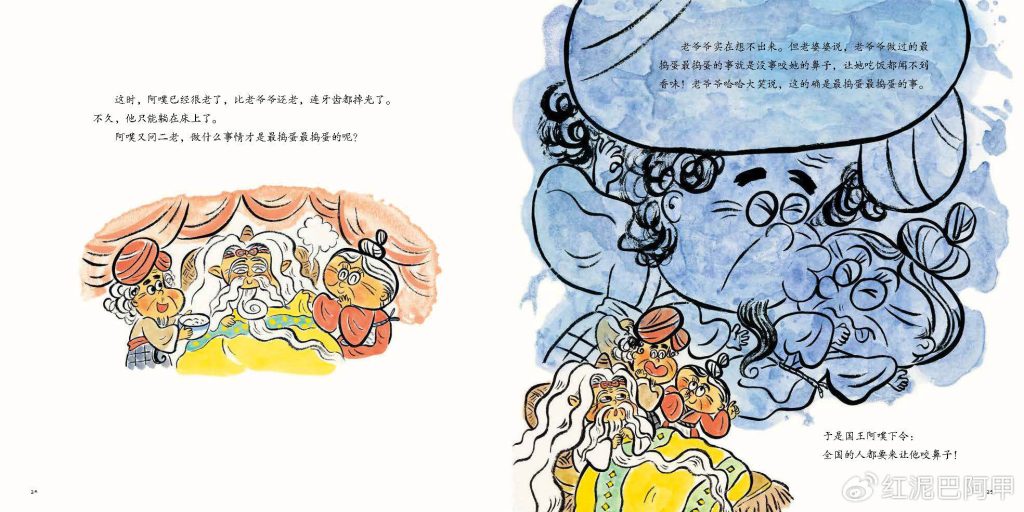
By the way, wasn’t the character originally called “Ah Bao”? Why was it changed to “Ah Pooh”? This is all thanks to the suggestion of Wanwan, the art editor I initially collaborated with. Wanwan is also a master at creating picture books. She suggested using the onomatopoeia “Pooh” as the name of the protagonist, which would be louder and more “flavorful.” I think it makes a lot of sense! Initially, I used the name “Ah Bao” mainly to make it more like a folk tale, and he is a silly and careless funny guy who always makes people laugh. But “Ah Pooh” is obviously more interesting and has more meaning, which reminds people of Winnie the Pooh.“噗”, and if you replace the word “口” with “木”, it becomes “樸”–Simple”, or think of returning to nature–“璞””.
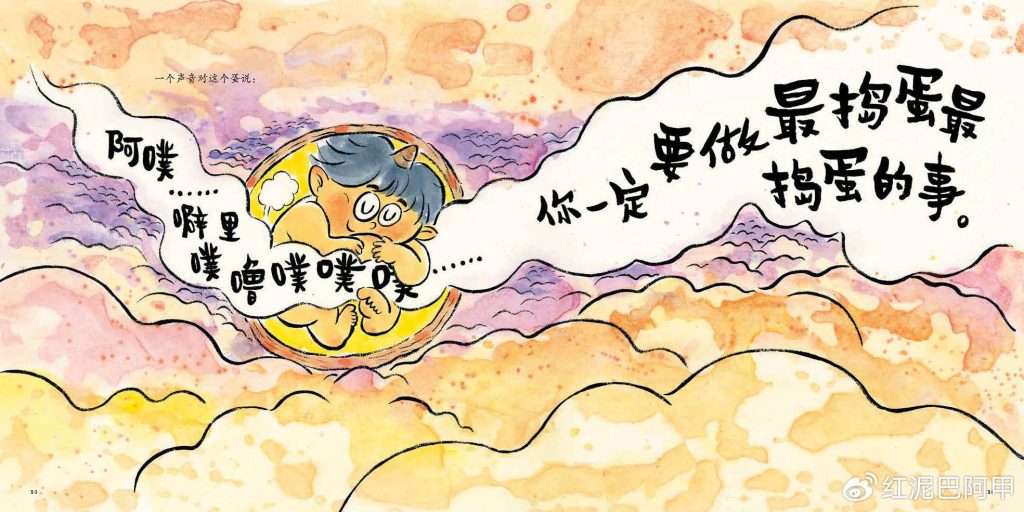
The ending of the story is especially thanks to Wanwan’s creativity. The original ending was to have Ah Pooh die in laughter. Although the people of Haha Country erected a statue for him and some young people tried to imitate his special abilities, it was still a bit regrettable and sentimental. During a brainstorming discussion, Wanwan suggested that Ah Pooh turn back into an egg and continue rolling all the way, still hearing the inexplicable command in the egg — “You must do the most mischievous and naughty things”. This is really a brilliant idea! It brings the story back to the starting point, completing a perfect closed loop, and also explains in disguise the true meaning of “the most mischievous” in the dictionary of the egg-born family. In the minds of the previous generation of Ah Pooh,“The most mischievous thing” and “the happiest thing” are the same thing!
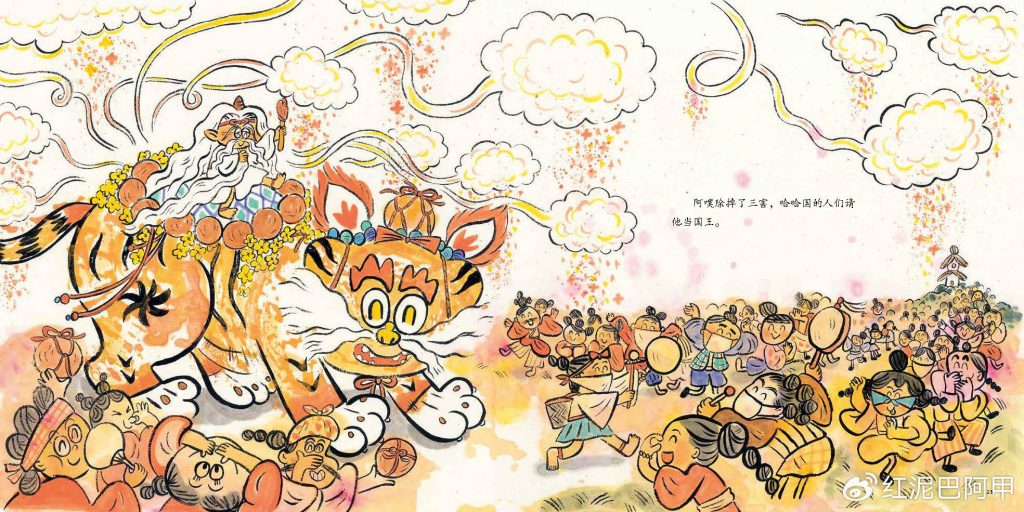
The picture book “The Mischief-King Ah-Pooh” took about seven years to develop, from initial concept to final version, and another year to be published. During this time, there were numerous discussions and detailed revisions. In fact, beyond the initial idea and story structure, many details completely transcended my original script. Illustrator Li Zhuoying created a world perfectly suited to the imagination of the residents of Haha Country: a tropical island nation, a paradise filled with coconut trees. The originally somewhat intense conflict of “Pooh’s Elimination of the Three Evils” became remarkably peaceful and festive. Even Pooh’s special abilities, which might have been somewhat annoying, were transformed into a shower of praise! This perfectly suited the temperament of Pooh and the Haha people. The editors I initially collaborated with also contributed many new perspectives, especially Ms. Fumiko Nakanishi. She immediately recognized that I had borrowed many elements from Japanese folk tales in this story and found a lot of relevant materials for us to reference.
Although my initial motivation for writing this story was to explore “big questions,” I still hope young readers will immerse themselves in the joy of the story itself. I myself have read countless folk tales since childhood. Initially, I simply found them amusing, imprinting all the strange and funny details in my mind. Only as I grew up did I gradually savor their unique flavor. In a sense, almost every detail in “The Mischief-King Ah-Pooh” has a source material; none of it can be considered “original.” I simply reassembled those playful elements to express my perspective and feelings on the world.
Of course, how each element unfolds depends entirely on the storyteller’s perspective. For example, Ah-Pooh’s farts lead to everyday “accidents,” a common theme in traditional folk tales. However, the residents of Haha Country enjoy Ah-Pooh’s “unique skills” because of this, which is the storyteller’s intention. Borrowing from the criminological “labeling theory,” people don’t “stigmatize” Ah-Pooh. Instead, they embrace him with kindness, and this “troublemaker” becomes a popular “good kid.” Isn’t the causal relationship here worth considering for parents and those who care about children’s education? For a more in-depth exploration of this issue, you can refer to psychologist Hayao Kawai’s book “Children and Evil.”
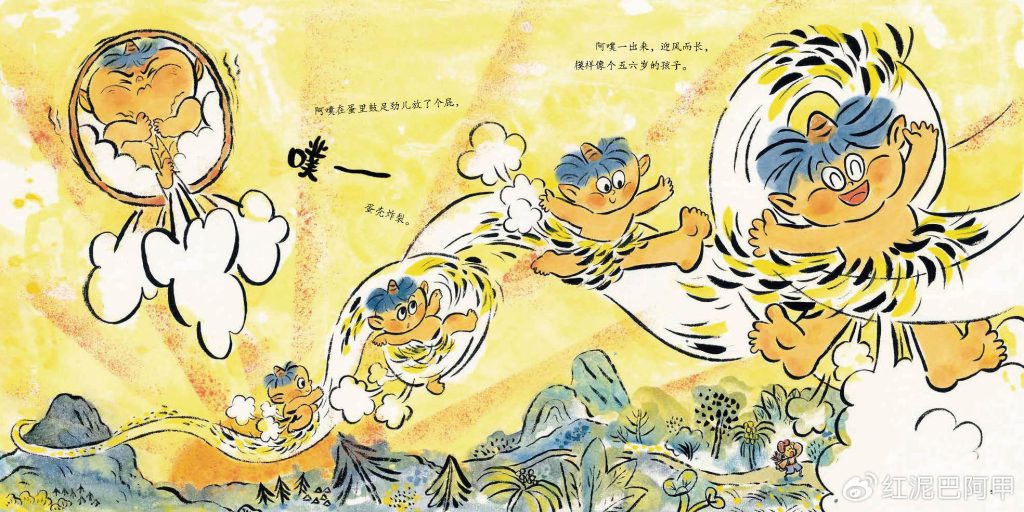
For example, the way Ah-Pooh, emerging from the egg, grows against the wind is clearly inspired by the stories “The Magic Book” and “Nezha Conquers the Dragon King.” However, once Nezha grows large enough to wreak havoc on the sea, his form is set, even immortal. I had to accelerate Ah-Pooh’s aging, so that each day is equivalent to three years for a human. The lifespan of those born from eggs is short, so they urgently need to find happiness and seize the present moment. Furthermore, if Ah-Pooh truly reaches the pinnacle of social power, still young and strong, with plenty of time left to tinker, who can guarantee he won’t commit something truly “mischievous” in the human lexicon?
To trick or not to trick, that is the question.
Ajia, written on August 18, 2024 in Beijing
【Storytelling Highlights】
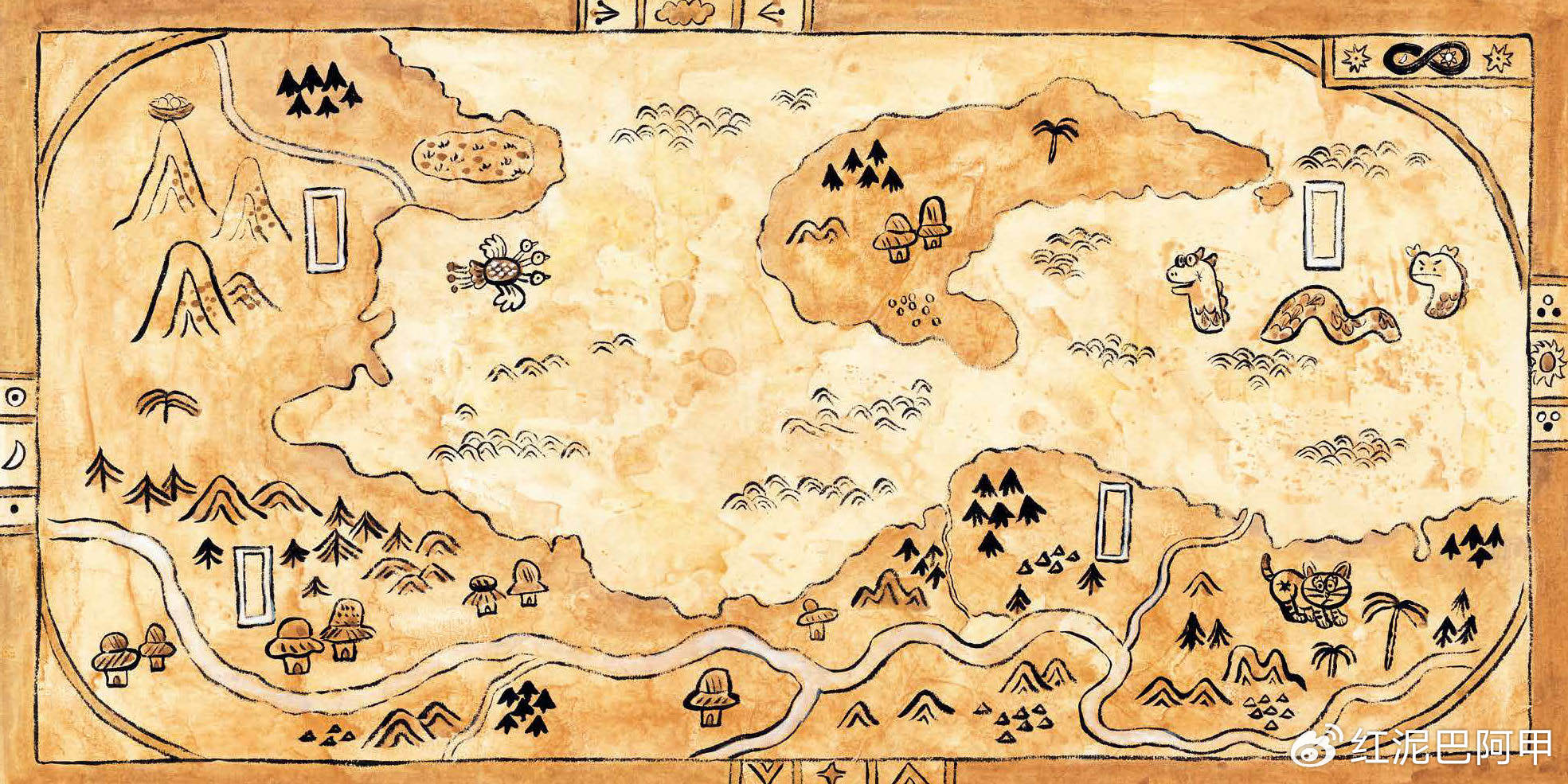
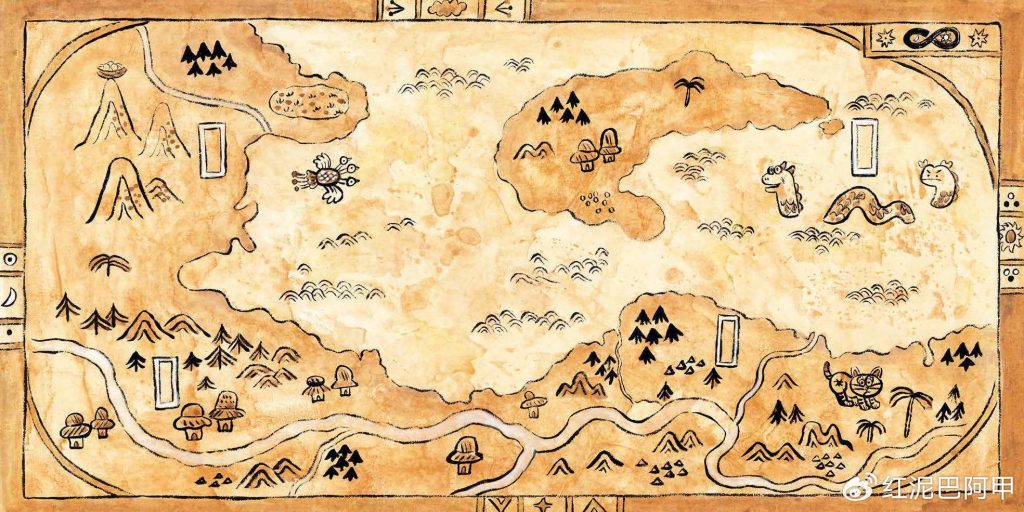
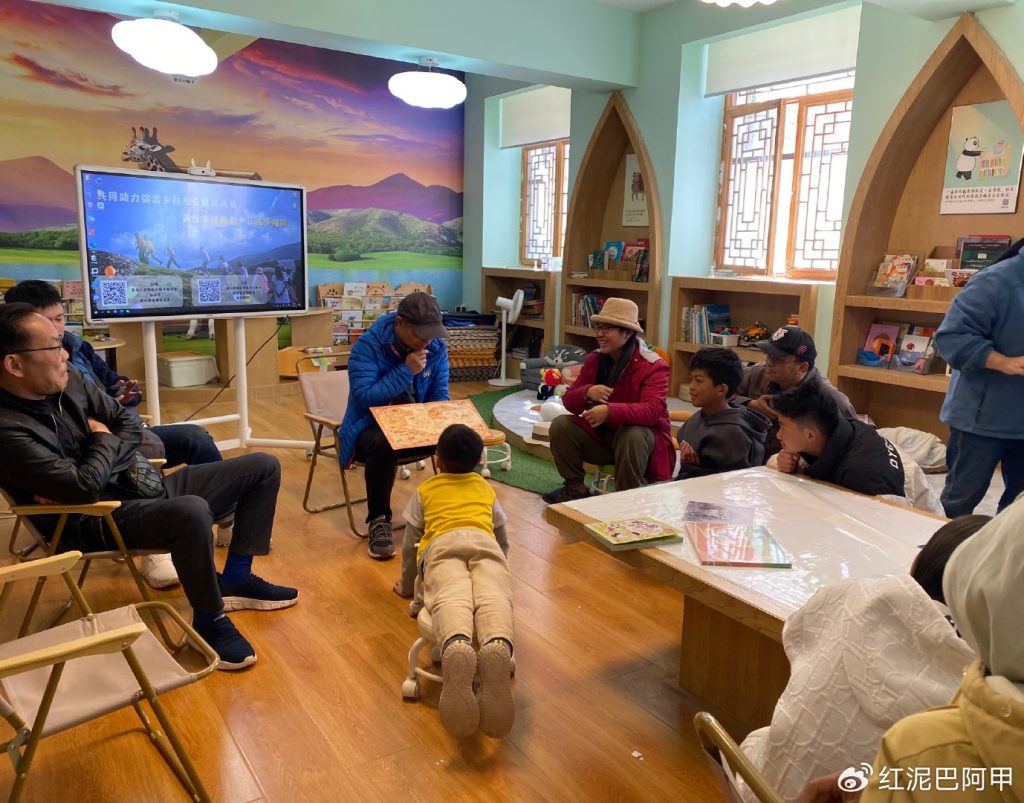
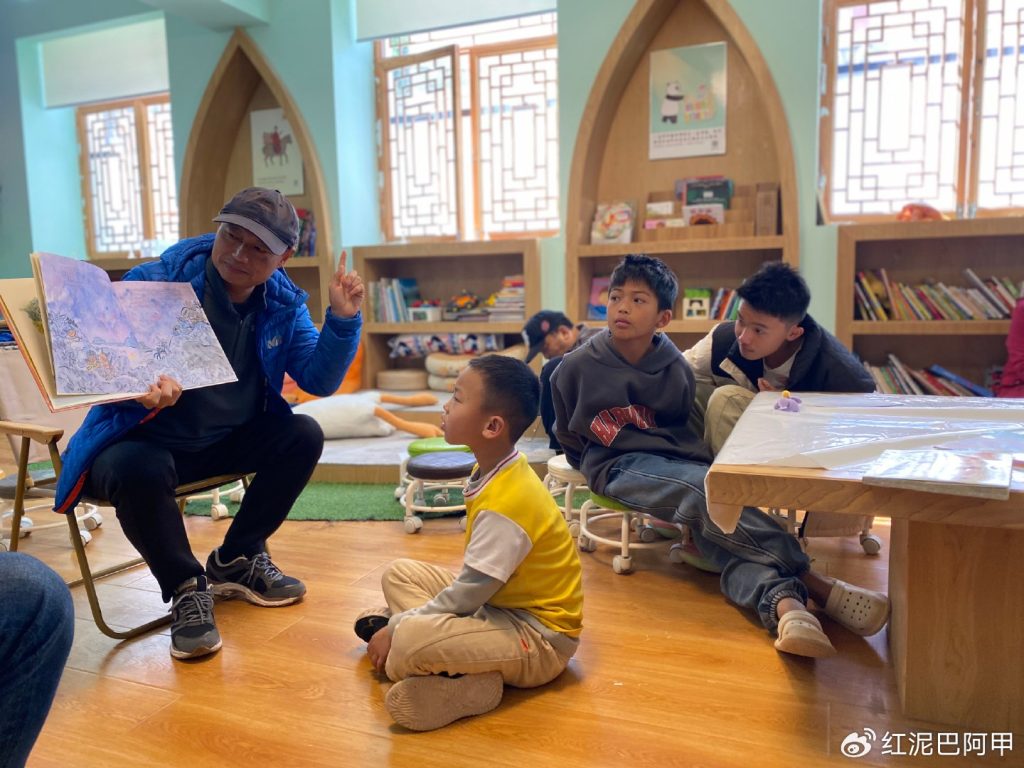
In early December 2024, I had the opportunity to visit the “Happy Little Taozi” children’s library in Sanhe Village, Midu County, Dali, Yunnan Province, and told the story of “The Mischief-King Ah-Pooh” to the children there. Interestingly, when I opened the book’s front endpapers, the children said they were familiar with the map because it looked just like the reservoir next to the village!
But the funniest thing is that they caught a troublemaker on the spot and made him play the protagonist of the story while making trouble.There is video evidence — click to open). But this mischievous child was the most attentive to the story. He immediately shouted out the true meaning of “bite the nose” (no spoilers for now), which surprised even me, the author!


Attachment: English reference translation
The Mischief-King Ah-Pooh
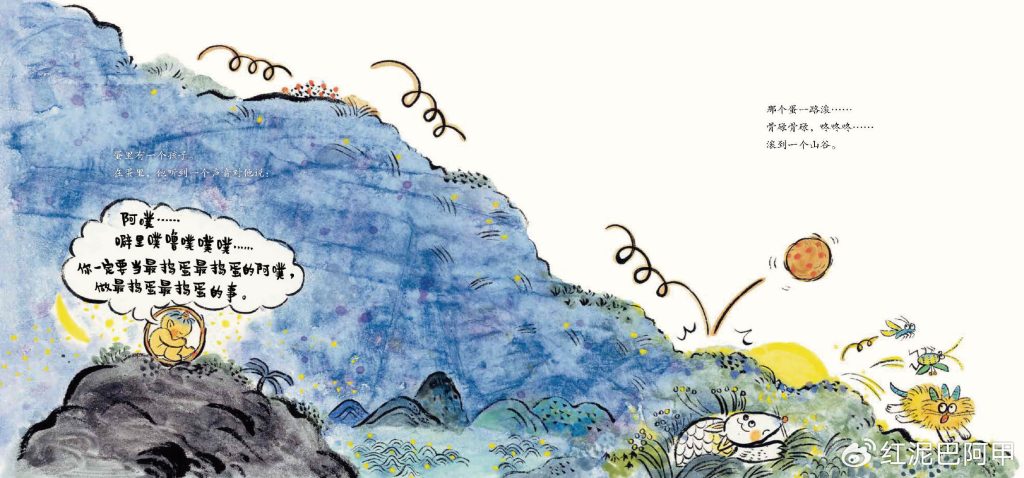
Once upon a time, there was an egg…
Inside the egg was a child.
And from inside the egg, he heard a voice whisper:
“Ah-Pooh… Pilly-pilly-pooh-pooh-pooh…
You must become the most mischievous, most mischievous Ah-Pooh,
And do the most mischievous, most mischievous things…”
The egg rolled and rolled…
All the way down to a valley.
Roll, roll, thump, thump, bump…
Inside the egg, Ah-Pooh gathered all his strength and…
Poof—!
The egg exploded!
Out popped Ah-Pooh, growing taller with the wind until he looked like a five- or six-year-old boy.
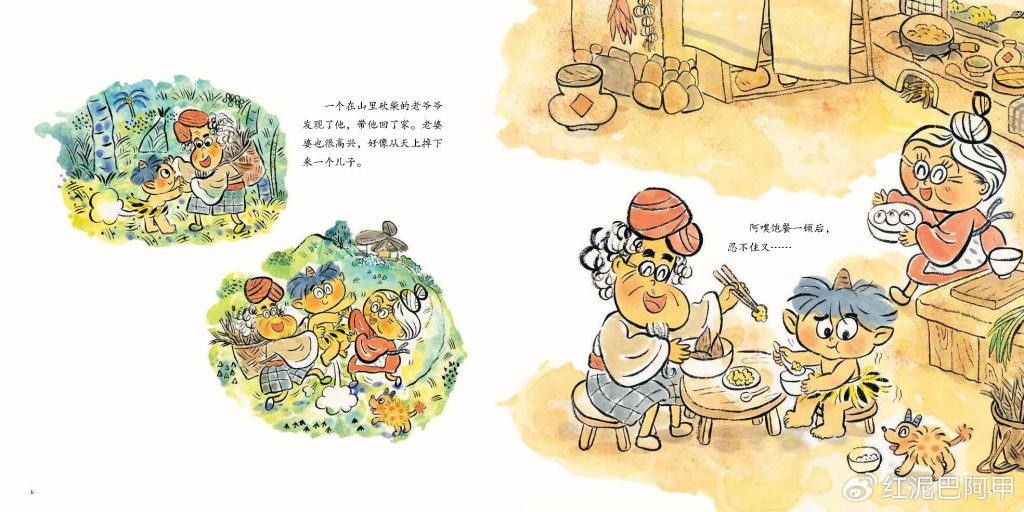
An old man chopping wood in the mountains found him and took him home.
The old woman was delighted, as if a child had fallen from the sky.
After a big meal, Ah-Pooh couldn’t help himself and—
Poof!
He sent the old woman flying into the kitchen!
When he turned to help her up—Poof!
He sent the old man at the door flying too!
But instead of being angry, they laughed and laughed.
Because this was the Land of Ha-Ha, where everyone loved to laugh.
Hearing the noise, the villagers came to see the commotion. They even asked Ah-Pooh to show off his special talent.
Poof, poof, poof!
Ah-Pooh’s farts could send people flying, blow rooftops off houses, and knock fruit from the trees.
The villagers laughed and said, “When it’s harvest time, we must invite Ah-Pooh to help!“
Everyone loved Ah-Pooh.
Ah-Pooh grew very quickly—one day for him was like three years for others. In just seven days, he had grown into a young man.
Ah-Pooh laughed often in the Land of Ha-Ha, where everyone laughed no matter what he did.
But he still wondered, “How can I do the most mischievous, most mischievous thing?”
The old man told him, “Here in Ha-Ha Land, we’ve never heard of the most mischievous thing. But once, there was a king who did whatever he wanted, and no one could stop him. That was pretty mischievous. After that, the people decided we wouldn’t have a king anymore.”
Ah-Pooh asked, “Could there ever be a king again?”
The old man explained, “There’s an ancient promise: Whoever can rid Ha-Ha Land of its three greatest threats—the Evil Tiger, the Dragon, and the Giant Eagle—will become king.”
The next morning, Ah-Pooh set off with bean cakes and bean buns prepared by the old woman, determined to defeat the three threats.
For seven days and nights, he battled the Evil Tiger in the valley.
“Ah—ha—heey!” Poof!
At last, his mighty fart sent the tiger flying into the river. The tiger begged for mercy and promised to follow Ah-Pooh and never harm anyone again.
Next, he faced the Dragon in the river, battling for seven days and nights.
Poof!
His fart sent the dragon crashing into a towering cliff. The dragon promised to leave the villagers alone forever.
Finally, after seven long days, he found the Giant Eagle’s nest on the highest peak.
He was ready to blow it away with a fart, but the eagle pleaded, promising to leave with its chicks and never return.
Ah-Pooh returned victorious, and the people of Ha-Ha Land asked him to become their king.
By then, Ah-Pooh was very old—older than the old man who had found him. His teeth had fallen out, and soon he could only lie in bed.
One day, he asked the old couple, “What is the most mischievous, most mischievous thing anyone can do?”
The old man couldn’t think of anything. But the old woman laughed and said, “The most mischievous thing your grandpa ever did was bite my nose for no reason—it made everything I ate funny smell!”
The old man burst out laughing. “That’s true! It was my most mischievous act!”
So, King Ah-Pooh made a royal decree:
“Everyone in the kingdom must come and let me bite their noses!”
People of all ages lined up by Ah-Pooh’s bedside. He gently nibbled each nose, making everyone laugh uncontrollably.
The last in line was a tiny baby. But this time, the baby bit Ah-Pooh’s nose instead! Ah-Pooh couldn’t stop laughing, and then—
Pilly-pilly-pooh-pooh-pooh…
In a puff of smoke, King Ah-Pooh disappeared!
Roll, roll, roll…
A giant egg rolled out of his bed.
And inside the egg, a voice whispered:
“Ah-Pooh… Pilly-pilly-pooh-pooh-pooh… You must do the most mischievous, most mischievous thing…”