Continued from the previous chapter: Masters of the Art of Storytelling for Children (Part 6)
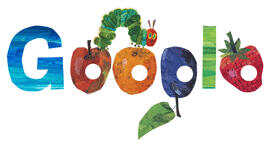
Eric was invited to design the Google logo using the very hungry caterpillar

Eric Carle
Eric Carle (1929-) is a junior of Lioni, and they are often inadvertently linked together, perhaps because they do have some similarities.
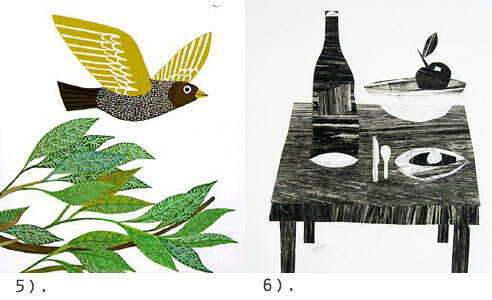
Illustration by Lionel Leoni on the left and Carl’s illustration on the right
For example, they both worked in advertising design before creating picture books. This was thanks to Lioni. In 1952, when 23-year-old Carl fled Germany to New York with only $40 in his pocket, he met Lioni. Somehow, this impulsive young man impressed the design giant. Lioni not only treated him to lunch but also arranged his first advertising design job.
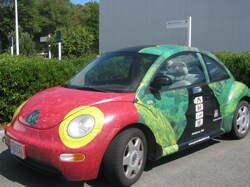
Beetle car painted with a caterpillar pattern
For example, they can both be considered European. Lioni was born in the Netherlands and spent his teenage years in Italy. Because of his Jewish ancestry and his wife’s status as the daughter of a founder of the Italian Communist Party, he was forced to immigrate to the United States during World War II. Karl was born in the United States, but his parents were German. When he was six, his family returned to Germany. Later, his father was drafted into the Soviet army and tragically spent eight years as a prisoner of war, and as a teenager, he was forced to dig trenches. Perhaps it was these unique experiences that gave the two artists endless topics to discuss whenever they met.
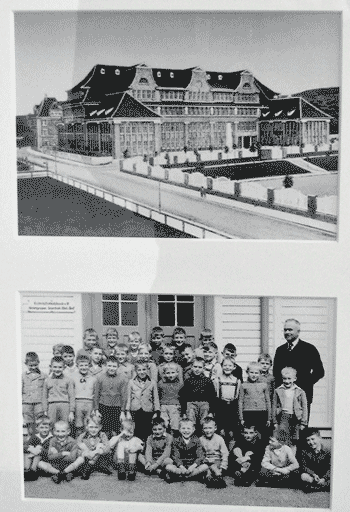
Eric Carle’s school in Germany
For example, they were both exceptionally skilled at using collage in their picture books, a technique no one had previously mastered. Lioni’s first book, Little Blue and Little Yellow, was collaged, as was Carr’s first book, Brown Bear, Brown Bear, What Are You Looking At? However, Carr employed this technique more thoroughly, incorporating it into nearly all of his picture books. He even wrote tutorials and illustrated them to teach readers how to create their own collages. Perhaps because Carr’s picture books resembled toys so much, the Caldecott Medal judges were reluctant to award him the grand prize.
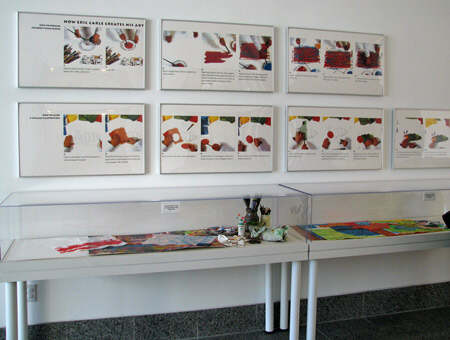
A demonstration of Carl’s methods and materials for creating picture books (inside the Carl Art Museum)
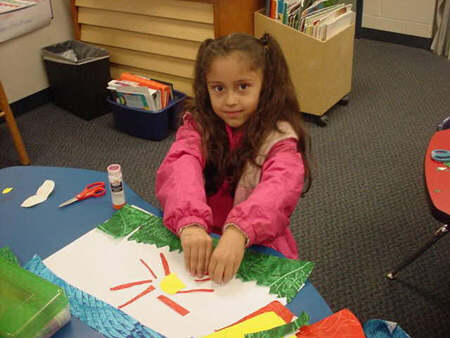
In fact, a child can easily learn this creative method
Another similarity is that they were both quite old when they switched to making picture books, and the opportunity was coincidental.
When Carl was 38, educator and author Bill Martin Jr. asked him to illustrate a story. He said he had seen an advertisement designed by Carl and was captivated by the red lobster in it. He thought it was exactly the illustration style he needed. Intrigued, Carl readily agreed, and the two collaborated to create “Brown Bear, Brown Bear, What Are You Looking At?” This book, as simple as it could be, has captivated countless children.
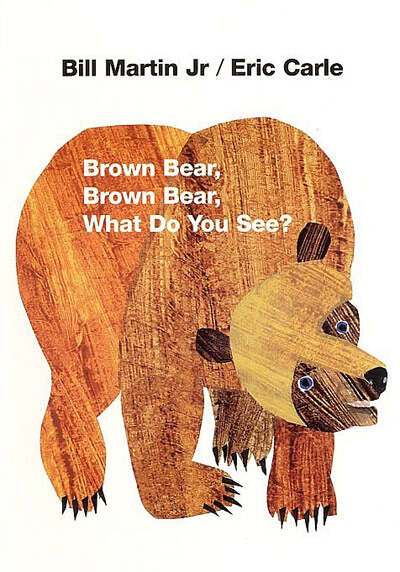
English version cover
Cover of the Chinese Edition (English and Chinese)
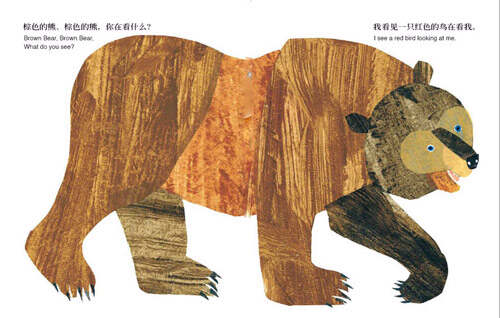

Chinese version interior page illustrations
This is also a singable book, but the version is slightly different. The original word for “teacher” is “monkey” :)
Carl found the exhilarating feeling of childhood drawing in creating this book. In his memory, his kindergarten days were a paradise. He missed his kindergarten teacher most. Although he couldn’t remember her name or what she looked like, he remembered how she greatly admired his drawing talent and even called home to tell his parents, “This child is incredibly talented. Please encourage him in this area.” Compared to advertising design, which he had grown somewhat tired of, creating picture books felt like a truly freeing experience. So, like Leonie before him, he began creating his own picture books.

Eric Carle Self-Portrait

One day in 1969, Carl was fiddling with a hole punch and looking at the tiny holes he punched on paper when he suddenly got the inspiration to write a story about a “bookworm.” He quickly called his editor, but fortunately, the editor was not overwhelmed by this wonderful idea and suggested that the name “caterpillar” would be better.

A few months later, “The Very Hungry Caterpillar” was born. It tells the story of a tiny, hungry newborn caterpillar who eats an apple on Monday, two pears on Tuesday, and three plums on Wednesday. As he continues his journey, he transforms into a plump caterpillar, a chrysalis, and, a few weeks later, a beautiful butterfly. The story is simple, but the stunning illustrations make it a visual feast. The highlight is the string of tiny holes throughout the book, representing the caterpillar’s path. For years, nearly every child has been unable to resist exploring it with their fingers. Translated into over 30 languages, including Chinese, the book has sold over 17 million copies, making it one of the most popular picture books for children.

The Very Hungry Caterpillar (Chinese version) cover


Illustrations from the Chinese edition of The Very Hungry Caterpillar
To date, Eric Carle has created more than 70 picture books and founded his own personal art gallery in Massachusetts in 2002, which is also the first picture book gallery in the United States.

Exterior view of the Eric Carle Picture Book Museum

Take a closer look at the museum’s icon, from top to bottom—
Carl’s caterpillar, Lionel’s field mouse, Sendak’s beast
To know what happens next, please wait for the next episode.
* * * * * * *
Highlight 1: Eric Carle’s official website demonstrates in detail how he makes picture books. You can try it at home. It is said that many young readers do a very good job and even send their works to the painter.
1. Carl’s process of making colored stickers
2. Carl’s process of making pictures

Bonus 2: Carl’s official website also features a video of him reading “The Very Hungry Caterpillar”:

Click the link on the picture to view it.
Tidbit 3: Photos of the picture book master’s happy home life. It’s said that Eric Carbone lived in the rather cold Massachusetts for 33 years before finally moving to warm Florida, where he and his wife lived happily ever after in a beachfront villa…






Thanks to this caterpillar (which actually has a cake behind it!)
Extra 4: A little extra about Eric Carle’s family (mild gossip)
There is not much official information about Carl’s family situation. The following information is collaged from articles in various media. Please forgive any inaccuracies.
Various Chinese biographies of Carr mention his wife as Barbara, spelled “Barbara Carle.” However, family friends generally addressed her as Bobbie, or Bobbie Carle. Using her original surname would spell her Bobbie Morrison—the name used in official newspaper reports. For convenience, I’ll continue to use “Barbara” below.
Barbara was Eric Carle’s second wife, but Eric was her first husband. She was approximately nine years younger than Eric, and they married in 1973. The New York Times reported on Barbara’s occupation as a “former special education teacher.” Another article explained that Barbara had helped to establish and teach at Side-by-Side, a special education school designed to help preschoolers with disabilities enter mainstream learning environments. In 2002, Barbara also helped her husband establish the Eric Carle Museum of Picture Book Art, demonstrating her dedication to his wife. However, Barbara and Eric did not have any children.
Carl met his first wife in Stuttgart, Germany, and they married around 1952. They later moved to New York and divorced in 1964. During this time, they had a son and a daughter. Later reports said that one of them was a masseuse and the other an artist, and neither of them had children, so Eric has no biological grandchildren.
Interestingly, Carl once received a book in the mail. The author, a supermodel named Emme, dedicated it to Eric Carl because Eric had played a father figure and had a profound influence on her during her childhood (approximately 34 years earlier). This was during a period between Eric’s two marriages, when he had a relationship with her mother. Eric was overjoyed to receive the letter. Although Emme was not his biological daughter, he and Barbara were happy to treat her as their own. The Carl family was especially delighted when they later learned that Emme was going to be a mother, as it meant Eric Carl would be a grandfather! They planned a grand welcome for the new baby…