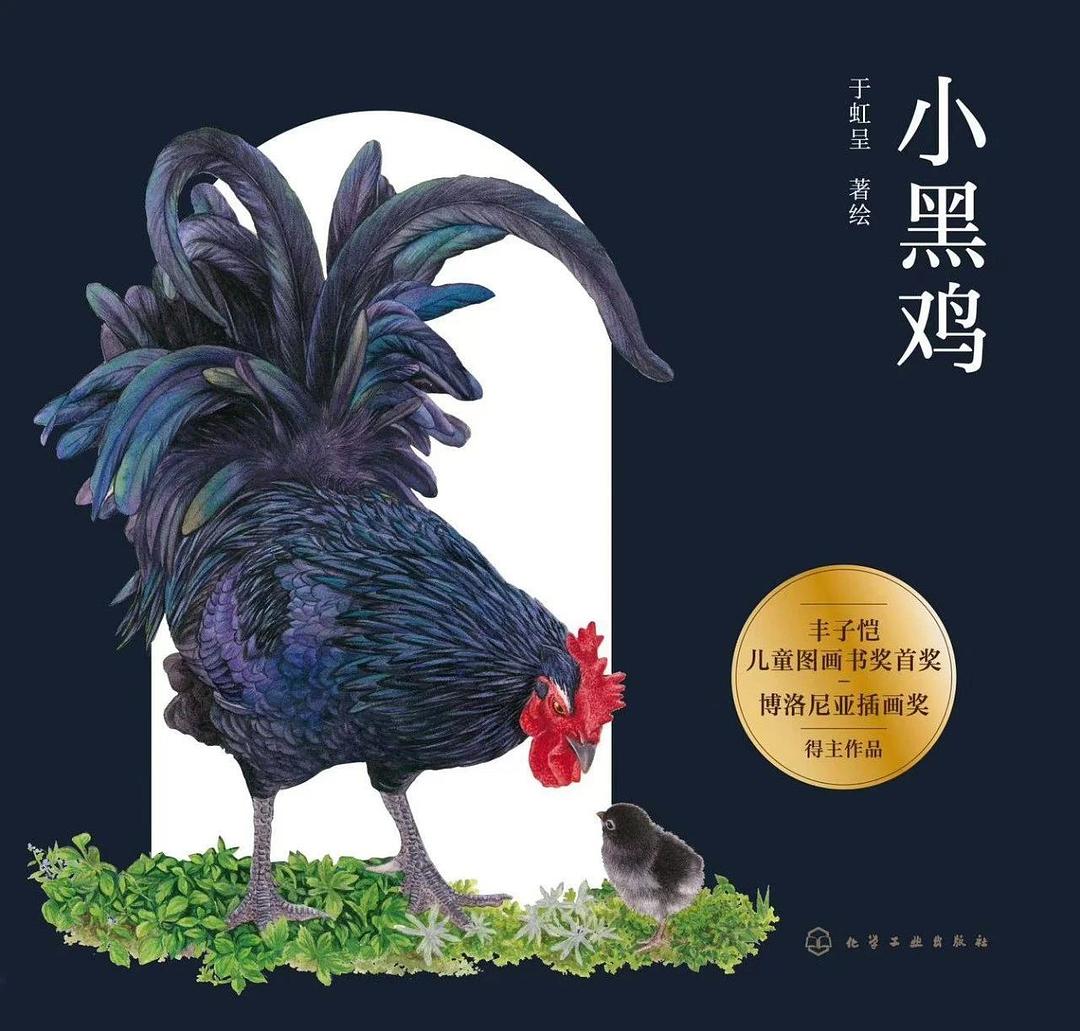
“Little Black Chicken” is another masterpiece by Yu Hongcheng, a post-85s picture book writer, following “Food on the Plate.” Through the growth story of a little black chicken, it leads readers into a warm yet challenging world, while realistically depicting the life cycle of a domesticated chicken from hatching to full maturity. Yu Hongcheng’s delicately realistic illustrations and profoundly emotional expression make “Little Black Chicken” not only a children’s picture book with a touch of popular science, but also an educational textbook about growth, courage, and life.
The story of a little black chicken’s growth from birth to becoming the leader of the flock, from a fairy tale perspective, resembles the coming-of-age story of a young hero. But this growth also begins with a loving family and the warm embrace of its mother. The story begins with the moment the little black chicken breaks out of its shell. With its mother’s protection and encouragement, it grows happily in an environment filled with love and care. However, when its mother leaves, the little black chicken must face life’s challenges independently. He leads his siblings in their search for food, drives away the mischievous ducks, and ultimately defeats the leader of the flock, becoming the new leader of the flock. In this journey, which bears a striking resemblance to human growth, readers witness the hardships and joys of growing up, while also feeling the preciousness of life and the warmth of family.
However, the little black chicken’s upbringing is vastly different from the natural environment humans experience. While the story has a fairytale quality, and the author attempts to use the first-person perspective of the protagonist, the little black chicken, the illustrations are completely realistic, with photographic detail depicting the animals, plants, people, village houses, and vegetable gardens. Without first reading the text, the reader’s initial impression might be that this is a popular science book. In fact, the author and publisher have included a handbook specifically for readers, detailing the complete growth process of a domesticated chicken, providing information on the various plants featured in the book, and even exploring the diverse breeds of chickens. From this perspective, reading “Little Black Chicken” is also a lively and engaging educational experience.
From a storytelling perspective, I think this story incorporates popular science, which is essential, at least for urban children. I was born in the 1970s, and although I didn’t grow up in the countryside, my family raised chickens, so I have some understanding of the life cycle of domesticated chickens. I thought this was common knowledge, but when I graduated from university and talked with a classmate who was born and raised in Beijing, I was surprised to discover she knew nothing about it. She said she had never even seen a live domestic chicken! I imagine that for a young reader who has never seen a live chicken, “The Little Black Chicken,” with its realistic illustrations, still feels more like an animal fairy tale.
Although told in a fairytale style, the challenges faced by the chicks during their growth are very real: the dogs and cats that often prey on them, the separation of the mother hen and her chicks after they reach a certain stage of growth, the chickens’ territoriality, the fights between roosters, and the competition for food with other poultry… The author observes from a human perspective, offering insightful insights into human growth. For example, the little black chicken grew up under the protection of its mother, but with her departure, it was forced to learn to live independently. This process demonstrates the inevitable difficulties and challenges of growing up and emphasizes the importance of independence. The little black chicken displays extraordinary courage and responsibility in facing the bad duck and the head chicken, reminding young readers to bravely face life’s difficulties. The little black chicken also has to face the reality of losing a loved one during its growth, which reminds us of the fragility and preciousness of life and the need to respect and cherish every life.
After years of experience, Yu Hongcheng has grown from a graduate of the picture book creation studio to a highly skilled picture book creator. In this book, she demonstrates a masterful narrative technique combining text and images. Similar to her work on “A Dish on a Plate,” she draws on long-term observation and sketching in rural areas, meticulously recreating the details of rural life with rich colors. Each illustration is imbued with a sense of life, immersing the reader in the scene. However, her illustrations don’t simply supplement the text; they also reveal details not mentioned in the text, and sometimes deliberately create contrast between text and image to create a unique narrative tension. For example, on pages 16–17, the text briefly complains about the mother hen’s nagging, while the picture shows a lurking cat, hinting at real danger. On the next page, the text admits, “I’ve just discovered that my mother was right,” while the picture suggests that the cat has already taken the life of a younger brother or sister. These seemingly ordinary and peaceful images conceal a harsh truth about the real world.
Yu Hongcheng maintains her characteristic calm demeanor as she narrates this rather inspiring coming-of-age story. By the end of the story, with the little black chicken becoming the new leader of the flock and dreaming of its mother nestling under its broad wings, the story could have had a happy ending. However, Yu Hongcheng deliberately left a blank double-page image, showing chickens pecking at food on the ground while a bowl of chicken soup sat on a table where humans were preparing dinner. This prompts the reader to ask: Who is that chicken? Is it the same chicken mentioned in the story? This is indeed a fact of life: domesticated chickens are not only part of the family, but they are also often destined for food. This realistic metaphor invites readers to reflect on the nature of life and the cruelty of existence.
In her statement, the author shares her experiences raising chickens with her mother, which not only inspired her to create “Little Black Chicken” but also deepened her reflection and reverence for life. Through the chicken’s growth story, she expresses her cherishment of life and her profound understanding of growth. This genuine emotional outpouring makes the story even more moving and affecting. This book can also be seen as a continuation of “A Dish on a Plate,” perhaps the hen and chicks depicted in the “Qingzhe” page of “A Dish on a Plate” serve as the introduction to the story of “Little Black Chicken.” Both books feature a delicately realistic style, reportedly drawing on firsthand material from the same rural area. From documenting the rice planting process to depicting the growth of the chicks, Yu Hongcheng has always been attentive to life and nature, and through these works, she helps readers gain a deeper understanding and respect for life.
Regarding the meticulously realistic style of painting, some might ask, with the advancement of photography today, is this style still valuable in picture book creation? I believe the answer is yes. While photography can capture realistic details, realistic painting is created through the artist’s vision and technique, embodying their emotions, perspectives, and expression. This unique quality cannot be replicated by photographs. Many scenes in “Little Black Chicken” appear to have been taken with a camera, but in reality, they are entirely redesigned and arranged by the creator based on real-life material, using fictional techniques. The unique perspective of the simulated lens also represents the author’s personal expression of emotions and opinions. For example, in the scene where the mother hen says she’s leaving, the reader looks to the lower left and sees the mother hen gradually moving away. At the end of the path is a gate in the fence, with the head hen guarding the flock… It’s more like a dramatic scene from a movie, evoking a sense of imagination. This is a highly subjective expression that conveys profound emotion and artistic conception, aiming to enhance the reader’s sense of immersion and emotional resonance.
“Little Black Chicken” is a unique and original work. It can be described as a fairy tale with a touch of popular science, or popular science with a fairy tale twist. In short, it possesses both educational and artistic value. This story of growth, courage, and life should be quite inspiring for children today who need to learn to face life’s challenges and difficulties.
Argentine Primera División written on June 6, 2024 in Beijing