
* For more information about Imperfect Mobilization, please refer to “Imperfect Mobilization: A Victorious Escape from Self-Awakening”

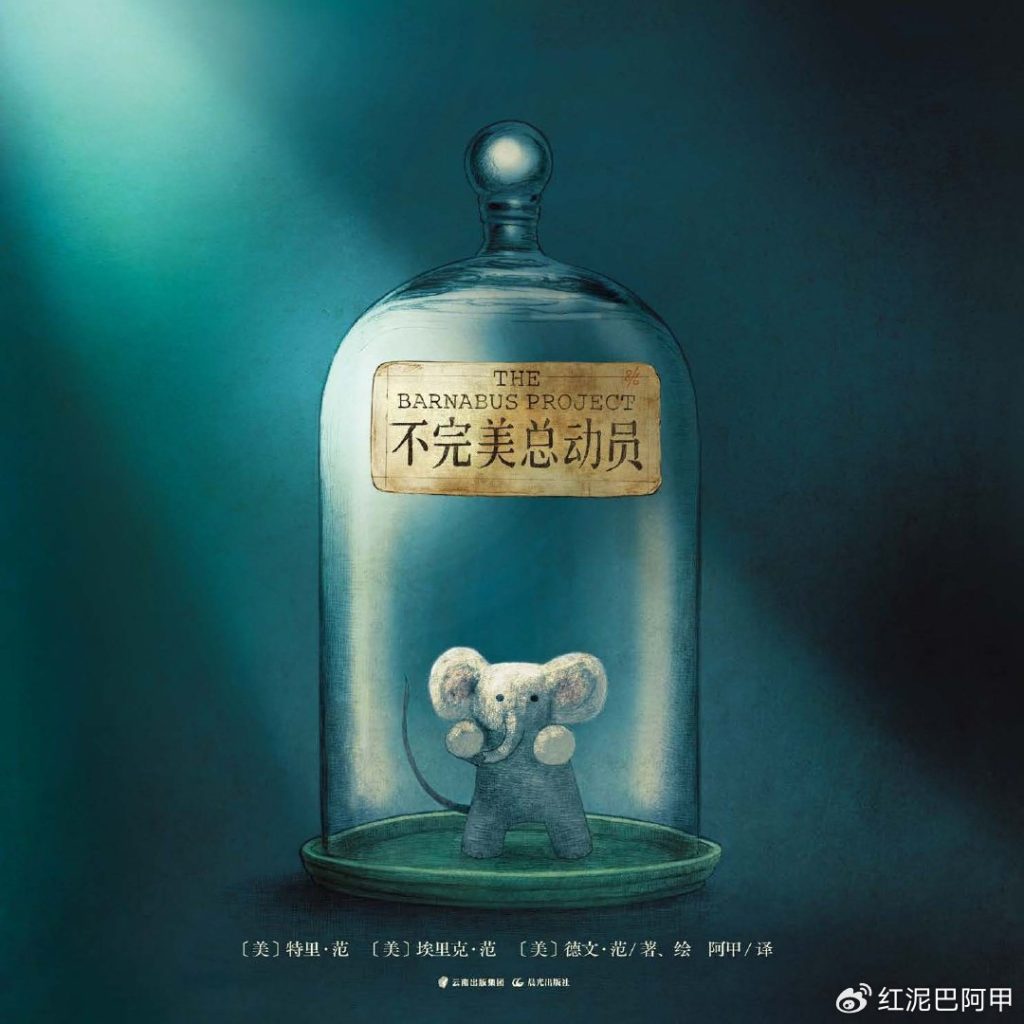
A few years after the sci-fi blockbuster “The Imperfect Mobilization,” created by the Fan brothers, garnered numerous prestigious international awards, we’ve received a somewhat unexpected sequel, “Barnaby: A Perfect Pet.” Initially, I was a bit apprehensive, as “The Imperfect Mobilization” seemed to perfectly capture the themes of “perfection” and “acceptance.” Would forcing a sequel be a poor imitation? Reading it, I was finally reassured. It turns out this is an equally fascinating parallel saga, more a companion piece to the original than a sequel.

The original work itself is a massive story, far exceeding the scope of a typical picture book, but the Fan brothers had much material they didn’t have time to present in that book. The original English title, “Barnabus Project,” literally translates as “Barnabus Project,” tells the story from the perspective of imperfect pets labeled “failed projects,” depicting their dreams and struggle for freedom. The story’s triumphant escape of self-awakening is thrilling, but that climax can easily lead readers to believe the creators favored “imperfection.” In reality, the Fan brothers weren’t so absolute.

Two details in the original painting are particularly noteworthy. One is when Barnabas is about to escape the Perfect Pet Shop, he involuntarily stops and earnestly admires Barnaby, the “successful project.” To Barnabas, Barnaby, with his larger eyes and “fur as fluffy as cotton candy,” is truly perfect. Of course, this doesn’t deter Barnabas from his determination to escape freedom. Another is near the end, when Barnabas and his fellow escapees “discover a place where there is abundant sunlight…” To the left-center of the painting, a little girl walks a pet. Isn’t the pet she’s holding a Barnaby? Barnabas, hiding behind a blade of grass under a tree, must be feeling a mixture of emotions. This scene suggests that the three Fan brothers didn’t completely dismiss the value of the “perfect pet.” The two elderly people sitting on a park bench on the right side of the painting, feeding a squirrel, are modeled after the Fan brothers’ parents. Do you think this painting is significant?


The companion book, “Barnaby the Perfect Pet,” was essentially created using this painting as its starting point. The Fan brothers recreate the scene at a similar point in their new book, using a nearly identical image. It still incorporates all the elements of the original painting, but the narrative shifts to the perspective of the little girl and Barnaby: “On a sunny, warm day, they can once again go for a walk in the park together.” The text and images still seamlessly integrate! I say “almost the same image” because, upon closer inspection, you can actually see some subtle differences. For example, you can roughly tell that the new scene is slightly later in time (as evidenced by the position of the flying bird), and the postures of the two elderly people on the bench have also subtly changed. It’s more like two consecutive scenes from a movie, but to uncover more interesting variations, it’s up to the reader to compare the two images using the “spot the differences” technique.


More broadly, the Fan brothers may be hoping readers will “find the difference” between the two books. In the new work, readers will see that the life of a “perfect pet” is not always easy, and for Barnaby and his companions, life is not always a smooth journey. When a new generation of “perfect pets” is introduced, such as the new product Rainbow Barnaby, Barnaby seems less perfect. He and his companions may be alienated, forgotten, eliminated, and even thrown into the trash can on the side of the road… What went wrong? What is true perfection?

In an interview, the three Fan brothers clearly expressed their original intentions for the film. Terry said that “Barnaby the Perfect Pet” was based on a reflection on the phenomenon of “child stars”: what happens when such stars begin to fade or are replaced by new stars?
Eric said that the book also focuses on the criticism of materialistic consumerism and disposable consumption behavior. In the commercial society, “perfection” is constantly changing, and products will always be replaced by the “latest” and “best” things.
Devin said that they hope to let Barnaby embark on a hero’s journey. Facing disillusionment, numerous obstacles and various tests, Barnaby will eventually return to his home and become a better person because of the adventures he once had!

“Barnaby the Perfect Pet” attempts a parallel narrative with “The Imperfect Mobilization.” The two stories take place in roughly the same time and space, but due to their different protagonists and perspectives, they present completely different experiences at different levels of life, making us feel as if we are in different worlds. But on closer inspection, these two worlds are inextricably linked, or perhaps even deeply interconnected. This reminds me of the black and white yin and yang fish in the Taoist Tai Chi diagram, which, though clearly divided into two halves, form an interconnected unity within this binary opposition. The Fan brothers’ father, Mr. Fan Guangdi (the elderly man in the bowler hat in the picture), was a lifelong philosopher and a renowned American scholar of Wittgenstein’s philosophy. He also meticulously studied and translated Lao Tzu’s “Tao Te Ching.” The three brothers were likely influenced by Mr. Fan to some extent.


In my opinion, “Barnaby the Perfect Pet” continues the previous film’s exploration of themes of “perfection” and “acceptance,” but it also focuses on reconstructing and deconstructing the concept of “perfection.” In the story, Barnaby is both perfect and imperfect. Compared to “failed project” Barnaby, Barnaby can be considered perfect at a certain stage and according to certain standards; but compared to the new product, Rainbow Barnaby, he becomes imperfect. After months of struggling in the wild, when all his outward perfection fades, Barnaby regains perfection in the loving eyes of a little girl who desperately searches for him. As the Tao Te Ching states, “When all under heaven know that beauty is beauty, then evil has already begun; when all under heaven know that goodness is goodness, then imperfection has already begun.” So-called “perfection” is completely dependent on so-called “imperfection,” and vice versa. These are relative concepts, mutually reinforcing and mutually exclusive. Only when people let go of their obsession with perfection or imperfection can they achieve true perfection deep within their hearts. That is not so-called perfection, but true love and freedom.
Near the end of the new novel, the little girl reunites with her long-lost Barnaby, who has now fully adapted and learned to fully enjoy the freedom of the wild. Barnaby could have made any other choice at this point, but why did he choose to return to the little girl? Enjoy freedom, or become someone else’s pet—why choose the latter? This question may be a question many readers ask. In an interview, the Fan brothers explained that “returning home” is crucial to this story. Although the little girl is temporarily distracted by the appearance of Rainbow Barnaby, the pain of separation makes her realize how much she loves him.

The love between the little girl and Barnaby is the core of this story. Love is joyful, but it also experiences ups and downs and pain, but those pains help people grow. When they reunited, they both grew a lot. Barnaby also understood what is truly important, became less self-centered, and looked at and helped other perfect or imperfect pets with empathy. In fact, their relationship has long transcended the concept of “pets” and become loving partners. Therefore, going home is necessary. It is not a shackle, but the freedom gained because of love.
“Barnaby, the Perfect Pet”, a legend about love and freedom, is an extension and supplement to “The Imperfect Mobilization”, and it can be said to be a perfect ending.
Written in Beijing on May 6, 2024