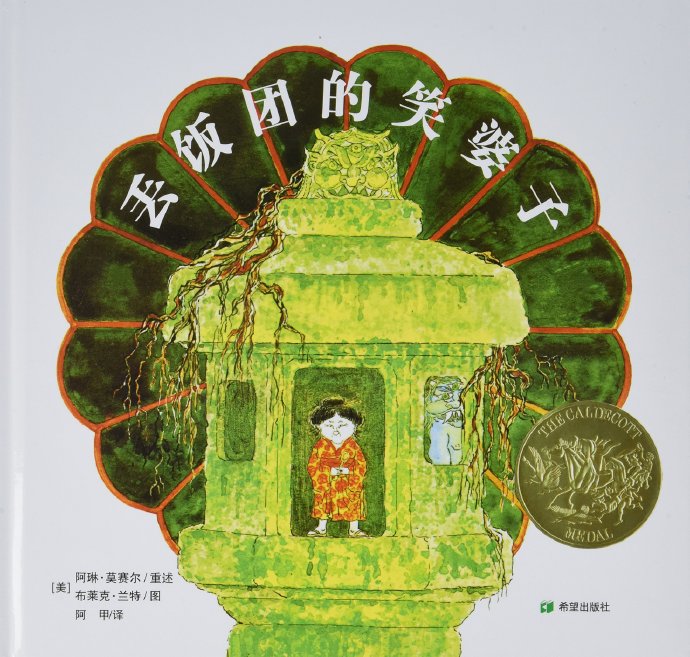
Welcome to listen:The third episode of Himalaya’s “Ajia Storytelling” — “The Laughing Old Woman Who Lost Her Rice Ball”
The translation of “The Laughing Old Lady Who Lost Her Rice Ball” was eight years ago (2008). From the records I have kept, I started preparing and editing the English manuscript on April 22, 2008, and completed the final revision on September 22, 2008, a full five months. After translating the book, I wanted to write something, but I kept putting it off until now.Himalaya audio program “Ajia Storytelling: Parent-Child Reading Private Class“I am going to broadcast the sharing of this book in the audio, so it is time to sort it out. However, what is written here is not the main content of the audio, but just a supplement for the translator.
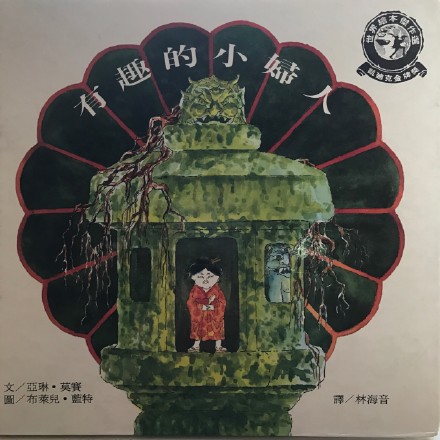 Cover of the Taiwanese version of Lin Hai’s translation of “Funny Little Women”
The original English title of this book is *The Funny Little Woman*. The Taiwanese traditional Chinese translation by Lin Haiyin is a direct translation of it as *The Funny Little Woman*. I knew about this book before translating it (I even had the copy, but refrained from reading it), but ultimately abandoned the direct translation and chose what might sound a little strange: “The Laughing Woman Who Throws Rice Balls.” Why was that? It’s a long story, so please let me explain.
First of all, the protagonist of this book is obviously a grandmother, and it is difficult to associate “little women” with older women in Chinese. However, the “little women” which is particularly famous in children’s literature is obviously about four girls who are about to grow up, so “I think “Little Women” is a title that easily evokes misconceptions and should be discarded. This story clearly reads like a folk tale, in which the terms “pozi” and “old woman” are often used to describe older women. I checked several versions of the translation process and used several alternative titles, including “The Laughing Old Woman,” “The Laughing Old Woman,” and “The Old Woman Who Lost Her Rice Ball.”
Compared to “old woman,” I prefer “laughing old woman,” as it doesn’t seem as “old-looking.” However, the problem is that “hehehe” and “laugh” are redundant, creating a strong effect that doesn’t quite fit the book’s tone, which is actually a little scary. Choosing a book title often depends on what the story is trying to say. But what is this book trying to say?
I noticed that the author’s name in the Taiwanese edition is listed directly as “Arlene Mosel.” This book won the Caldecott Medal in 1973, and the author is American. How could he tell such an authentic Japanese folktale? The corresponding author’s name in the English edition is “Retold by Arlene Mosel”—it turns out the author of this picture book is just a “reteller.” So who is the original author? Or is it simply a purely Japanese folktale?
Interestingly, there is no eye-catching mark in the English version, only a very small line of words on the copyright page:The Funny Little Woman “It is based on a tale by Lafcadio Hearn”—but who is this strangely named Lafcadio Hearn? A quick Google search revealed that it was him—Lafcadio Hearn! Lafcadio Hearn is a renowned figure even in the history of modern Chinese literature, having had a significant impact. His collections of Japanese folk tales, such as “Kwaidan,” still have many readers today.
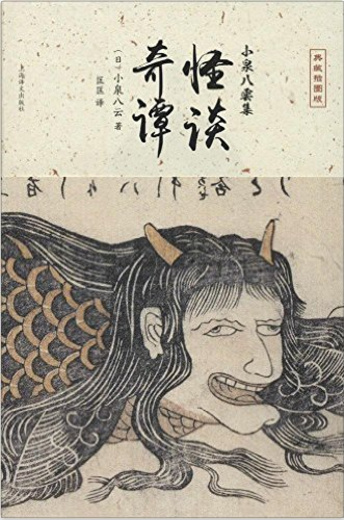
The life of Lafcadio Hearn is quite legendary. He was born in Greece, grew up in England and France, spent most of his first half of his life working in the United States. He went to Japan on business, but ended up staying there because he was fascinated by Japanese culture. He married a Japanese woman and named himself Lafcadio Hearn after her surname. Yakumo)…but the Japanese folk tales he collected and compiled were mostly Gothic in style, full of strange and bizarre things, and often quite scary!
In order to translate this book and get a feel for it, I tried to read all the Japanese folk tales compiled by Lafcadio Hearn that I could find. I also bought an English-language anthology, a collection of stories specially selected for children — I wanted to know what people in the English-speaking world thought of Lafcadio Hearn’s potentially chilling ghost stories.
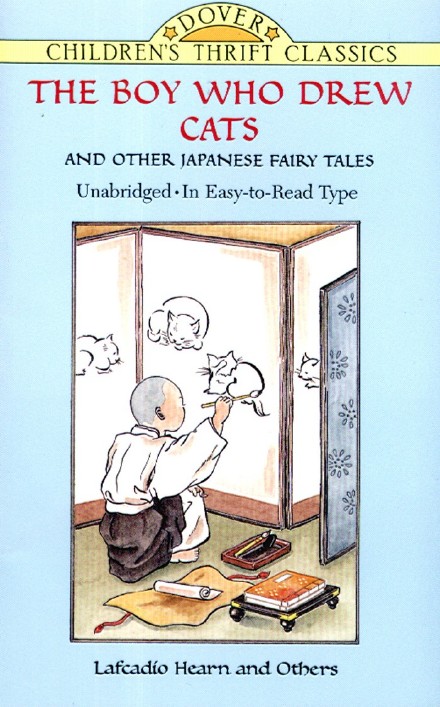 Lafcadio Hearn’s Words: An English Children’s Selection of Japanese Folk Tales
In this book, I think I found the original version that Arlene Moser read. The English title of the story is: The Old Woman Who Lost Her Dumplings—currently translated into Chinese as “The Old Woman Who Lost Her Rice Balls,” which again proves that translating it as “Little Woman” is inappropriate! The phrase “lost rice balls” gave me a lot of inspiration, and the final title, “The Laughing Old Woman Who Lost Her Rice Balls,” is related to this; this name combines Moser’s “Funny Little Woman” with Lafcadio Hearn’s original title. I think the translator’s role is also one of “retelling,” and when retelling, one should refer to the original version.
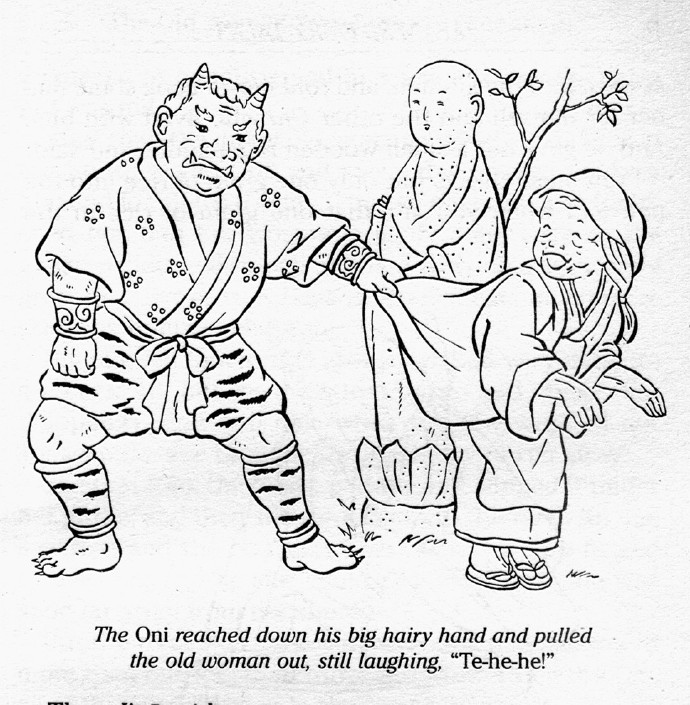
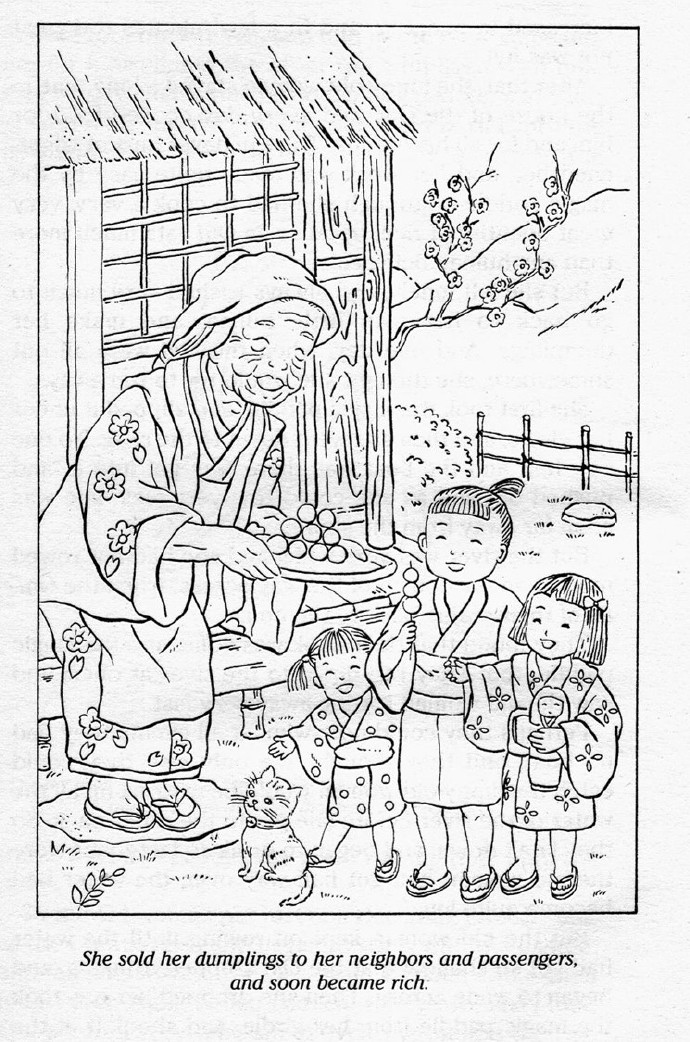
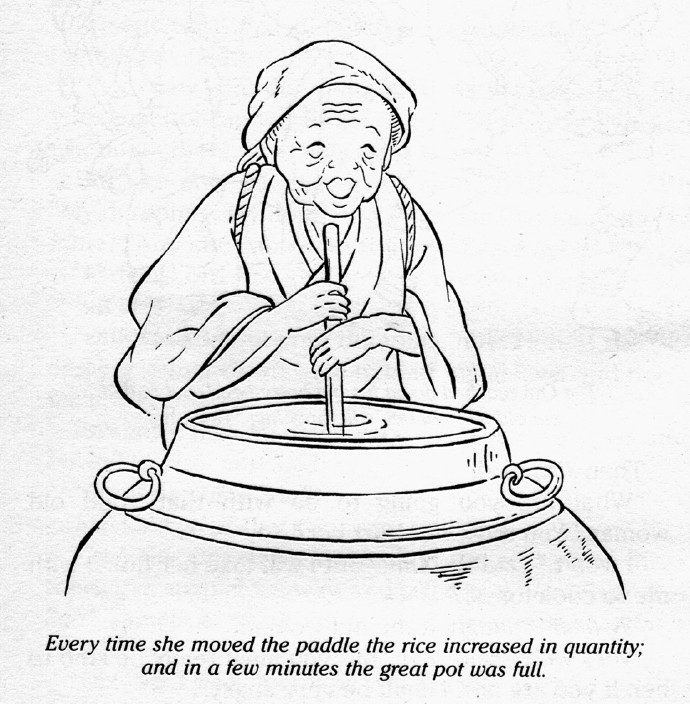 Illustrations from the original English version of the story “The Laughing Woman Who Lost Her Rice Ball”
Judging from Lafcadio Hearn’s original version, the protagonist is indeed an “old woman”! But is this story simply for fun? In English, the old woman’s laugh is “Tee-he-he-he,” and the ghosts’ laughs are also “Tee-he-he-he.” Either the ghosts laugh like the old woman, or the old woman’s laugh resembles the ghosts’ laugh. Why is this? How should we understand this? (The Taiwanese Lin Hai transliteration makes a distinction on this point: the old woman laughs “Hee! Hee! Hee!” and the ghosts laugh “Ha! Ha! Ha! Ha! Ha! Ha…!”)
To understand the meaning of this laughter (and thus determine how to translate it), I had to continue my research. So I began searching for books on Japanese folk literature, and luckily, after a week or two of frantic searching, I found a fantastic book: Hayao Kawai’s The Legends and Souls of the Japanese!
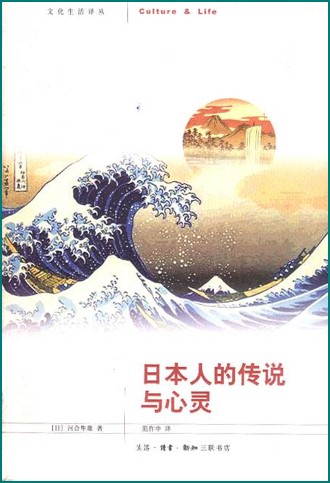
Hayao Kawai is not only a psychologist but also deeply knowledgeable about children, children’s literature, and picture books. His book “A Child’s Universe” is a treasure trove of mine, and you’ll also discover his profound understanding of picture books in “The Power of Picture Books.” What is this book, “Legends and the Soul of the Japanese,” about? In his own words, he explains: “From the perspective of depth psychology, the author attempts to explore the essence of the Japanese soul through Japanese folk tales. The recent interest in folk tales suggests that, faced with the intense impact of modernization and internationalization, Japan is consciously or unconsciously seeking to rediscover its own soul through ancient, time-honored folk tales.”
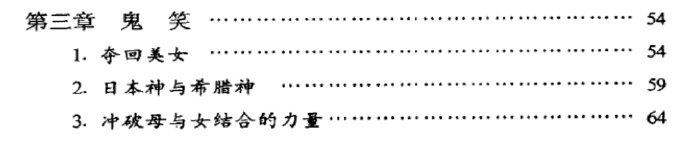
In this book, I finally found the original story behind “The Laughing Old Woman Who Lost Her Rice Balls.” It turns out it’s “Ghost Laughter”! Of course, in “Ghost Laughter,” the protagonist is the mother. The climax of the story is still the ghost sucking the river dry, but the nun teaches the mother and daughter a trick that makes the ghost laugh uncontrollably, saving them. Please take a look at the table of contents for this chapter:

So, what is the symbolic meaning of the ghost’s laughter? Please refer directly to Kawai Hayao’s analysis:
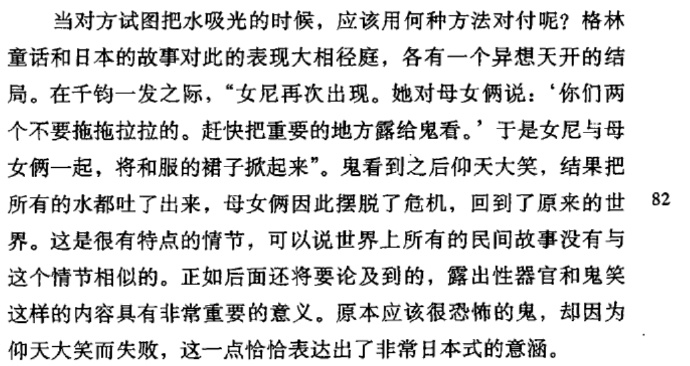
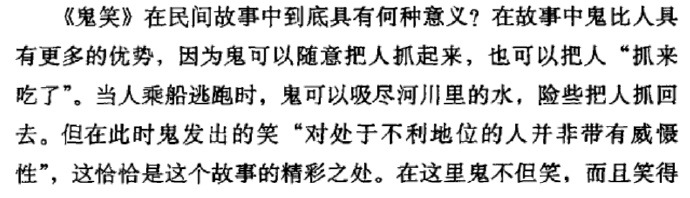
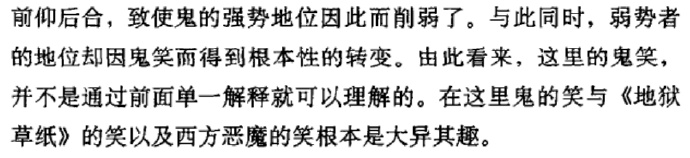
——Excerpt from “Legends and Souls of the Japanese” by Hayao Kawai
It is precisely because of the inspiration from Hayao Kawai that I understand this sentence on the back cover of the Chinese version of this picture book:There is no absolute strength. Because of the laughter, the strength of the ghost completely collapsed. Although in Kawai Hayao’s opinion, this is veryIt has a “Japanese connotation,” but it can also be regarded as a consensus among people all over the world. Remember the spell that Harry Potter’s magic teacher taught them to defeat the terrifying Boggart? — Think about it — think about it again — yes, it’s “funny funny”! — This is similar to the principle of ghost laughter.
Therefore, after understanding this, we must do the following in the translation:
1. Make the laughter of the old woman and the ghosts exactly the same!
2. This kind of laughter should be both extremely funny and a little scary (at least give people goose bumps)!
I thought about this for two or three weeks, and finally, one night, I suddenly figured it out. Then I burst into laughter in the study… and felt a little sorry for my neighbor…
This kind of laughter translates to “Eh-hee-hee-hee,” but a more accurate translation would be “Eh-hee-hee-hee-hee-hee!” For the exact sound, please listen to the audio. I once led 1,400 children in a large playground and laughed like this (with some apology to the residents of the surrounding neighborhood)… I warned the children not to laugh like this in dark places…
In the program, I also mentioned the sharing I had at the USBBY conference in 2015. The host of that conference, Doris
Ms. Gebel, a former children’s librarian, had just started her career with Arlene Moser, who happened to be her mentor. She learned to tell this story from Moser and has told it countless times to children. The climax of the story, of course, is the laughter. So, the competition to learn how to do the “ghost laugh” became one of the most amusing memories of that event, though it’s a shame I didn’t record it.
Thank you for the “ghostly laugh”! Thank you for the wonderful picture book!
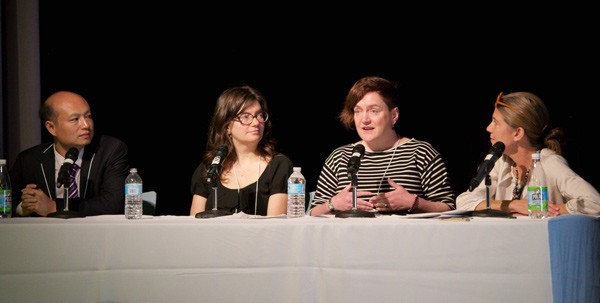
Translators’ dialogue and sharing at the 2015 USBBY Conference (New York, October 2015)
 Ms. Doris Gebel, host of the 2015 USBBY Conference
Written in Beijing on December 22, 2016
【A little behind the scenes】
The final sentence in the translated version of “The Laughing Woman Who Lost Her Rice Balls”—“She sold rice balls to neighbors and passersby”—is different from the original text in the picture book. The original text simply translates to “She sold rice balls” without mentioning to whom. However, this sentence is present in Lafcadio Hearn’s original text; see the accompanying illustration:
However, perhaps because I was too focused on the text and the author of the book, I didn’t pay much attention to the illustrator at the time. It might have been a key error at the beginning, and I mistook Blair for Lent was translated as Black Lant, but the correct translation should be Blair Lant. I’m so sorry! I hope this can be corrected in the next edition! However, the flaws outweigh the merits of this book, “The Laughing Old Lady Who Lost Her Rice Balls.”
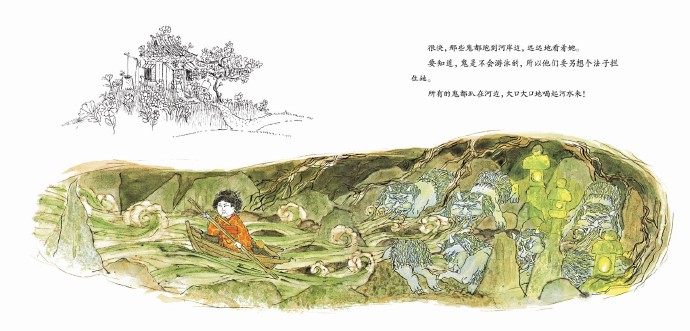
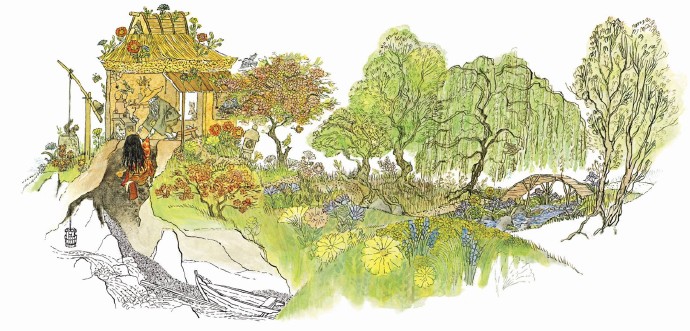
Blair Lant’s illustrations are absolutely superb, and the two plotlines, from a narrative perspective, even surpass the original story! The Caldecott Medal is well deserved.