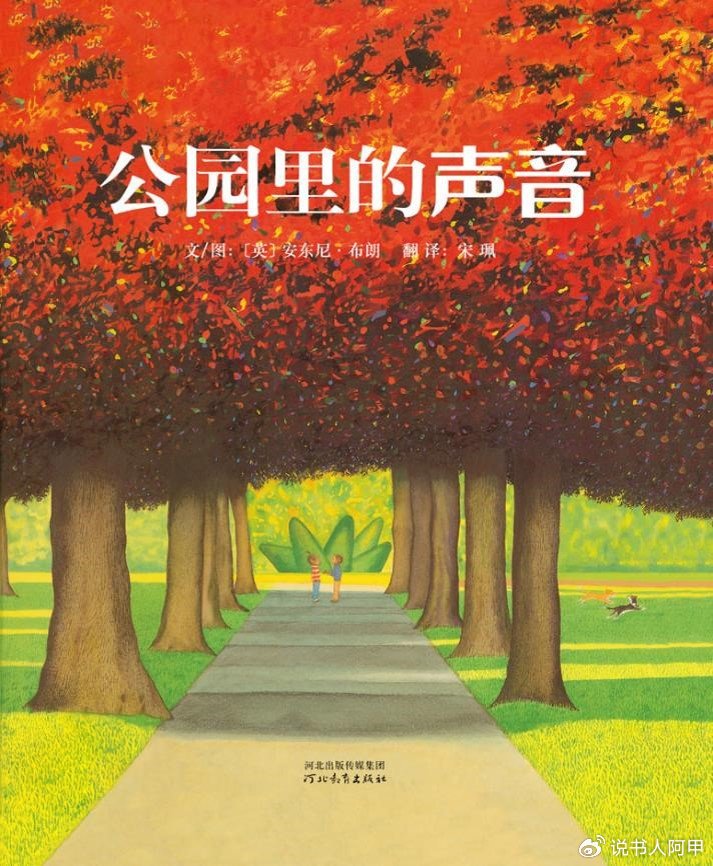
Anthony Browne is a picture book master who is currently gaining popularity in the world. He firmly believes that he is a picture book creator, in other words, neither a pure writer nor a pure painter.
http://landaishu.hi2net.com/home/upload20083/201162373542818.jpg

Anthony’s work is most celebrated for its surreal, enigmatic style. Its seemingly unrealistic images, sometimes dreamy and sometimes eerie, are filled with suggestive symbols and exaggerated associations, sometimes provoking contemplation and sometimes eliciting laughter. This remarkable effect is largely due to his mastery of shape-based play since childhood. However, his immense success in pictorial expression has somewhat overshadowed Anthony’s ambitions and achievements in the literary realm. He repeatedly emphasizes his identity as a picture book creator, perhaps to remind everyone: Don’t forget that words are an integral part of picture books, and I’m also very skilled in this area!
The first book by Anthony I encountered was *Voices in the Park* (translated as *When Naiping Meets Naiping* in the Traditional Chinese edition of Taiwan). At the time, I was a complete novice, browsing through English bookstores in Hong Kong looking for picture books to start with. I was drawn in by the large format and vibrant, warm cover, and picked it up casually, reading it in one sitting. On my first read, I felt I understood the book. Later, I learned it might be one of Anthony’s most difficult works to understand. Looking back, I realize I overlooked many details in the illustrations, only grasping the text and the narrative structure. Even so, I thought it was a truly remarkable book! If Anthony knew that a complete novice had fallen in love with his picture books after reading his words, wouldn’t he be even more proud?
In fact, it was in this work that I read another work I deeply love — The Sound and the Fury by American writer William Faulkner. To this day, I still think that there is a surprising similarity between these two seemingly unrelated works, although this similarity is likely just a coincidence.
First, both books employ a narrative structure in which four different people tell the same story. This method itself is not novel, but it is extremely rare in children’s books. Secondly, the four characters involved each have roughly the same length, and the events are clearly related, which really makes people’s imagination run wild.
The four characters featured in “The Sound and the Fury” are: the muddled, idiotic brother Benjy, the eldest brother Quentin, who collapsed and attempted suicide, the extremely selfish younger brother Jason, and the healthy and strong old black maid Dilsey. The four characters featured in “A Voice in the Park” are: the arrogant and rude mother (Anthony says her name is Mrs. Smits) and her depressed son Charles, the unemployed blue-collar father, and his energetic daughter Ching-Ching.
Four characters with vastly different identities and mental states, told from four completely different perspectives, naturally create a complex narrative. However, understanding the story is easy, as there is a common thread. In “The Sound and the Fury,” the true protagonist is Katie, the three brothers’ sister. The story centers on her unfortunate downfall and the subsequent downfall of her entire family. Faulkner, deeply moved by her love for him, was reluctant to allow her to speak on stage. In “A Voice in the Park,” however, the true protagonist is the girl, Qingqing. Just look at the narratives of the other three characters; she’s the center of attention. Even the mother, the noblewoman, hastily leaves out of disgust. In Anthony’s mind, this girl must have been absolutely perfect, like an unbridled ray of sunshine, bringing warmth and brightness wherever she passed.
http://landaishu.hi2net.com/home/upload20083/20116237484421.jpg

What puzzles me, however, is the girl’s English name: Smudge. It literally means “stain.” How could it possibly be a name, especially for a girl? Didn’t the boy, Charles, also say it was peculiar? Was it a random name chosen by the author? I imagine Anthony, who prides himself on his writing, certainly didn’t do it casually. Perhaps there’s a certain ironic contrast in this story: the lady’s immaculate mansion, the boy’s room as neat as a hospital ward, yet both are anxious, depressed, and insecure. In contrast, the girl, a blue-collar worker in a cluttered apartment with a dirty name, is so healthy, happy, and full of life! Of course, this is just one possible explanation.
http://landaishu.hi2net.com/home/upload20083/201162374829383.jpg

Another explanation could be pure coincidence. Faulkner explicitly told readers that the idea for “The Sound and the Fury” came from a single image: a girl climbing a tree to peer through the window of her home at a funeral. Her three brothers and the black boy stand beneath the tree, looking up at her petticoat, stained with mud (she had recently been playing in the river). And in this picture book, we see the protagonist, the little girl, high up in the tree, while the little boy follows, muttering the strange name “stain.” Coincidence, isn’t it? Of course, in this story, it’s the girl’s dog, Albert, who jumps into the water.
There is another deeper coincidence. It is worth mentioning that “Voices in the Park” is a re-creation of “A Walk in the Park” which was originally published in 1977.
park), judging from the introduction, the clues of the story are similar, and judging from the cover, it happens to be the scene of a father, his daughter and the puppy entering the park gate together.
http://landaishu.hi2net.com/home/upload20083/20116237503125.jpg
http://landaishu.hi2net.com/home/upload20083/201162375029724.jpg
Comparison: The left image above shows the cover of the 1977 edition; the right image shows the front page of the 1998 new edition of The Fourth Voice.


Although *Voices in the Park* is out of print, Anthony Faulkner himself particularly liked the story’s concept, but wasn’t entirely satisfied with the original illustrations. So he redrawn them and changed the narrative style, having four characters retell the story from different perspectives. The new book was published in 1998, renamed *Voices in the Park*. The coincidence I’m referring to is that *Voices* is similar to *Sound* in *The Sound and the Fury*, both meaning “sound.” And where does Faulkner’s title come from? It turns out to be a soliloquy from Shakespeare’s *Macbeth*: “Life is a story told by an idiot, full of noise and commotion, yet meaningless.”“
Faulkner’s use of allusion is a typical example. The advantage of allusion is that it can convey extremely complex information within a very limited text, a common practice in classical Chinese poetry. However, the most effective allusion is subtle and seamless, like salt dissolved in water. Readers who don’t know the allusion can still appreciate it, while those who happen to know the allusion will understand it even more.
So how should we interpret the similarities in this work between Anthony Brown, a master of surrealist picture books, and William Faulkner, considered a mentor by magical realist writers? I don’t think it’s purely coincidental, but it’s also possible that they are learning from and paying homage to the earlier master. If the latter is the case, then it’s a brilliant use of allusion, as this similarity provides the reader with further avenues to delve deeper into the work.
http://landaishu.hi2net.com/home/upload20083/20116238017436.jpg
Anthony Brown is a master of using allusions in his paintings. For example, this painting contains at least four allusions.

Let’s talk about the font. “The Sound and the Fury” is a purely textual novel, written by a gifted stream-of-consciousness novelist. How does one convey the protagonist’s narration and the chaotic, whirling thoughts of the protagonist in his peculiar mental state? Faulkner primarily uses the omission of punctuation and frequent changes in font, which makes the reading more challenging, but also gives the work a richer expressiveness. As a picture book, “Voices in the Park” boasts an even greater advantage in visual expression. The four characters’ narrations are narrated in distinct fonts: the aristocratic mother’s narration is written in a formal, elegant font, likely the typefaces used in fashionable women’s magazines; the blue-collar father’s narration is written in a bold, bold font, likely the typefaces used in the tabloids he frequently reads; the boy Charles’s handwriting reflects his personality, delicate and neat, suitable for a textbook; and the girl Qingqing’s handwriting is a lively handwriting, seemingly more common in cartoons. Clearly, the font here reveals the narrator’s identity, personality, and interests.
http://landaishu.hi2net.com/home/upload20083/20116238727485.jpg
Comparison: The upper left picture shows the wealthy mother; the upper right picture shows the blue-collar father

Anthony is relatively adept at using images to convey interesting symbolism. For example, the scene is vibrant with autumn when the wealthy mother appears, but it becomes a gloomy winter when the blue-collar father appears. Meanwhile, when the boy and girl play together, it’s clearly spring. When they first meet on a park bench, the sky to the left of the lamppost is cloudy, while the sky to the right is sunny! The most intriguing scene is the scene where two dogs run between two statues, their tails unexpectedly swapped, while the statues, clearly representing two adults, a man and a woman, remain silent and ignore each other.
http://landaishu.hi2net.com/home/upload20083/201162381052537.jpg

http://landaishu.hi2net.com/home/upload20083/201162381216993.jpg

Let’s look at the relationship between the text and the images in this book. For example, the scene where the boy is taken away by his mother appears three times:
The first account is from the mother. The little boy is almost completely hidden from her view; his feet are somewhat confused with the dog’s, and the dog’s tail seems to be his. They leave a trail of maple leaves behind, and a tree catches fire. The relevant text is: “We walked home in silence.” Here, the fire might represent the mother’s anger; contrary to the words, neither of them is at peace.
http://landaishu.hi2net.com/home/upload20083/201162381556601.jpg

The second account is from the boy’s perspective. We see him lingering, looking back at the distant view. They walk in the spring sunset, leaving a trail of pink petals behind them. The sculptures in the park resemble mischievous Cupid, holding only an empty bow; perhaps the arrow has already been shot. The relevant text is: Maybe Smudge will be there next time?
http://landaishu.hi2net.com/home/upload20083/20116238174188.jpg

The third narration is by the girl, still depicting a spring scene. The imagery is exaggerated and distorted, yet vibrant. We see a close-up of the boy looking back in the center of the picture, with the accompanying text: “He looked sad.”.
http://landaishu.hi2net.com/home/upload20083/201162381728249.jpg

As can be seen from the examples above, the book’s text and pictures actually tell different stories. Sometimes they coincide, but often they speak in different directions, often even contradicting each other. So, we can say that Anthony tells at least eight stories in this book: four in the text and four in the pictures! But in reality, it’s likely nine. The ninth story appears on the cover, narrated by Anthony himself as a transcendent narrator. In the center background, a giant plant resembling a Buddha’s hand blooms like a heart flower, radiating golden light…
http://landaishu.hi2net.com/home/upload20083/201162381749979.jpg

There seems to be an endless amount of detail to be mined about this work, whether in the text, the pictures, or the relationship between them. After more than 20 years of fame in the picture book world, Anthony Brown finally couldn’t resist crafting a work that challenges both children and adults, retelling a children’s story about everyday life in an incredibly complex way. What was he trying to achieve? It reminds me of Faulkner’s assessment of his most proud work, The Sound and the Fury, which many readers struggled to understand: “A glorious failure!” This is the pride of an artist who sees art as his life. Without this almost aloof pursuit of infinite heights, how can there be a true masterpiece?
In fact, “Sounds in the Park” is brilliant, yet not a failure. In classrooms in Britain and the United States, it seems to be one of Anthony’s most popular picture books, both for teachers and children. Just as “The Sound and the Fury,” along with other works, won William Faulkner the 1949 Nobel Prize for Literature, “Sounds in the Park,” along with other representative works, earned Anthony Brown the 2000 International Hans Christian Andersen Award, commonly known as the “Little Nobel Prize.” In this book, he accomplished an extremely difficult and thrilling challenge, presenting the most familiar and everyday life with an unusually colorful and bustling atmosphere. Perhaps because it is dedicated to children, the book ultimately eschews the commotion and noise, reverting to harmony and tranquility. If Faulkner were still alive, he would probably be envious of this harmony.
The first draft of the 2011 Argentine Primera División was published in Guangzhou in February and revised in Beijing in June.