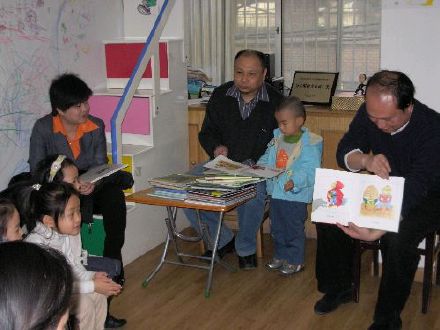
Book Club Scene——I Like Books
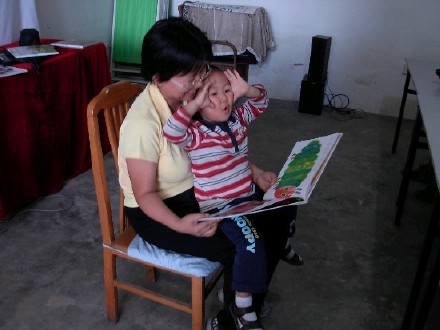
Little Storyteller — The Very Hungry Caterpillar
In July 2007, Beijing Red Mud Bookstore began hosting its first parent-child and adult book clubs in a small living room on the second floor of the bookstore’s main building. (Previously, book clubs had been held in public venues like libraries.) Due to space limitations, each Red Mud Book Club could only accommodate a maximum of 20 people (including adults and children). However, in this small space, everyone spent many joyful hours together.
To celebrate the second anniversary of the Red Mud Reading Club,A parent-child reading competition will be held on July 18.
Although it’s a competition, in the spirit of “aiming to be involved,” we’ve designed a winning rate of no less than 99.99%, so there’s no need to be nervous, young or old. I’ve also compiled a few tips for parent-child reading or storytelling at a book club for your reference.
First, let me share a few ideas that the Red Mud Reading Club strives to promote. Our understanding of the ideal state of reading can be simply put: just pick up a book and read it. If we and our children can pick it up and read it, become absorbed in it, and read with joy, then we have reached a very ideal state!
Based on this philosophy, Red Mud’s book clubs (primarily parent-child book clubs) aren’t the typical storytelling sessions—the kind where everyone brings their children to listen to a storyteller tell a wonderful story. Instead, we strive to invite every participant (both adults and children) to share stories: listening and telling stories, and the sharing should be as everyday as possible—just like sharing stories with family at home every day. Therefore, ideally, storytelling doesn’t require any props or elaborate costumes (though of course, unrestrained creativity and the need for playful play are welcome). Simply prepare for the perfect storytelling mood.
In my memory, the most exciting moments of the Red Mud Reading Club were probably like this:
When a child under three years old heard his mother telling the story of the Plaid Elephant, which he was most familiar with, he could not help but run to the book and then told the story again incessantly. His expression and posture were more like his mother than his mother, even though he knew almost no words in the book.
Another time, a four-year-old girl sat in her father’s arms, listening to him read her favorite story, “My Daddy is Johnny.” Every time her father read the part where the character Gadim spoke, she would say in a particularly childish voice, “This is my daddy, his name is Johnny!”—She moved everyone present. I have never heard a better storyteller than her.
Another time, two girls aged nine or ten, after 10 minutes of collaborative preparation, performed the story of “The Warrior and the Dragon” perfectly for everyone with ease.
…
These seemingly simplest ways of presentation, although only a few minutes long, allow us to see the long accumulation behind them, and to see the truest, purest, and therefore most beautiful relationship between parents and children. The perfection of that tacit understanding is simply unparalleled.
It is not difficult to achieve this state. You just need to read and live happily with your children every day.
But, honestly, it’s not easy to perform flawlessly in a group reading session or a somewhat nerve-wracking competition. After all, facing so many strangers is a completely new experience, and younger children tend to be more natural. Therefore, a bit of a “strategy” is necessary.
This strategy is actually just a few simple principles, which are purely based on experience. It is not “universally applicable” and needs to be used flexibly on the spot.
Tip 1: Always have a backup plan! As the military maxim goes, “Before you advance, think about retreating.” No matter how perfect your plan, a child is always likely to back out. If they’re stubborn, even if there are thousands of people around, they’ll retreat! So, to at least have some fun and have some fun at the event, it’s a good idea to have a backup plan in case your child doesn’t cooperate. For example, simply having your child lie in their mother or father’s arms while they listen to a story is a great option.
Strategy 2: Don’t force your child to practice or demonstrate their abilities. For children, reading is a game, and competitions are even more of a game within a game. In this somewhat tense game, there’s no need to specifically encourage children to demonstrate their abilities, such as by showing off their proficiency in reading and recognizing words, or by forcing them to memorize information that others struggle with. Since it’s a game, anything uninteresting should be omitted. If children become immersed in the game and gradually become more engaged, their abilities will naturally emerge, and their potential will be more easily stimulated as they become more engaged. For example, in a rendition of “The Giving Tree,” if a child truly doesn’t want to read the narration or play the tree or the children, then playing the large rock beneath the tree is fine. I heard that the son of Taiwanese actress Fang Suzhen became famous for playing the rock in the fairy tale “Snow White” (see the picture book “Yay! Fat Rock” for details).
Strategy 3: Unlimited creativity and enjoyment lie in the process of playing. Those who aren’t very good at games assume the fun lies in the moment and pin their enjoyment on the outcome. Experienced gamers understand that while the outcome is meaningful, it’s actually quite limited, and the joy begins long beforehand. For example, the actual storytelling competition typically only lasts about 10 minutes, but preparations take days. This preparation process is the most fun! For example, you can devise several scenarios and rehearse them, each time potentially sparking new ideas. To have fun, you can devise all sorts of props, even drawing and crafting, and even tearing a couple of sheets if you’re completely lost. Therefore, props are generally used in storytelling competitions. Can you guess why? It’s not that these props are essential for storytelling; it’s simply that during the preparation process, you’re overwhelmed with creativity, creating a ton of “junk.” If you don’t use them on the spot, they’ll likely end up in the trash! ——So for many players who know how to play, when they get to the scene, it becomes almost just a “routine” because they have already had enough of the most fun part.
Tip 4: Adapt to the atmosphere and prepare a few surprises. If, as Tip 3 suggests, players are already having enough fun before they even arrive, that’s a bit of a flaw. A true expert needs to go the extra mile to help children experience the other side of the fun. This fun, playfully described as “making friends through martial arts,” emphasizes friendship. Before you begin, familiarize yourself with the venue and the other participants, making as many friends as possible—big brothers and sisters, younger brothers and sisters, uncles and aunts—to build a buzz. For the more creative, you can even prepare a surprise reveal. Add the finishing touches at this point. Even if you don’t win a standing ovation, at least you’ll have created something new and exciting.
…
There are many other strategies like this, but the short of it is: play with a normal mind, relaxed and natural. The goal is to make children feel that reading is so fun, just like playing at home :)
Every day is a good day, and every day is a good mood!
Red Mud Parent-Child Storytelling Arena Strategy Beta 1.0